Warm greetings.
I would like to thank you for all the likes, shares, and comments under the previous published video. It’s very important for our channel to grow, which allows us to reach even more people. In the name of our Lord Yeshu, thank you!
If you receive the gift of faith in the name of our Lord Yeshu, take the next step and contact me to be immersed in the name of Yeshu. You can find contact details on our website or simply write on Messenger.
To begin, we’ll listen to some Christian hymns in languages where the name Yeshu has survived in its original form.
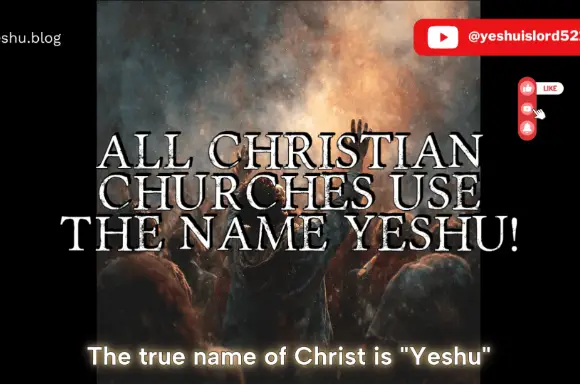
This name is pronounced differently—in fact, it depends on diction and language. Sometimes I hear “Ishu,” sometimes “Yeshu” or “Isu.” Very often also “Yesu.” From the songs I found, the name of our savior is pronounced in Hindi as “Yeshu”, in Korea as “Yesu”, in Japan as “Yesu”. So you can see that in many countries the name took a slightly different path: not “Jesus,” not “Jésus,” not “Jezus” as with western countries, but the short “Yeshu/Yesu/Isu.” And yet, that main root from which everything derives remains obvious. Part of the world turned “Yeshu” into “Yesu”—and this makes sense, because in Greek it was written as “Iesou” (in the nominative, “Iesous”). Greek didn’t have the “sh” sound, so it naturally replaced it with “s.” In many parts of the world, people don’t pronounce “sh” at all—hence the versions “Yesiu” or “Yesu.” All of this together is clear evidence that the name took various sound paths, and forms like “Yesiu/Isu/Yesu” are closer in sound to the original than “Jezus,” which really borrows little from the name “Jeszu.” Most likely, in our tradition, the “s” was swapped for a “z,” hence “Jezu,” and then “Jezus.”
Notice also that some songs I found are simply beautiful. What’s important, however—the name is known and used. In India, where Protestant churches, Adventists, Jehovah’s Witnesses, and the Catholic Church operate, all these denominations have their believers there, where “Yeshu” or “Yesu” is often spoken. If so, it’s worth noting how much ignorance on this topic prevails in Western countries. At times, clergy who theoretically should be well-informed—even people who teach Hebrew pronunciation online—can claim that “Yeshu” is a curse. Meanwhile, their fellow believers in India or other countries use this name in worship. This rather shows a lack of discernment than genuine knowledge. I myself once didn’t know that the English say “Jesus,” the French “Jésus,” and in Asia, often “Yesu.” I thought everyone said it the same way. Understanding that people can and do say it differently was a big surprise to me—and at the same time a strong argument that “Yeshu/Yesu/Isu” cannot be a curse word. No reasonable person would call a name a curse that bishops and archbishops in other countries use. It’s rather a matter of local prejudices and lack of knowledge. You can look into the topic yourself; it might take you 10 minutes to find the materials—there are plenty—to see how Eastern countries pronounce the name of our Lord. “Yeshu Tera Naam” or “Yeshu Naam” often appears—“naam” means “name,” so these are songs about the glorious Name, about salvation, etc. There are also songs with “Hallelujah” or using “Jehovah.” Not everything will always align theologically; we don’t know the language, so it’s worth being cautious, and if needed—use a translation before deciding what to listen to. At the same time, remember that in many regions—in India, parts of Africa and Asia—Christians pay a high price for faith in Christ and for that Name. In India, there have been years where hundreds of believers have died. These are not isolated cases.
What do some Messianic Jews claim? Do they believe that “Yeshu” is offensive, so they use “Yeshua”? The actual picture is more complex. I once showed a recording of a Jewish family who believe in the Messiah (but do not identify with Christianity). When they hear, “Do you believe in Yeshu?” they respond, “No, in Yeshua.” In this way, linguistically, they distance themselves from the Christian reception of the word “Yeshu,” because in many Jewish circles “Yeshu” is associated with Christ. I know of a study by a Lutheran pastor from Denmark, who lived in Jerusalem for several years, researched the topic of the name, and described it thoroughly. He personally believes that “Yeshu” is correct, but honestly states that in Israel the name “Yeshu” itself is not by definition a curse; the problem arises mainly in orthodox circles, where it is sometimes written as an acronym (with dots) from a polemical formula used in arguments. Only in that acronym form can it carry a negative tone—not as a name, but as an abbreviation of a sentence. In text, however, if the name “Yeshu” appears without dots, it is read as a name. There are extreme examples of aversion toward the person Yeshu—there are testimonies that some religious teachers advise against pronouncing “Yeshu” without adding a condemning term. There are also recordings where, in a polemical context, someone uses the name. However, it should be emphasized: it is not the name itself that is a “curse,” but rather a certain polemical tradition in which a phrase was created from the initials of the name’s letters. At the same time, many Jews associate “Yeshu” directly with Christ, so they stopped giving such a name to children; instead, the form “Yeshua” is used. I have also seen banners saying “Yeshu = Yeshua,” and apparently there are Jews who openly speak about believing in Yeshu. The mentioned film, on the other hand, shows that some believers in the Messiah prefer to say “Yeshua” so as not to be associated with Christianity.
In one of the articles I came across, the author compared numerous school textbooks used in Israel and pointed out that many of them call Christ “Yeshu”—which he described as both historically and philologically consistent with contemporary usage. One can argue about the wording, but it shows that the form “Yeshu” really functions in the Hebrew-speaking sphere.
There are also rabbinic attempts to explain why the apostles said “Yeshu” and not “Yeshua.” One argument claims that the apostles mostly came from Galilee and had a characteristic pronunciation (for example, they reduced vowels). Regardless, the most important thing is what the oldest sources show: in Greek, we have Iesou (in the nominative Iesous), and Greek had no “sh,” so sigma is the natural equivalent here. In Hebrew manuscripts of the Matthew version, there is a spelling corresponding to the pronunciation Yeshu; sometimes the letter ayin (ע) appears at the end, which can be silent and in antiquity in many words was not pronounced. This goes well with the fact that the Greek rendering does not show any “a” at the end.
It’s worth breaking this down calmly, step by step:
• In the Hebrew spelling, the name consists of letters corresponding to Y/E/SH/U/(AYIN). Since ancient Hebrew orthography did not record vowels, we know the vowel values, among other ways, thanks to Greek and Latin transcriptions and reading tradition.
• In Greek, it was written I-E-S-O-U, where OU (diphthong) is read as a long “u/y”: Iesou. In the nominative, a typical masculine ending -s was added: Iesous.
• Greek did not have the “sh” consonant, hence the sigma “s.” This explains the transition from “Yeshu” → “Yesu” in many languages that took their pronunciation from Greek.
• Here, the letter ayin is often silent; if it were to be pronounced as “a,” we would expect a trace of it in the Greek transcription, which is absent. Therefore, it is justified to read the ending as “-u,” not “-ua.”
• The ending “-s” in Iesous emphasizes the masculine gender. So, building feminine forms today (“Yeshua”) to designate the Messiah (in the sense of “Salvation (Yeshua)” as a feminine noun in Hebrew is a secondary procedure. In practice, we say “Savior (Yeshu),” not “Salvation (Yeshua).”
The question about “Yeshua” is often raised. This is the form that some communities regard as correct. However, it is worth remembering that:
• in order to read “Yeshua”,we would expect the letter he (ה) or a clear indication of the vowel “a” at the end; in Greek, there is no such trace, and the oldest Greek manuscripts are very consistent in this regard;
• in the Hebrew version of Matthew (the oldest records) the name is repeatedly written without ayin, which further supports the pronunciation “Yeshu”;
• in the Greek version, cases without the nominative sound like Iesou (Yesu), which aligns with the liturgical practice of many Eastern Churches, where they call out “Yesu”.
For illustration: there is the well-known biblical story of recognizing the enemy by their pronunciation of the password “shibboleth/sibboleth”. In that situation, incorrect pronunciation of “sh” as “s” meant death. Of course, I am not drawing mechanical theological conclusions from this; it is rather a reminder that pronunciation can have identifying and cultural significance. This is precisely why it is worth studying the sources and listening carefully, not just sticking to what is “customary”.
Someone asked about the Dead Sea Scrolls: these are collections hidden around the time of the destruction of Jerusalem (70 CE), though some were created earlier. Regardless of the dates, these texts are very close to apostolic times. However, in terms of the name of the Messiah, the New Testament manuscripts give us more: the Greek and Hebrew versions of Matthew and the Aramaic Peshitta. In the Peshitta, the spelling consistent with the Aramaic alphabet is preserved (the same one used by Jews), and transliterations into the Latin alphabet often result in “Yeshu”. For example: in the Syrian (Orthodox) Church, you will encounter clergy named “Yeshu”—with the same spelling with ayin at the end, but without pronouncing it as “a”. This is another clue that the pronunciation “Yeshu,” is traditional and well-rooted.
A side but instructive observation: in Greek, many male names received the ending -s (Paulos, Petros, Ioudas). In English we usually removed these endings (Paul, Peter), but kept them with “Judas” and “Jesus”, which introduces a certain dissonance. In languages that consistently followed the Greek or Semitic route, we more often find “Yeshu/Yesu/Isu” without the extra “-s”.
An English curiosity: in older editions of the Bible (up to the 18th century) in England, the form “Yesu” was reconstructed, and later it evolved into “Jesus”. This shows how later standards influenced the pronunciation.
As for the languages of Africa and Asia: in many of them, “Yeshu/Yesu/Isu” is natural. Forms with “-a” usually appear when indicating belonging (“Yeshua Band” as “a band belonging to Yeshu”—declension clarifies this; when they sing directly about the Lord, you hear “Yeshu”). Therefore, we should not be surprised if in one country you encounter both endings: it is often a matter of syntax, not two different names.
Let’s return once more to the issue of ayin (ע). In classical pronunciation tables, ayin is marked as a pharyngeal consonant, but in many cases in antiquity it lost its sound (especially at the ends of words) and did not take a permanent vowel. Some studies directly call it a silent letter. Modern Masoretic systems (introduced about a thousand years after Christ) added vocalization, which in some places is debatable; some editorial decisions are controversial among scholars. In any case, ancient Greek transcriptions are an important witness: they do not confirm an “-a” at the end.
To sum up the “Yeshu vs Yeshua” dispute: the dating of witnesses (Greek NT manuscripts, the oldest Hebrew manuscripts of Matthew, Syriac traditions) support “Yeshu” as the original pronunciation of Christ’s name as used by the disciples. The form “Yeshua” exists and has its own tradition, but it often appears as an identity marker or theological variant in Jewish environments. It is key to avoid generalizations and respect the sensitivities of others; at the same time, it is worth sticking faithfully to the oldest sources.
From my side, I encourage you: let’s pass on reliable information. In Western countries, awareness of various pronunciation traditions is limited. It is therefore good to show material that anyone can verify—recordings from India, Korea, Japan, Syriac transliterations, Greek forms (Iesou/Iesous), examples from early English Bibles. In 1 Corinthians we find a beautiful thought:
1 Corinthians 12:3: “Therefore I reveal to you that no one, being under the influence of God’s Breath (Ghost), can say, ‘Cursed is Yeshu.’ And no one can say ‘Yeshu is Lord’ unless they are under the influence of the Holy Breath (Ghost).”
It’s not about winning arguments, but about loyalty and honor to the Name. If, after calmly presenting the sources, someone stays with their own customs, well — our role is to shed light, not to force.
Let us remember: the Lord’s name was and is known all over the world in different pronunciations. The most important thing is that behind the pronunciation there is the truth about the person — about the Messiah, who saves.
Thank you for listening all the way through. I will be extremely grateful for likes, shares and comments, which help grow the channel and give a chance to reach even more people.
If you receive the gift of faith in the name of our Lord Yeshu, take the next step and contact me to immerse yourself in the name Yeshu. You can find contact details on our website or just write on Messenger.
Glory to Yeshu!!!