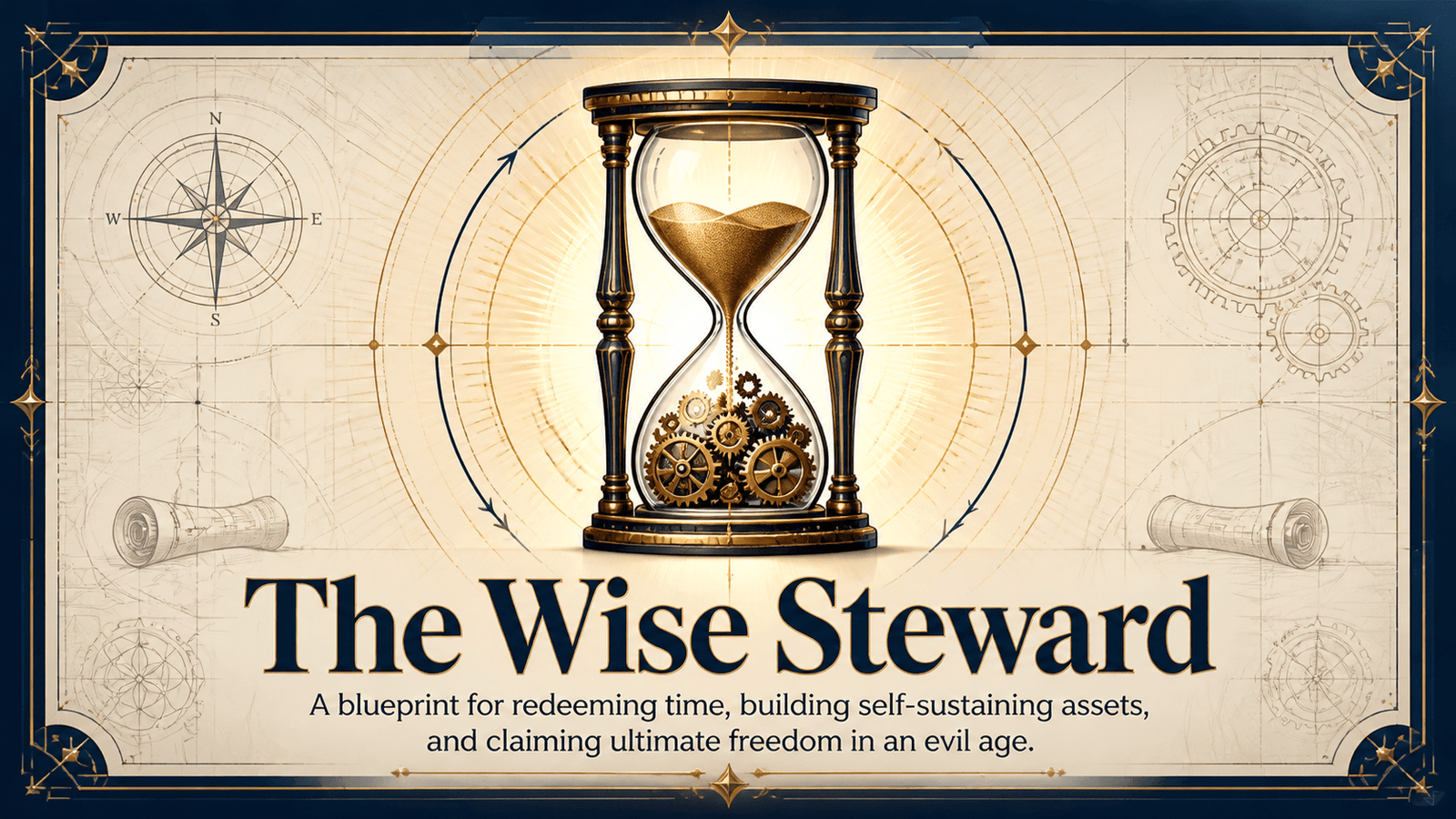
Welcome everyone. Today’s article will be devoted to an incredibly precious resource that each of us has received from God – time. We will reflect together on how we invest this gift, how we can “redeem” it, and whether we can realistically have more of it. I believe today’s topic will bring you valuable insights.
Before we get to the main thread, let us begin with a parable recorded in the Gospel of Luke 12:42-48. The central theme is responsibility for what has been entrusted to us by God. I will remind you that last week we reflected on the words about how many will want to enter the Kingdom of God, yet not everyone will succeed – even if they discover the right path, not all will manage to pass through the door. It turns out there are certain requirements, spoken of in the parable of those invited to a banquet – all received an invitation by grace, without any merit of their own, yet the person who was not properly dressed was asked to leave. Grace is given freely, but to persevere in it and be accepted, one must meet certain conditions and behave accordingly.
Today we will focus on managing what God has entrusted to us. This is one of the key conditions that God – through Christ – places before us so that we may receive grace, salvation, and the reward of life in the new aeon. The parable from the Gospel of Luke will help us understand this better. Verses 42-48 say: “Who then is the faithful and wise steward, whom his master will set over his household servants, to give them their portion of food at the proper time? Blessed is that servant whom his master will find so doing when he comes. Truly I tell you, he will set him over all his possessions.” We can see clearly that Christ – our Lord – entrusts duties to his servants, and the one who faithfully fulfills them will receive a reward. It is not the case that we don’t need to do anything – the reward is for service.
We then read a warning against an irresponsible attitude. “But if that servant says to himself: My master is delayed in coming, and begins to beat the male and female servants, and on top of it eat and drink and get drunk, the master of that servant will come on a day when he does not expect him and at the hour he does not know, and will cut him in pieces and put him with the unfaithful.” This is a warning against passivity and the misuse of received graces. Also interesting is the matter of those who perform their service carelessly: “That servant who knew his master’s will but did not get ready or act according to his will, will receive a severe beating. But the one who did not know, and did what deserved a beating, will receive a light beating. Everyone to whom much was given, of him much will be required, and from him to whom they entrusted much, they will demand the more.” One cannot excuse oneself with ignorance – whoever knows more is required more. And those who are aware of their duties and do not carry them out will bear stricter responsibility.
This is an important lesson for all of us: it is not enough to passively await salvation, to focus only on everyday matters and personal pleasures, thinking that a reward is simply “owed” to us. Such an approach is a path toward being counted among those servants who did not fulfill the role entrusted to them. A similar message can be found in other parables – for example in the Gospel of Matthew in chapters 24 and 25: about the faithful and unfaithful servant and about the talents. Christ entrusts talents to his servants, expecting them to multiply the gifts received – even the servant who did not lose his talent but failed to multiply it was harshly judged as a bad servant.
It is worth noting that the talents were distributed according to ability – some received more, others less, but action and engagement were expected from each one. A servant who does nothing does not fulfill his role. He is not a worker but a parasite who only takes without giving anything in return. Besides the parable of the talents, there is also the parable of the minas – here each servant receives the same amount and each one is expected to multiply what he has received. This leads us to a key question: what resource have we all received in equal measure? It is time – each of us has 24 hours in a day. Some use this time better, others worse, and some waste it entirely.
We are therefore stewards of time, which is not our own possession, but a gift from God. The sun, the clock, the rhythm of the day – all of it created by Him, and it is to Him that we owe our lives. The most important question is: how do we manage this time? That is precisely the topic of today’s article. We now turn to the Letter to the Ephesians, which contains an extraordinarily important verses: “See then that you walk carefully, not as unwise, but as wise. Redeeming the time; because the days are evil.” (Ephesians 5:15-16). Today we will focus on how to “redeem” time and what that means for us.
For a fuller understanding, let us look at the earlier verses of this chapter. We read a warning there: “Let no one deceive you with empty words, for because of these things the wrath of God comes upon the sons of disobedience.” (verse 6). Empty words include claims that we don’t need to do anything to receive salvation. The author then urges: “For you were once darkness, but now you are light in the Lord, walk as children of light.” (verse 8). Notice the difference – children of light and children of darkness walk differently. If we have passed from a state of darkness into light, our attitude should change.
The letter specifies what the fruit of light consists of: righteousness, justice, and truth. That is why the following words are so important: “Find out what is pleasing to the Lord.” (verse 10). One must continually verify what is pleasing to God – this is reminiscent of the situation in Matthew 7, where our Lord Yeshu rejects those who performed miracles in His name yet did not do His will. Many people mistakenly assume that what pleases them must also please God, which is a serious error.
The next verse 11 also encourages us to: “And do not participate with the unfruitful works of darkness, but rather expose them.” Unfruitful, meaning bringing no benefit – useless actions that build neither ourselves nor others. We are to avoid such attitudes. “The life of the sleeping and the dead” – that is what you might call an existence devoid of reflection on the meaning of investing one’s time and life. It also criticizes the attitude of people who focus only on temporal matters, without considering their service to Christ.
Christ said: “Let the dead bury their own dead” (Matthew 8:28) – meaning those who do not follow Him are already dead, because their lives are limited to temporal things alone. True life, meanwhile, is in Christ and consists of making proper use of the time we have been given – in service that bears fruit and gives deeper meaning to our daily lives.
And further on we read: “See then that you walk carefully.” Put more simply – what are your deeds? Do you walk as unwise or as wise? Redeeming the time, because the days are evil. This passage truly calls for deep reflection. You see, there are several important elements here. First, “see carefully“ – meaning be watchful and careful. Second, consider “how you walk” – are you using your time wisely? What does it actually mean to be wise according to this passage? It means to redeem the time. So the question arises – how can one redeem time? After all, time cannot be bought; we all have 24 hours in a day at our disposal, not a minute more. And yet today you will learn that in a certain sense one truly can “buy” time – and not only figuratively. We will return to that shortly, but first let us read Psalm 90:10 to understand the relationship between time and money.
Before we go further, I would like to ask you: for how much would you sell a piece of your life? An hour, a day, a year? Would it even be possible? Write in the comments how you see it – what is the value of one hour of life to you? In the meantime, let us look at Psalm 90:10. “The years of our life are seventy, or even by reason of strength eighty; yet their span is but toil and trouble; they are soon gone, and we fly away.” Do you see how little has changed since those times? People still live an average of 70–80 years, even though they lie to us that thanks to pharmacology we live longer – that’s not true. It’s true that thanks to hygiene we live a little longer, but these are not huge differences compared to antiquity.
Returning to the question: how would you value an hour or a day of your life, knowing that time is limited? Time and money – both are important, but they differ fundamentally. Time is non-renewable – today I will tell you how to “reclaim” it more effectively, but for now, for the average person, time cannot be renewed. Money, on the other hand, can be lost and regained, and one can even grow wealth despite previous debts. Money is a human invention – time comes from God and is strictly allotted.
Reading your responses, I see reflection: First person writes that she would give away a piece of her life for free; Second – that life is priceless. That is very true! Yet every day we sell hours of our lives for £10–£20, and sometimes even less – and we are happy if we manage to get even £25 per hour. Notice how greatly our declared value of time diverges from reality. Another person writes that she would not sell her time, but she still has to make a living – and that is the heart of the problem. God gives us life and time, but to survive, we must earn money – for food, electricity, housing.
So we sell our time, often without even realizing it. Interestingly, if you ask about the value of life, most people firmly answer that it is priceless. But the next day we go to work and hand someone an hour of our life for £10 or £25. It is interesting how our mind separates these two things – perhaps because the left hemisphere focuses on details while the right grasps the broader context, but they rarely work together. This lack of awareness is the reason why we sell so easily our own time without thinking about the consequences.
These articles are meant to stir you to reflection – so that you are not spiritually asleep, but alert, thoughtful, and wise. “Redeem the time, because the days are evil.” Today we will consider how to do this practically. Look at the hourly rates – 10, 25, even £100 per hour. I know people who, wanting to earn more, simply sell more time – they take a second or third job. Others have no unique skills that would allow them to negotiate better terms, so they are easy to replace, and their time is valued low. Christ said: “No one can serve two masters” – mammon and God. So whom do we serve when out of 24 hours we sleep 8 and sell the rest? Do we have any time at all to serve the Lord? Here is the call: be wise, redeem the time.
Let us also look at the context of Ephesians 5. In verse 17 we read: “Therefore do not be foolish, but understand what the will of the Lord is.” Many desire to enter the Kingdom of God, but they will not achieve it because they waste time and do not seek God’s will. Then we read: “And do not get drunk with wine, for that is debauchery, but be filled with the Breath (Spirit).” Instead of wasting time on worthless things, let us devote it to what pleases God: singing, gratitude, building good relationships. Further on, there is talk of wisdom in relationships – a husband is to love his wife, a wife to respect her husband. These are concrete guidelines on how to use time wisely – to invest it in what builds up, not what tears down.
Let us focus, however, on the main topic: how to redeem time? Here are a few reflections. Today we have many “time thieves.” Pay attention to digital hypnosis – hours of mindless scrolling through social media. We spend time following sports at the expense of family or time with God. We often fall into false economy – we drive across town for cheaper butter, not counting the cost of fuel burned and an hour lost. Is it worth spending an hour of your life to save £1? That is flawed time economics.
Another issue is the lack of optimization – we perform tasks ourselves that a specialist would do faster and better. I am reminded of the story of a man who once bought a house at a sheriff’s auction for 200 dollars. Of course, the house I am talking about was in terrible condition. Imagine how much time he devoted to renovating it in order to finally move into his dream home? Eight years of his life! When it was all over, he threw his hands up and said: “Never again.” Later, when he became wealthy and could afford to buy several houses, he would repeat: “Never again in my life will I waste eight years on a renovation!” After all, what professionals can do in a month – once we simply pay them – will be done faster and, most likely, to a significantly higher standard. That is why we come to the conclusion that it is worth thinking about how we can “buy ourselves time”. Yes, we really can do this! Just as the Letter to the Ephesians says: “Redeeming the time.”
Let us start with the “slave” model: you give your time to earn money. You say: “I will give you a piece of my life – you give me money, and I will do what you tell me.” Of course, there is no formal slavery today, but wage labor is not all that different. The difference is that after work is done, you can go home and have time for yourself, whereas slaves of the past were at their master’s full disposal. They had families, wives, but privacy was severely limited. Today – you work set hours, carry out tasks according to someone else’s instructions, and earn as much as you negotiate.
But we want to talk about something different – about management, about being a steward of time, not money. We reverse the thinking: let us use money to gain time. Money is renewable, time is not. A wise steward invests resources that can be multiplied in order to recover something that passes and never returns – time. So we let go of the illusion of greed, pay for services, and in doing so reclaim time for what truly matters.
I used the example of a renovation here – it is very illustrative. But there are more such examples. Take celebration or entertainment. Right now we have the Football World Cup, matches are played at night – many people will stay up late to watch the games. Is that wise stewardship of time? The next day they will be sleepy, less productive, and yet it can be handled differently! I am not condemning watching matches – I enjoy it myself sometimes – but moderation is what counts. I prefer to watch a 6-8 minute highlight reel with the best moments rather than waste two hours watching a dull match. It is simply a waste of precious time.
Of course, we all need entertainment – I enjoy a good film myself. Everything, however, should be in moderation, with good sense.
I can see questions and comments appearing in the chat. For example, the question: “If I spend time renovating my home, am I not learning new talents?” That is interesting. I will answer: Talents are given to us by God, and we should use them in service to others, not only to ourselves. It is like a singer – if they use their talent solely to build a career and for personal gain, they are wasting that gift. Talents are meant to serve the community, other people.
Each of us has different gifts. One person can offer comfort, another has biblical knowledge and shares it, yet another has practical or manual skills. The point is that by using them, we complement one another.
Returning to the renovation – if you are not a professional, and you invest a huge amount of time in doing the work yourself just to save money, it is often a waste of precious time. The same work done by professionals would take a month, and you would reclaim eight years of your life and enjoy the comfort sooner.
Let me give another example showing how money can save time. Today it would not occur to anyone to walk from Portsmouth to York. Once it happened, because there was no other option. Today, thanks to money, we prefer to travel by car, train, or coach. Why? Because we do not want to waste time on a journey lasting several days. And that is exactly the point – you pay with money to reclaim time.
Wealthy people hire private jets not because they cannot afford a plane ticket, but because they want to avoid queues, layovers, check-ins, lost luggage, and wasted time. For them, time is the most precious thing.
Personally, when I flew to Morocco, the journey from leaving home to arriving at the destination took me 24 hours. I was exhausted. Someone wealthier, with more resources, would have flown directly, taken care of business, and returned, saving a great deal of time and energy. Obviously, not all of us can afford such luxuries, but whenever possible, let’s invest money – a resource that renews itself – to gain something we can never get back: time. It is for that time that we will be held accountable before God.
We also have examples from everyday life: I myself sometimes prefer to pay someone to mow the lawn or clean, because instead I can prepare an article, record a video, do something useful for others. The person I pay is happy to have earned something, and I am happy to have been able to focus on what matters most.
That is what wise time management is – not wasting it on things that can be done by others, and instead focusing on your own mission, on what brings the most good.
These seem like small things, but notice how often people appear who take great pleasure in walking around with a cloth, cleaning, while constantly criticizing others that the grass is too high or that something isn’t to their liking. I sometimes have grass that’s too high myself, because if I have no one to assign the mowing to, I simply don’t want to waste time on it. Paradoxically, I even enjoy mowing, but I can’t afford to waste time, which is the most precious thing to me. I try to literally “buy myself time” – to use it as well as possible. Even so, I still feel like I’m doing too little and wish I could do more. This is exactly what the Letter to the Ephesians speaks about: be wise, make the most of the time, because the days are evil. Time today is seized by numerous “time thieves” – we all have them. I myself more than once catch myself going on Facebook to send someone a message, and half an hour passes, and I… don’t even remember why I went on. I didn’t send the message, and the time is gone. Someone just stole those minutes from me, because the content I found there pulled me in. I am aware of this, which is why I encourage: let’s be sober, watchful, let’s take care of our time, redeem it every day. That is what I am talking about today. We want to be those at whose sight Christ will joyfully open his arms, not hear “I do not know you.” To achieve that, however, we need good service – we must be faithful and resourceful servants of God.
How do we translate this into a professional context? Because where do you get the money for a plane, a car, or other needs? I know this sounds abstract to many, but the essence lies in imitating God – even though everyone has different talents, we are created to imitate Him. Let’s look at what image of God, the beginning of the Book of Genesis shows us. Notice the very first sentence of the Bible – what do we learn from it? Not about God’s love – we learn that He is the Creator! “In the beginning God created…” – our God is a creator, and we, made in His image, are also meant to be creative, called to create new things. God creates systems that operate automatically – once set in motion, they function without constant supervision. An example? The water cycle in nature: water flows to the oceans, evaporates, falls as rain, appears again in the mountains – perfect cycles. The entire work of creation is a kind of “perpetuum mobile.” Humans cannot create such a mechanism, but it is worth considering: can we build something that will bring benefits without our constant presence? How do we earn without giving all our time to earning money, and even – buy ourselves time with money? A person without money sells time for money. Those who have more of it hire others and benefit from the results of their work, “buying” their time. That is precisely why it is worth investing in opportunities to free up your own time.
Someone asks: “Work is an obligation, but what about after work? We often waste time on nonsense.” That is exactly what was being discussed – mindlessly watching matches, movies, scrolling the internet. Even at work or while riding a bike, some people can’t put down their phone, losing time and energy irreversibly. And yet our goal should be to make optimal use of time, not only to have the means to live, but also to be able to devote time to family, personal growth, and most importantly, serving God.
The ideal situation is when you manage to create your own “perpetuum mobile” – an asset that generates income even while you sleep. This gives you space for meaningful relationships, developing passions, studying the Bible, and above all, proclaiming the Gospel. The Bible encourages us to be ready to serve the Lord with full commitment, without placing excessive importance on material possessions. The point is not to waste time on secondary things, because the days are evil, and our service should be fervent and wise.
God created the world in six days, setting in motion incredible, self-sustaining systems – the water cycle, the seasons, the cycle of day and night. We are called to imitate this pattern in managing our resources: our time, energy, skills, and money. We should not sell our own priceless hours at a low rate every single day, but instead work toward making a one-time effort bear fruit many times over. This requires entrepreneurship and resourcefulness, but today there are many opportunities for this – selling copyrights, books, online courses, products that solve other people’s problems. Each of us has knowledge or skills that can be “packaged” and sold repeatedly, helping others while gaining time for ourselves.
Interestingly, God seeks out precisely entrepreneurial people. We often imagine the apostles as poor fishermen or shepherds, but that is not true – they were owners of large fishing vessels and entrepreneurs. The sons of Zebedee, John and James, ran a serious business together with their father – they had property and employed workers. When Christ called them, they left not only their family, but an entire enterprise. Peter and Andrew likely also had a boat, perhaps they rented it out – these were entrepreneurial people.
That is why I encourage you: be entrepreneurial, do not settle for hourly wage work, though sometimes that is the only option at the start. Gradually work toward being able to “buy back” your time, moving toward financial independence. Notice that each of us uses the services of others – a mechanic does not file their own taxes, but delegates that to an accountant, because their time is more valuable. It is better to spend money on a specialist than to waste hours on something we are not experts in. This is a key insight – it is not about being rich for the sake of possessing things, but about letting money help us reclaim our time.
Money should work, not sit idle. The Bible repeatedly encourages investing, not hoarding possessions without purpose. Christ’s parables about the talents or about the owner of the vineyard show that being resourceful and investing is valued by God. The owner of the vineyard did not work alone; he hired others and invested his money. He built a vineyard and leased it out – unfortunately, it fell into the hands of dishonest farmers. They were the ones supposed to cultivate it, because they themselves could not have afforded such an estate. They took advantage of the fact that the owner was wealthy and offered them a partnership: “Listen, I have money, I will give you the vineyard, provide fences, machinery, everything is here, you just manage it and pay me my share of the harvest.” He was thus buying their time and labor with his own resources, offering them the opportunity to manage someone else’s property. Unfortunately, those farmers turned out to be greedy and did not want to share with the owner what rightfully belonged to him – they were the greedy ones, even though the world often portrays the capitalist as the greedy one who “took” the vineyard from them. In reality, it was the farmers who displayed a typical “communist” way of thinking: they wanted to seize someone else’s property without regard for principles, and were even willing to kill his son and servants in order to avoid giving the owner his share. The golden rule, therefore, is: overcome greed, use money not only to grow wealth,… but to buy for yourself the most precious resource – time. If someone spends money, it means they are not a materialist; a materialist is one who only hoards and loves money for its own sake. I wish you to use money wisely: supporting others, buying back your own time to spend it on what is truly valuable, not just on work.
How to do it? Consider digital assets – creating solutions you can sell multiple times: a proprietary app, a course, or a guide, such as a boiler repair manual for engineers. Many people sell their expertise and earn good money doing it. You can also take advantage of modern third-party logistics – an online store connected to external warehouses eliminates the need for physical trading. In the past, to sell anything, you had to get up at dawn, drive to the market, claim your spot, and stand there all day in all kinds of conditions just to earn a few pennies. Today, all you need is an online store – you don’t have to go anywhere, not even to the post office, because a courier will come to your door. This is an enormous time saving worth taking advantage of, but it does require building the right system.
If you can’t write a course or a guide, consider affiliate programs – simply recommend someone else’s products and the commission comes to you. Even without your own store, you can earn money by promoting other people’s products. This is an outstretched hand to those looking for extra income. Of course, it requires promotional skills and specialization in a chosen field, but the possibilities are truly broad: from sales to affiliate programs to multi-level marketing (MLM). For some, MLM isn’t appealing, for others – it’s perfect as a side hustle. I personally earn anywhere from a few hundred pounds a month through MLM – there have been better and worse months, but among other things, it’s how I got a trip to Marrakesh for my results, at no personal financial cost.
The foundation is discovering what you can do and what you can be good at. I know many of you think you “can’t do anything”, but if you can talk on the phone for an hour – that means you have knowledge! We often don’t realize that something obvious to us can be invaluable to others. So try looking at your skills from a different angle – they may well become the basis for creating your own product, course, or service.
The simplest step that most people start with is selling their own time for money – that is, a job. From there, it’s worth developing further: upgrading your qualifications, becoming a specialist, and raising your hourly rate. However, the number of available hours is limited, and salaries often barely cover the cost of living. The next level up is delegation – you hire someone who works for you: you pay them £15 per hour and earn £30 yourself. Finally, you can become the creator of a system that generates passive income – just like some people on this course do by running language courses or tutoring. Instead of hour-long face-to-face lessons, you can prepare an online course that a user buys and works through at any time, while you earn even while you sleep. We can compare this kind of automation to how God created the world, where everything happens automatically. So find in your life a talent, a skill you can monetize and automate – perhaps you have a completely original idea for how to buy back your time.
Share your ideas with others, build ecosystems – support each other, delegate tasks, learn from one another. In this way, step by step, you will reclaim your freedom from the “labor market” understood as a system of slavery, where we exchange our time for a low wage. I share my knowledge with you, and you can share your resources and experience. The true goal of “bought back” time is not laziness or idleness – a person is not happy when doing nothing. We buy back free time in order to serve God and others, to be available in a moment of need – when a brother has an accident or a foundation needs helping hands, so that we can help immediately without asking our boss for time off. In this way we have more time for our families, but above all we are truly free.
Finally, I will recall a beautiful and wise verse from Proverbs 24:27. “First finish your outdoor work and get your fields ready, and then build a home.” This is advice for every young person planning marriage should take to heart. First get a job, then build something of your own, and only then build a home and invite someone else into it. If you reverse that order, you may find yourself buried in debt and financial problems, which breeds family crises. Get your affairs in order and establish stability first, then start a family – even if that means you’ll be thirty and your partner twenty. You’ll be a better, happier husband and father for it.
Remember: God gave you time as your starting capital. Young people have the most of it, yet unfortunately they tend to waste the most of it. First build systems, achieve financial independence, and stop the leaks of money and time. Only then will you gain real time to build a spiritual life and serve the kingdom in difficult days.
This is what I wanted to share with you, and I encourage you to reflect and comment. Hard times are coming – automation, artificial intelligence, and robotics will cause many professions to disappear. Robots are becoming increasingly advanced, they don’t need sleep, just charge them and they keep working. As manual workers we won’t be able to compete with them – which is all the more reason to start preparing for these changes today. Of course, there are professions that will likely survive because they require distinctly human creativity and empathy. Interestingly, I suspect that even the medical profession, which is currently considered stable and prestigious, may in the future be replaced by robots or artificial intelligence. Although doctors earn well today, their work is based on procedures that can be automated – and the system will push toward that. Artificial intelligence, once programmed, carries out tasks without compassion, without an individual approach to the patient, which can lead to the mechanical application of even harmful therapies. A human can sometimes notice that something is causing harm and react, but a system driven toward automation doesn’t always want that. Therefore, in my opinion, the professions of doctor, teacher, and lawyer will be gradually eliminated – everything that can be entrusted to artificial intelligence will be handed over to it. This applies to many professions that today offer good earning potential. It will probably be harder to replace a plumber or a handyman, but even there automation may find its application in the future. That is all the more reason to look for alternative professional solutions that will give you more freedom and time.
Notice that when working a salaried job, you effectively have only one client – your employer. You sell them your time, and if they let you go, you’re left without a source of income. If, on the other hand, you create your own product or service that you can offer to many clients, even if one leaves, the rest continue to use what you offer. With a larger number of clients, losing one is no longer a problem – and new ones appear over time. With salaried employment you are at the mercy of one client and their decisions, which is risky, especially now when the job market is shrinking. That is why I encourage you to think about what kind of earning system you can create that solves real problems for other people. This is very important, because genuine income comes from providing something of value.
I don’t endorse playing the stock market or investing in cryptocurrencies – not because you can’t make money there, but because they don’t bring real value to others. Money made on the stock market most often comes at the expense of someone else’s loss, not from genuinely helping or meeting someone’s needs. For me, honest earnings are those that create good – for example, selling something someone truly needs or that solves their problem, like a guide or a service. Playing the stock market is, in my view, moving money from one wallet to another without creating value. Greed – the desire to earn without working – manifests itself both in stock market speculation and in number games, such as the lottery. This is dishonest money – the desire for gain without the contribution of work.
The Bible says: “Make friends for yourselves in heaven through unrighteous mammon” – meaning that even money can be used to do good. By giving to others, employing them, or supporting those in need, we not only buy back our time but also help our neighbors. If we are stingy and want to do everything ourselves, we miss the chance to help others and to make better use of our own time – which we could spend on something valuable, such as writing an article or recording a video.
I encourage you to think about how you can serve God and others without wasting time on things that bring no value. Someone wrote that a “handyman” will be needed for a long time to come, because these are jobs that require an individual approach. I can imagine a robot that patches a hole in a wall or replaces a pane of glass, but we’re still a long way from that. Besides, some trades are disappearing because products are getting cheaper and repairs are no longer worth it – there used to be a cobbler on every street, today they’re hard to find. The same goes for glaziers – I had trouble getting a window pane replaced myself because I didn’t know where to find such a specialist. Trades disappear not only due to automation, but also because of economic changes.
The second important matter is everything that leads us to do good. Every act directed toward helping another person is at the same time service to God. However, the most important task we have is proclaiming the name of our Lord Yeshu. “For everyone who calls on the name of the Lord Yeshu will be saved.” (Romans 10:13) This mission of proclamation is tremendously important and carries a great reward. Salvation can be achieved through faith in Christ, though good deeds are its complement. If the Lord entrusts something to us and we fail to carry it out, the consequences can be unpleasant. Yet it is worth seizing every opportunity to serve others and proclaim the Gospel. Whoever gives up this chance gives up an enormous blessing – let me be honest, that is a lazy attitude. We have the opportunity to attain great glory in heaven. The more people we bring to our Lord Yeshu, the greater the glory we will receive. The Bible emphasizes that desiring this glory is not a sign of pride – it is a worthy goal, of which it is worth striving. God wants to reward us, but there is a certain rule here: if we want to experience greater glory in heaven, we must serve our brothers and sisters even more here on earth. It is amazing: in order to attain glory in heaven, one must serve others! That is truly a beautiful principle.
Thanks for listening until the end. I would be extremely grateful for likes, shares and comments, because it helps grow the channel, which gives a chance to reach even more people.
The full written version of the article is now available at yeshu.blog . There you will also find my videos and music — all created in the name of our Lord Yeshu.
If you receive the gift of faith in the name of our Lord Yeshu, take the next step and contact me to be immersed in the name of Yeshu. You can find contact details on our website or simply write on Messenger.
Glory to Yeshu!!!



2026-08-07 @ 02:18
I have learn several good stuff here. Definitely value bookmarking for revisiting. I wonder how much attempt you set to make this sort of magnificent informative site.