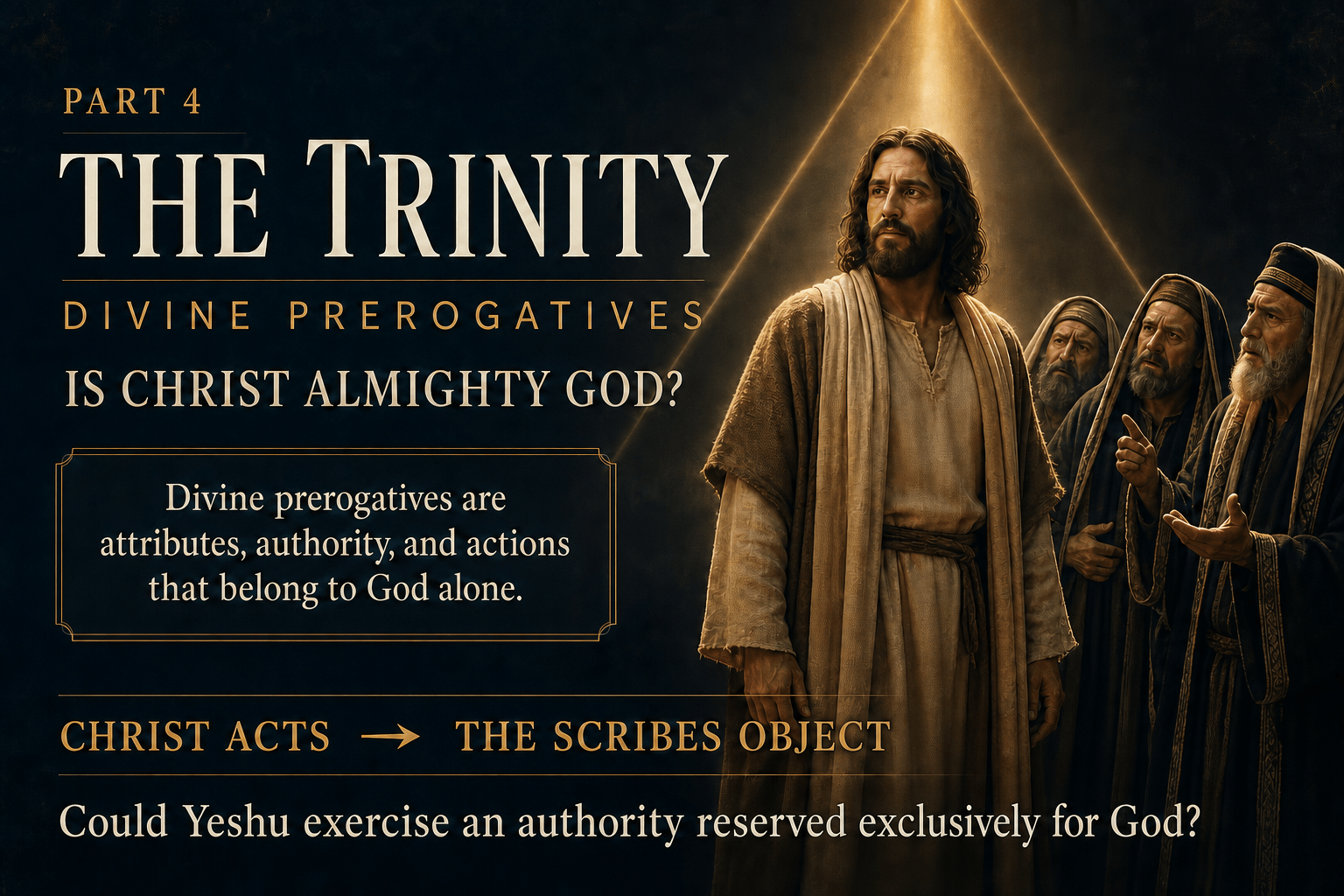
At the outset, I will say that today we are talking about so-called divine prerogatives. I admit that the word “prerogatives” itself sounded a bit ugly to me – it reminded me of horns. But what actually are prerogatives? They are divine attributes, meaning those traits that distinguish a given being – that only God has such possibilities, such talents, such abilities.
As I said, the definition is about an attribute of divinity. And here various issues arise. Let us start with one that is mentioned directly in the Bible – Christ did something, and the scribes were offended by it, because they believed that only God was allowed to do it.
On freedom and responsibility
Today we also have a few similar, mistaken beliefs – that people are not allowed to do something, that it is reserved exclusively for God. In general, we live in times when much is said about what is not allowed. People impose all sorts of restrictions on themselves – contrary to what the Holy Scripture says: everything is permitted to you, but not everything benefits you, not everything is for your good.
We have freedom, but responsibility is always connected with freedom. The same with privileges – responsibility must go along with privilege. You cannot give anyone a privilege, for example to govern, without responsibility for what they do. That is very, very bad.
Today we have such a situation in the world that people come to power and do not take responsibility for their bad conduct. And the same applies to ordinary life. People do various things and do not want to take responsibility for them – they always shift the blame onto someone else.
Besides, it was already like that in the garden of Eden: Adam shifted the blame onto Eve, Eve onto the serpent – only the serpent had no one left to blame. So it is clear that the tendency to avoid responsibility is deeply rooted in humans. But we, as servants of God, should take responsibility upon ourselves, because we should be aware of the consequences.
One of the main teachings of Scripture says that every person sooner or later will give an account of their life. And God’s servants will give one too. To whom more has been given, of them Christ requires more.
First attribute: forgiving sins
In the meantime, let us look at the first attribute – that which in Judaism was considered the exclusive domain of God, and which Christ did, causing offense.
We have it recorded in the Gospel of Mark 2:5-7:
“Yeshu, seeing their faith, said to the paralytic: ‘Son, your offenses [sins] are forgiven.’ And several scribes were sitting there, thinking in their hearts: ‘Why does He speak like this? He blasphemes. Who can forgive offenses [sins], if not God alone?'”
So they had such a belief – and the whole nation shared it – that only God can forgive sins. Therefore they were offended that Christ forgave someone’s sins.
Were they right? It turns out that their belief was wrong. That is – perhaps up to that time only God had indeed forgiven. But if someone acts in God’s name, then they can have such authorization from Him.
Christ, moreover, proved that he had it – the proof was performing a miracle. He realized what they were thinking, so he asked: “Why do these thoughts trouble your hearts?” – and by the way, here we have another thought concerning omniscience: Christ knew human thoughts. And further: “Which is easier: to say to the paralytic: Your offenses [sins] are forgiven, or to say: Get up, take your bed and walk?” And then he told him to get up and leave – he performed a miracle. In this way he proved that he also has the right to forgive sins.
For them it was offensive, because they thought he was exalting himself. In today’s language – that some narcissist had appeared who would pretend to be God here, appropriating God’s power for himself. What does he think, that he will forgive sins? After all, only God can do something like that! So they assumed that he was making himself God, that he was putting himself on a par with God.
So the first attribute is forgiving sins. It turns out that Christ has the right to forgive sins, and the scribes were offended,because they thought he was appropriating divine attributes.
But Christ himself did not claim or teach that he was God – as may be shown by the final conclusion people drew from this event. That conclusion is described in Matthew. The same story, the same miracle, the same problem – but Matthew adds an important detail. Matthew 9:8:
“And the crowds were seized with fear at this sight, and glorified God, who had given such power to people.”
So the crowds understood it this way: a human received authority to forgive sins, and also to perform miracles. The conclusion was: God gave people the authority to forgive sins.
Therefore this example is not proof that Christ was God the Father. Because I repeat once again – here everyone believes that he was God, just not everyone believes that he was equal to the Father. And here it is clearly said that God gave such authority, such a possibility.
What is more – let us look at a surprising verse in the Gospel of John 20:23:
“Whose sins you forgive, they are forgiven them, and whose you retain, they are retained.”
Wow. First it says: “After these words he breathed on them and said to them: «Receive the Holy Breath!” And he gave them the power to forgive sins. That is, Christ passed on the right to forgive sins to his apostles, his disciples.
What conclusion follows from this? That it is not a purely divine attribute. People can also receive the privilege of forgiving sins. So it is not proof that Christ is God the Father and has the same power – since he passes it on, to ordinary people.
And yet those people did not become gods because of this. They were still the same apostles who made mistakes.
We can therefore see that the conviction “only God is allowed to do this” was simply wrong. Yes, God could pass it on to someone else. He passed it on to Christ, and Christ – to people.
Second attribute: creating
Another attribute of divinity is being the Creator. Here we have verses that refer to Christ – so let us first quote about Christ’s participation in creation. There is no doubt about this.
Gospel of John 1:3:
“All things came into being through Him, and without Him nothing came into being that came into being.”
This refers to the Word – Logos. This Word is identified with Christ, as follows from the later text. So it is said that through Christ everything came into being, and without Him nothing came into being that came into being. Thus according to this verse Christ was an active participant in creation.
In the opinion of many, this is proof of Christ’s divinity. Again I remind you – we all here believe in the divinity of Christ, just not in equality with the Father.
But all right, let us look at a similar verse from the Letter to the Colossians 1:15-17:
“who is the image of the invisible God, the firstborn of all creation. For in Him all things were created: in the heavens and on the earth, visible and invisible, whether Thrones or Dominions or Principalities [priority, headship], or Authorities. All things were created through Him and for Him. He is before all things, and all things stood in Him.”
So again: Christ existed earlier, before anything else came into being. Everything then came into being through Him and for Him. We see clearly here that Christ is an active part of the work of creation. So it can be said that he is a creator. At first glance it seems that this confirms the theory that he is the same as the Father, right?
However, the first sentence somewhat spoils this picture: he is the image of the invisible God – and therefore not God the Father himself. God the Father is invisible, and He is His image. And further: the firstborn of all creatures. This word simply means the first, but among creatures. There is quite a dispute over it, we discussed it earlier, but the fact remains: he is the first of the creatures, meaning he was created first.
The very expression “firstborn” indicates that he had a beginning. We will never say of God the Father that he is firstborn. Why? Because he had neither beginning nor end.
Although Christ is not called creator, nevertheless logically speaking – since everything came into being through Him – he was involved in creation.
Hebrews 1:2 – a verse in a similar spirit
“At the end of these days He spoke to us in the Son, whom He appointed heir of all things, through whom He made the eons [times, ages].” – some translate this as “worlds”, but in the original it is eons.
We read further: “Being the radiance of glory and the exact representation of His essence, He upholds all things by the power of His spoken words. After making purification for sins, He sat down at the right hand of the Majesty on high.”
What matters is the first point: through Christ, God created.
Isaiah 44:24 – apparent conflict
There would be nothing problematic in saying that Christ created and God the Father created, were it not for verses like this:
“Thus says YHWH, your Redeemer, who formed you in your mother’s womb: I, YHWH, make all things. I alone stretch out the heavens, I spread out the earth by my own power.”
This word “alone” seems to conflict with the Son’s participation. Supporters of the Trinity say: there you go, it is one God, but in two persons – and then the Holy Spirit comes in as well. The whole concept of God in three persons arose precisely because people could not reconcile that God is one, and yet the Son is called God, and the Father is called God. So they had to invent a philosophical explanation for something that cannot be explained.
I offer you an alternative: both can be Gods, and yet it can still be said that God is one – because everything depends on the context. I have already discussed most of the verses about one God, and you will find them in the previous parts.
Is Christ, by the very fact of creating, God the Father?
No. And this follows directly from the biblical verses. Even the one from Colossians says that God created through His Son – He made use of Him.
I will give you an example to illustrate: King Solomon built a temple for God. Except that he probably did not move a single brick there. He built it by making use of workers. And yet we say that he built it. He could even say: “no other king helped me, I am the only one who built this temple” – and that would be true. Because ordinary workers helped him, not kings.
Similarly here: no other god – in the context of the deities of the nations, the Moabites, the Ammonites – none of those gods competing with YHWH helped in creating. But the Son of God? Absolutely.
1 Corinthians 8:5-6 – a clear distinction
“Although there are indeed those called gods, whether in heaven or on earth, so there are many gods and many lords, but for us one God the Father, from whom are all things and we to him and one Lord Yeshu the Anointed, through whom are all things and we through him.”
God the Father is the originator, and Christ the instrument – or worker, if you prefer – whom God uses for creating.
By the way, this verse does not deny that Christ can also be God. Since it speaks of many so-called gods, and we recognize only the Father and the Lord Yeshu – the context allows the reading: from among many gods, we recognize these two. No one reasons this way, because everyone reads superficially, but that is the sense of this verse. Except that, for distinction, one is called Father, and the other by name – Yeshu. The difference is clear, right?
If we took literally that no one helped God – no archons, no sons of God, absolutely no one – we would fall into contradiction with many other verses.
Proverbs 8:22-30 – wisdom at the work of creation
“The Lord made me the beginning of his ways for his works. Before the eons he established me at the beginning, before he made the earth and before he made the abysses, before the springs of waters flowed, before the setting of mountains, before all the hills he begot me. The Lord made the lands and uninhabited places and the inhabited peaks under heaven. When he prepared heaven, I was with him, and when he marked out his throne on the winds. And when he made strong the upper clouds, and when he strengthened the springs under heaven, And when he firmly established the foundations of the earth, I was beside him, fitting myself; I was that in which he delighted and I rejoiced daily before him at all times.”
Exactly as in Colossians: before everything came into being, Christ was.
This wisdom is later called the Logos. Few people know that logos basically also means wisdom – that is why the names of sciences derive from this word: stomatology, pharmacology. “Logy” is simply science, and therefore wisdom. At the same time logos means “word”.
So when John speaks about the Logos, he is referring to the beliefs of the Greeks, who believed in a first cause and called it the Logos – and he tells them: that Logos is Christ. But for Judeans it is obvious that he is referring to the eighth chapter of Proverbs, to wisdom.
If one were to accept that God the Father literally created everything alone and no one helped Him, many contradictions would appear in the Bible.
So how do we explain Isaiah, Jeremiah, and other texts? In this way: that none of the rival gods of that time – and they had specific names – had any share in it. He himself created everything. But “himself” in the same sense in which King Solomon himself built the temple.
God created through Christ
That is an obvious fact. And here an important methodological principle: we do not use the Old Testament to explain the New. The other way around. The New Testament came into being in order to explain unclear matters from the Old. Therefore the New Testament says precisely: God created, but through Christ. And that is what we hold to.
So both, in a certain sense, can be called creators. Except that “out of nothing” God the Father created only once – and that was only the Son. Though I admit that the very expression “out of nothing” is misleading. Because what does it mean? That God is nothing? After all, he created out of himself.That is why I prefer the wording – and I like it – that God begot the Son. He did not create Him, but begot Him. Nevertheless, the effect is the same as if He had created Him.
And then time comes into being. Because when the Father and the Son speak, the interval between question and answer is measurable, right? Space also had to come into being, in which they both moved. The more space, the more room to create further beings; the more beings, the more space is needed. And so the world spread out – but everything apart from Christ came into being with His active participation. The rest was not begotten, but created – in a sense produced from something.
Third attribute: who assigns to whom
We see that the Father could make use of the Son. And that fact alone already shows a hierarchy: the Father higher, the Son lower. Because a worker is always lower than the one who assigns work to them. Christ Himself says that a messenger is not equal to the one who sends him. Similarly, Solomon built the temple by the hands of workers – and the workers did not thereby become equal to Solomon.
Fourth attribute: omniscience
Here many people – in my opinion, going too far – attribute omniscience to Christ. They cite verses saying that He knew people’s thoughts. I will quote another one, John 2:24-25:
“Yeshu, however, did not entrust Himself to them, because He knew them all and did not need anyone’s testimony about a person. For He Himself knew what was hidden in a person.”
On this basis – mainly supporters of the Trinity – they claim that Christ was omniscient, and therefore had the attribute of the Most High God. Unfortunately, not entirely. Let us look at Mark 13:32:
“But of that day or hour no one knows, neither the angels in heaven, nor the Son, but only the Father.”
And this is checkmate. There is no longer an argument that Christ knew everything and in this respect was equal to the Father. He was not. The Son did not know the day or the hour – until the Father reveals it to Him, He has no idea. All the knowledge the Son possesses, He receives from the Father. He knows as much as the Father allows Him to know.
My favorite example – Revelation 1:1:
“The Revelation of the Anointed One Yeshu, which God gave Him to show His servants what must soon take place; and He, through the Messenger, passed this information on to His servant John.”
Look at this chain: God gives Christ information about the future. Christ passes it on to the angel. The angel goes to John. John passes it on to people. This is the channel of communication and this is how God acts.
That is why in the Book of Revelation – we read this at the previous meetings – Christ is called the God of the prophetic spirits: because it was He who sent those prophecies through the prophetic spirits, and here we specifically see an angel who carried them to a human being, and the human being passed them on further. That is simply how it worked.
Conclusion: Christ was not omniscient, the source of His information was God. The claim that He has the attribute of omniscience, and therefore is equal to the Father – falls apart. It is simply untrue.
Fifth attribute: immutability
There is a verse in the Letter to the Hebrews that supporters of this attribute cite. I discussed this letter very thoroughly, for several hours, at meetings among brothers immersed in the name of Yeshu.
Hebrews 13:8:
“Yeshu the Anointed One yesterday and today, the same also forever.”
Many people draw the wrong conclusion from this, that Christ does not change. But it is about something entirely different: there will be no other Christ. The letter is written to Hebrews – Judeans, Israelites, as you prefer – who had begun to have doubts and wanted to return to Judaism. The author informs them that there will be no other Messiah. This one is and will always be. In this sense He is unchanging.
However, as Messiah, as a human being – He learned. God Almighty, the Father, does not learn anything: He knows everything, understands everything. That is why with God there truly is no variability – in the sense that He does not develop. I suppose that is what Marek meant when writing about the lack of creative development. God creates, but He does not learn.
Christ, however, did learn – already as a child, because it is said that He acquired wisdom. And look: the same Letter to the Hebrews 5:8-9:
“And although He was the Son, He learned obedience through what He suffered,”and having been made mature [perfect], He became the source of eonian salvation for all who obey Him.”
So Christ is God – on that we agree – who learns. That is what Scripture says. There will be no other Christ, it will be the same one, but Christ acquires knowledge. Perhaps at one time He did not know the day or the hour – and who knows, maybe today He already does? Just as earlier He did not have the prophecy of Revelation, and when He received it, He immediately passed it on to the angel and to people. Christ develops, Christ learns.
Why this is so important
Because there are places in the Bible where God is presented as Someone who changed His mind. And God the Father never – I repeat: never – changes His mind. Every word of His is certain.
However, we do have descriptions of YHWH changing His mind. What does that mean? That someone else appeared under this name – namely Christ, the reflection of God, who says and does what He sees and hears from the Father.
Isaiah 55:11:
“Thus shall My word be that goes forth from My mouth: it shall not return to Me empty, but it shall accomplish what I please, and it shall prosper in the thing for which I send it.”
So when the Father speaks – there is no change, because He knows everything. If He knew that someone would press Him – as Moses pressed YHWH – He would have known it in advance and would have made the decision in advance.
By contrast, Christ, appearing under the name YHWH – we talked about this, and next week we will return to the prophecies concerning YHWH which, according to the New Testament, were fulfilled in Christ (people usually skip over this) – could yield to persuasion, could change His mind, could even ask someone about something.
And we have such a case – described twice, in 1 Kings and in 2 Chronicles, so confirmed by two sources. A strange description of a prophetic vision. 1 Kings 22:19-23. I am sure almost no one knows this passage and has no idea that such verses even exist:
“Then he continued: «Therefore hear the decree of the Lord! I saw YHWH sitting on His throne, with all the hosts of heaven standing by Him on His right and on His left. Then YHWH said: ‘Who will deceive Ahab, so that he may go and fall at Ramoth in Gilead?’ And one said one thing, while another said something else, until a certain spirit came forward and stood before YHWH and said: ‘I will deceive him’. Then YHWH said to him: ‘How?’ And he replied: ‘I will go out and become a lying spirit in the mouth of all his prophets’. Then He said: ‘You may deceive him, and you will succeed. Go and do so!’ So YHWH has now put a lying spirit in the mouth of all these prophets of yours. And YHWH is to bring disaster upon you».”
Notice: YHWH asks “how?”. He asks – because He does not know. This is not an image of the Father. This is an image of the Son, acting in the name of the Father.
Further: “So YHWH has now put a lying spirit in the mouth of all these prophets of yours, and YHWH is to bring disaster upon you”. These are the words of the prophet Micaiah addressed to King Zedekiah – the same one who later tries to ignore and shout down this prophecy.
Pay attention to the context of this scene. The YHWH who appears here consults with other spirits, asks them how to carry out the task. Let us pause over this for a moment. Would God the Father need to consult with anyone? Never in His life. He always knows the answer – to every question and about every being. This is precisely an example showing that Christ, even when appearing in the role of God YHWH, was not omniscient.
I know that for many of you this is now causing considerable cognitive discomfort. I understand that perfectly. You simply had no idea that such verses are even in the Bible. And there are many more of them. Take, for example, those passages where YHWH intends to do something, and Moses begs Him and begs: “No, do not do this!” – and YHWH changes His mind. It is Christ who changes His mind. God the Father, once He decides, it will simply happen.
That is why we must learn to distinguish: when YHWH means God the Father, and when the Son of God appears there, representing Him.
To sum up: Christ is not an omniscient God. His source of information is God the Father. He does not have this attribute – although of course He knows more than any other being, spiritual or human.
Sovereignty – an attribute that surprises
Let us move on to the next attribute that many people invoke: sovereignty. You may be surprised. There is a belief that since it speaks of Almighty God, it must certainly mean the Father. At the same time, people are eager to use the term “Mighty God” for Christ – which I said is an uncertain verse, because there is no such name in the Septuagint.
And here a problem arises. For it turns out,that Christ is also called God the Sovereign. Let us look at Revelation 1:8:
“I am Alpha and Omega, the beginning and the end, says the Lord, who is and who was, and who is to come, the Almighty.”
Indeed, some translations do not have the word “God”, only “Lord”. Then everything fits: Alpha and Omega, “who is coming” – because we are, after all, waiting for Christ’s return. But “Sovereign” is also there.
Why “almighty” is a wrong translation
And now pay attention – the key point. Do not use the expression “almighty”. It is false, although it has become deeply ingrained in people’s minds.
The Greek word that I translate as “sovereign” literally consists of two parts: “all” and something like “above weight”, “outweighing”. The meaning is this: above everyone. Literally – “outweighing everyone”. He has an advantage over everyone. That means: He is the Sovereign. He has authority over everyone and there is no one who would have greater authority.
There is no such thing as an “almighty God”. And do you know what this wrong translation leads to? People make a mockery of God. They ask: can God create a stone that He Himself cannot lift? Can God kill Himself? It turns out that God cannot do everything. God cannot lie – it is impossible. Well then He is no longer “almighty”, since He has limitations. Some explain that He limited Himself voluntarily, but that does not change the fact: He cannot.
Sovereign – meaning having the greatest authority in the spiritual and material universe, in all spheres of the heavens. No one has greater authority than God.
Alpha and Omega – why this must be Christ
Let us look at Revelation 22:12-13:
“And behold, I am coming quickly, and my reward is with me, to give to everyone according to his works. I am Alpha and Omega, the beginning and the end, the first and the last.”
Here it is clearly visible that this is about Christ. People argue about this, but think about the very logic of this image. Alpha and Omega are the first and last letters of the alphabet – and therefore the beginning and the end. God the Father is not Alpha and Omega. He is not an alphabet at all! He is beyond the scale, immeasurable.
Do you understand what I mean? The alphabet has a beginning and an end. Christ is that beginning and end. But God the Father has neither beginning nor end – He is beyond time and beyond space.
I always describe it like this: where the space created by God ends – whether spiritual or bodily, because that is only a matter of vibration – there is God. Where there is not yet a universe, where there is no cosmos, there He is. And He is everything apart from what exists outside Him, that is, apart from our world.
Solving the mystery: where Christ gets supreme authority from
So a problem appears, right? How is this possible? After all, the Sovereign is the Father. I completely agree with that. God the Father is God the Sovereign and no one has greater authority than He does.
So how is it possible that Revelation calls Christ the same thing? Is this not proof of equality? From the previous verses we already know that He is not equal. So where does this designation come from?
The answer is given to us by the Gospel of Matthew 28:18:
“Then Yeshu approached them and spoke these words: «All authority in heaven and on earth has been given to Me.”
He received all authority – so He became sovereign. Of course with the exception of authority over God the Father, who is beyond heaven and earth, beyond time and space. God the Father is not part of creation.
God the Father, who until then had been the highest authority over the material and spiritual world – over heaven and earth – handed this authority over to His Son. And at that moment the Son became the highest authority, that is, supreme authority. He is above all others, exactly as the Greek word says.
But notice: He was appointed to this. He does not have it by His own nature. It was given to Him – for specific merits, for a mission carried out. The fifth chapter of Revelation says directly why Christ is worthy of honor and glory: because He redeemed people for God the Father. Again we see Christ performing service for the Father.
What did the apostles call Christ?
It is worth recalling one more little-known verse. Did the apostles believe that Christ is equal to the Father? You will be surprised – even those who do not believe in the Trinity are surprised by the words the apostles used.
Let us turn to Acts 4:24-30. There is a prayer of the apostles there: “And when they heard this, they lifted their voices together to God and said: Lord, You who made heaven and earth, the sea and everything in them…” And then the key sentence:
“For truly in this city they gathered together against Your holy Servant, Yeshu, whom You anointed.”
Some translations have “son” here – but that word appears only in later manuscripts. It was inserted because what they read in the older manuscripts did not fit for the translators. The apostles call Christ the Servant of God, not equal to God.
Conclusion: exaltation by the will of the Father
Nevertheless, at this moment Christ is exalted by the will of God the Father. God wants us to honor Him just as we honor Him. For this purpose He has given Him authority to judge humanity and all authority.
Christ is therefore for us at this moment like God – like God the Father. But not because we humans decided so. Because God the Father willed it so. Whoever does not honor the Son does not honor the Father.
Colossians 2:9 – “the whole fullness of deity”
The verse from the second chapter of the Letter to the Colossians, which in the view of Trinity supporters – or rather supporters of the thesis of equality with the Father – would settle the matter.
“For in Him dwells all the fullness of deity bodily (formed).”
It is worth pausing over this Greek word. There is a term there that literally means “formed” – and that is why in my translation I rendered it as “bodily,” while in Zawias it is translated simply as “formed.” So it refers to something that has been enclosed in shape, given form – in Christ dwells the whole fullness of deity.
According to many people, this is conclusive proof that Christ is fully God – that we have one God in two persons, as it is usually phrased. But let us think calmly: is this really proof?
In my opinion, no. And I will explain why right away.
Ephesians 3:19 – the same expression about us
Look at what Paul writes to the Ephesians:
“…and to know the love of the Anointed One surpassing all knowledge, so that you may be filled with all the fullness of God.”
Pay attention to the wording. Our goal – the goal of ordinary people, disciples of Christ – is to be filled with all the fullness of God. The same expression, the same idea.
And now the questions worth asking:
• Will we become God in this way?
• Will we become equal to the Father?
• Will we become Him, only in another person?
• Will we become co-eternal with Him?
The answer to all of them is: no. And yet that is precisely our goal – that God be in us, and we in God. Which, unfortunately, for some is a hard thing to accept.
The conclusion is therefore simple and logical: the mere statement that the fullness of deity dwelt in Christ is not proof of His equality with the Father – since according to the teaching of the same apostle Paul, we too are to be filled with the fullness of God.
Omnipresence
We have not yet discussed another attribute, and it is very important: God is everywhere.
Let us begin with a fundamental statement: there is no place on earth that could contain God. God is simply too powerful. But He is present – always and everywhere – through His Spirit.
“Where two or three…”
There are Christ’s words: “I will be with you” or “where two or three are gathered in my name, there am I among them.” On this basis some reason as follows: there is a little group of Christians here, another there, a third somewhere else – and since Christ is with each of them, that means He is everywhere.
But notice that this verse does not say that at all. Christ is not declaring His omnipresence here. He is saying something else: that He will be there where several people gather. He does not even speak of one person – though of course He can be present with His Spirit even with one. Here He emphasizes something entirely different: the need to gather.
Does the Bible say that God is everywhere?
Yes and no. Why? Because He is not everywhere personally – He is everywhere by His Spirit. Some interpret this as omnipresence in every place, but that is His Spirit, not He personally.
A great example is the temple built for God. The apostles in the New Testament say clearly that God does not dwell in temples built by human hands – because none of them is able to contain Him. So what was there? His Spirit. Or His name – there are verses saying that the temple was built for the name of God. There are also indications that the Spirit of God was present there in the sense of angels who guarded that holy place.
Psalm 139 – a verse that explains both aspects
And now the most interesting part. There is a passage that at the same time says that God is everywhere, and immediately explains that this happens by the Spirit. This is Psalm 139, from verse seven:
“Where can I go from Your Spirit? And where can I flee from Your face? If I ascend to heaven — You are there; if I descend to Sheol — You are present. If I take the wings of the dawn and dwell at the far side of the sea, even there Your hand will lead me, and Your right hand will hold me up.”
Notice: the psalmist asks about the Spirit and the face – and it is the Spirit who turns out to be the one from whom there is no escape. So yes, some rightly say that God is everywhere – but by His Spirit, not personally.
The scale worth remembering
Personally – as the Bible describes it – the earth is God’s footstool. Not a chamber where He spends time, but a footstool. Let us simply understand that God is so great, so vast, that the earth is like a tiny ball to Him.
And that is exactly why His love and care are revealed so beautifully here. Since He even cares about us humans, since He wants what is good for us – even though we are to Him as ants are to us, or perhaps even like bacteria. We are that small before Him, and yet He cares for us. And that is truly beautiful.
How God is present: through the Representative and through the Spirit
God the Father can therefore come to us in two ways: through His Representative or through His Spirit.
God’s Representative on earth is Christ – because He is His image. And in connection with this omnipresence, it is worth saying: He is literally sitting beside us. And He sends His Spirit.
Let us read what Paul writes to the Romans:
“But you are not in the flesh, but in the spirit, if so be that the Spirit of God dwell in you. Now if any man have not the Spirit of Christ, he is none of his. And if Christ be in you, the body is dead because of sin; but the spirit is life because of righteousness.”
The point is that Christ is present with us in spirit. He has spirits that He sends to us – and He can even assign each of us a spirit that will be with us.
Likewise God the Father: He is not literally present in His body or some form, because He has another form – the form of energy. But He is present by His Spirit. And His Spirit really is everywhere, which means He has His messengers everywhere.
The attributes of the Father pass to the Son
And now comes the astonishing thing: all these attributes that the Father has, over time pass to the Son. More than that – at a certain point the Son will be called Father. Revelation 21:3-7:
“I heard a mighty voice coming from the heavenly throne, which cried out: ‘This is the dwelling of God among people, because He will dwell with them, and they will be His peoples, and He will be the God who will be with them, because He is their God.'”
And here the name Immanuel – Emmanuel, “God with us” – will be fulfilled. Only then will God truly be with us.
“He will wipe away every tear from their eyes, and there will be no more death, nor sorrow, nor despair, nor suffering anymore, because what was before has passed away. The one seated on the throne declared, ‘Behold, I make all things new.’ And He said to me, ‘Write: These words are true and worthy of trust.’ And He said to me, ‘It is done. I am Alpha and Omega, the beginning and the end. To the one who thirsts I will give freely from the spring of the water of life.’ The victor will receive his share in all this, and I will be God to him, and he will be a son to Me.“
This is what Christ says. He will be God, and those who overcome will be His sons. So one could say that Christ will also be God the Father for a certain group of people.
Thanks for listening until the end. I would be extremely grateful for likes, shares and comments, because it helps grow the channel, which gives a chance to reach even more people.
The full written version of the article is now available at yeshu.blog . There you will also find my videos and music — all created in the name of our Lord Yeshu.
If you receive the gift of faith in the name of our Lord Yeshu, take the next step and contact me to be immersed in the name of Yeshu. You can find contact details on our website or simply write on Messenger.
Glory to Yeshu!!!