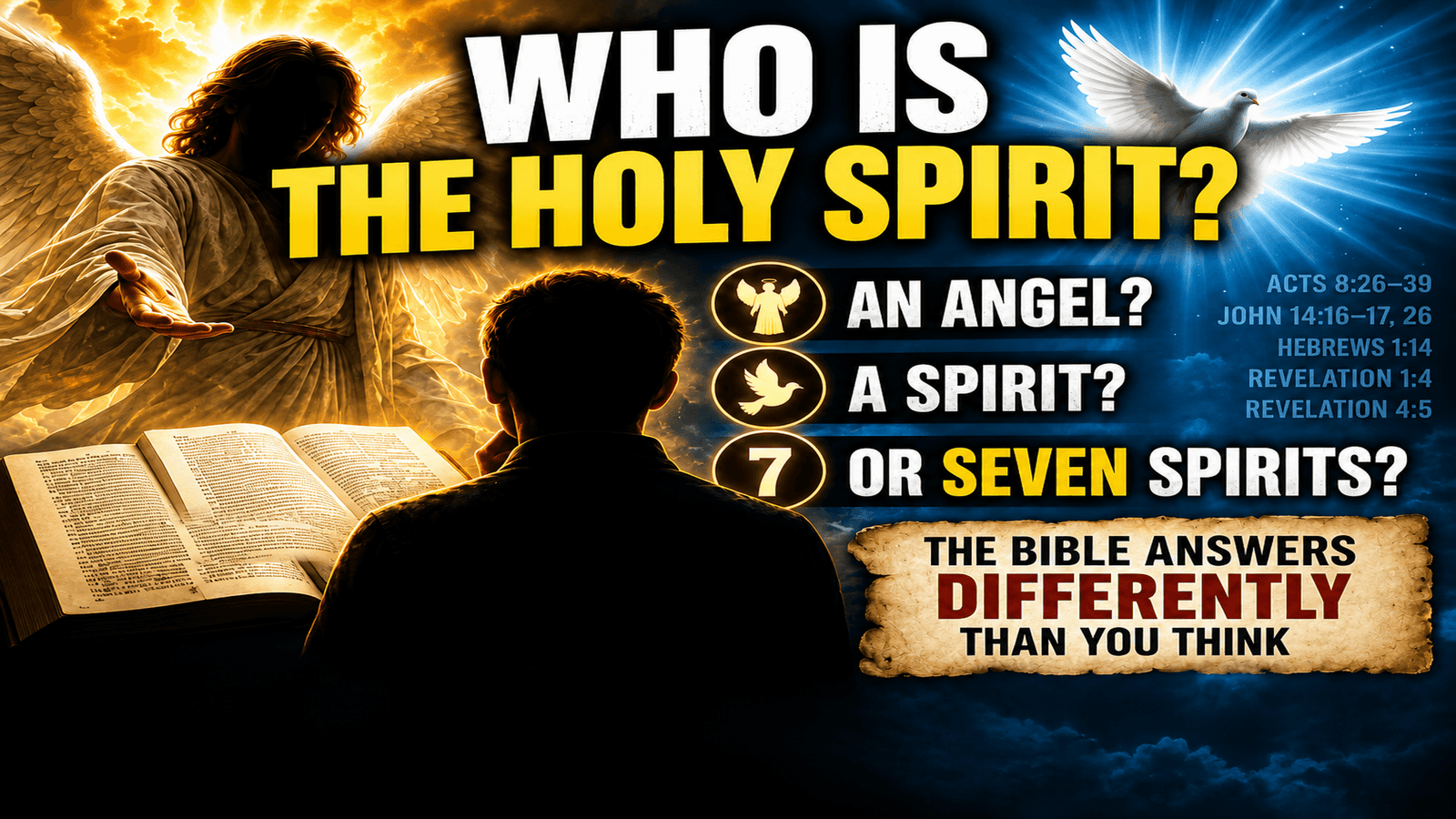
I hope today’s topic will be interesting for you. It is in a way connected with the previous reflections, that is, with the concept of the “trinity”, because the Holy Spirit – according to the beliefs of many people – is a component of something like the trinity, that is, one God in three persons. In reality, Scripture says very little about the Holy Spirit, which is precisely why there is especially much room here for speculation. Today we want to approach this topic honestly, that is, not favor our own views, but stick to what Scripture says.
For I would like to pose a question that we usually do not ask when reading the Bible. Not because the Bible does not answer it, but because we often approach the text with a ready-made answer. The question is: whom did Christ promise to send to his disciples as help from heaven? Who was this helper to be – some translate this word even as “advocate”, “defender”, “supporter”? Everyone has the answer to this question that was instilled in them in Church. So your answer depends on what Church or congregation you grew up in. A Catholic and a Protestant will answer differently, and a Jehovah’s Witness, for example, differently again. And everyone will be convinced that they are basing it on the Bible.
So I suggest that today we set interpretations aside and look at the biblical texts themselves. Let us simply see what the Bible says on this topic. Let us try to consider the verses not in order to bend them to our beliefs, but neutrally – getting rid of human accretions, of what someone has talked us into. Let us clear the mind, focus solely on biblical verses as the source of information, and see what emerges from them. I am not asking you to accept my answer right away. I am only asking that you allow the Bible to explain itself.
Let us begin with the Acts of the Apostles, because the clear action of the Holy Spirit actually begins there. Of course we also encounter it earlier, in the Gospels, but the one who was to be sent by Christ comes only after His return to heaven – Christ promised to send him, and the disciples waited for him. On the day of Pentecost the Holy Spirit is poured out and we know what happens then. From then on we observe his special action: he is given to very many people, and people receive supernatural abilities, that is, gifts of the Holy Spirit.
We, however, will look at a situation in which the Spirit acts in specific circumstances – in the eighth chapter of the Acts of the Apostles.
Acts 8:26: “‘Get up and go about noon to the road that leads from Jerusalem to Gaza: it is deserted’ – the Angel of the Lord said to Philip.” Let us remember: “the Angel of the Lord” said to Philip. And verse 29, so not much later: “‘Go over and join this chariot!’ – the Spirit said to Philip.” Question: is “the Spirit” the same as “the Angel of the Lord”? Traditionally, taking this verse out of context, we assume that this must be the Holy Spirit – but just a moment earlier an Angel was clearly mentioned. And further, verse 39: “And when they came up out of the water, the Spirit of the Lord snatched Philip away, and the court official never saw him again. He went on his way rejoicing.”
So we have three terms: first – the Angel of the Lord, second – the Spirit, third – the Spirit of the Lord. The question arises: how many heavenly messengers are active in this story? How many figures from heaven are in it? Did the Angel from verse 26 complete his mission and get replaced by the Spirit? If the Angel were not this Spirit, it would turn out that we have two persons there. But why two? It was very rare for more than one angel to be sent on any mission. One of the exceptions was the destruction of Sodom – there it was necessary to talk with Abraham, lead Lot’s family out, there was a bit of trouble. In general, however, in most missions there was no need to send several angels. Why? Because they have such powerful might. So if the Holy Spirit appears, why does he need an angel to help him? And if an angel has power, why does he need the Holy Spirit? Why would both of them be there together? Are they there together, or is it perhaps one person – that is a question you will find the answer to yourselves. Is Luke describing one heavenly figure using two, or even three different terms? Or perhaps are there two or three persons there? Is there an angel and the Holy Spirit there, or only an angel who is a holy spirit – or only the Spirit who is an angel?
And as if that were not enough – someone will say: after all, the expression “Holy Spirit” does not appear here. True, but in the Syriac Peshitta, that is, the local version of the Acts of the Apostles, in verse 29 there is not just “Spirit”, but literally “Holy Spirit”. So we have: the angel of the Lord, the Holy Spirit, and the Spirit of the Lord. Why as many as three different terms? Does that mean three different persons?
That was the introduction. Let us try today to answer three questions. First: Does the Bible call angels holy spirits? Second: Does the role of the Holy Spirit correspond to the role of angels? Third: Why does Revelation speak not only of one Spirit, but also of seven spirits? If these three elements connect with one another, we will at least have to theoretically consider whether “Holy Spirit” is not a collective term for holy spirits sent by God to help His people.
Before we move on to the arguments, let us establish three principles.
First: we will not build a teaching on one verse. This is a very common mistake – someone creates an entire teaching, a dogma, on the basis of one verse, and invalidates ten other verses that contradict that logic. No, we build nothing on one verse.
Second: we distinguish what the Bible says directly – then we have no doubts at all – from conclusions resulting from comparing texts. Most teachings that depart from the teachings of the apostles arose precisely this way: some conclusions were drawn, further conclusions were built on those conclusions, and in this way a pyramid of something grew that ultimately moved far away from biblical teaching. And the Holy Scripture warns that cursed will be anyone who proclaims something different from what was proclaimed at the beginning. Such “overwriting” of successive conclusions therefore leads to a curse, to rejection by God. This is a very dangerous situation.
Third: we will not bypass passages that may seem difficult for our conclusions. So if you have any counterarguments, please provide them in the comment. However, before you do that, familiarize yourselves carefully with the whole material. To those who would like to argue already now, I will recall a verse from the Book of Proverbs: “To answer before listening is folly and shame.” It is therefore unwise to enter into a discussion until one knows all the arguments. Wait for the whole.
We must honestly say that the Bible nowhere contains a sentence like: “The Holy Spirit is a collective name for angels”. There is no such sentence. If there were, the matter would be simple. There is none, so in order to reach such a conclusion, one must have reasons. But it is also true that the Bible nowhere speaks of the Trinity. And that is exactly what I am talking about: we must distinguish our self-confidence, which does not come from the Holy Scripture, from the truth revealed in it. Today we will try to reach that truth. We will compare verses that speak of the Holy Spirit with verses that speak of angels, and check whether perhaps they are not speaking about the same thing.
Let us open the Letter to the Hebrews, chapter one. For me this passage is already a decisive argument, but I understand that for someone it may not be enough. Verse 14: “Are they not all spirits intended for service, sent to help those who are to inherit salvation?” Who is being spoken of here? From the previous verses we learn that it is about angels – “To which of the angels did He ever say: Sit at my right hand until I make your enemies a footstool for your feet.” And immediately afterward we read: “Are they not all spirits”. So angels are spirits – we have the term: an angel is a spirit. Spirits “intended for service, sent to help those who are to inherit salvation”.
Let us try to remember several elements. Who are angels? Spirits. What do they do? They serve.Who sent them? God. Whom do they serve? The heirs of salvation, that is, the followers of Christ.
The second term can be found in the Gospel of Mark, chapter 8, verse 38: “For whoever is ashamed of Me and My words before this faithless and sinful generation, of that person the Son of Man will also be ashamed when He comes in the glory of His Father together with the holy angels.” I mean the word “holy”. So from the Letter to the Hebrews we have the information that angels are called spirits sent to serve, and here – that the angels serving God are holy angels.
What follows from this? Since angels are spirits, and faithful angels are holy, faithful angels are – in the literal meaning of these words – holy spirits. That is, a single angel is a holy spirit. Does anyone disagree with that? It seems to me that this is obvious: based on Holy Scripture, we learn that angels are spirits, and those of them who serve God are holy.
That is, a single angel is a holy spirit. It is very important that we know this, because there is also such a thing as an unclean spirit – and that is the opposite of a holy spirit. What characterizes an unclean spirit? That it does not serve God. In principle, it may be a former angel who rebelled, or some other form. This must be said clearly: not every spirit is an angel, whereas every angel is a spirit. And now some of these spirits are holy, and some are unclean. The term “holy spirit” is therefore the opposite of the term “unclean spirit”. Both the singular and the plural are used for one and the other, because they are simply counterparts. If we reserved the words “Holy Spirit” exclusively for the Third Divine Person, then we would not have an opposing counterpart for an unclean spirit. We would have to transfer all those verses onto God in the Third Person, right? And logic indicates that since unclean spirits exist, clean spirits, that is, holy ones, also exist.
All right, but this still does not prove our whole thesis. However, it removes the first obstacle: the term “holy spirit” is not something that, by definition, could not refer to an angel. An angel can be called a holy spirit.
Now we will see why these holy spirits are sent, and compare their task with the task of the promised helper, comforter – or however it is translated.
The Gospel of John, chapter 14, verses 16-17: “And I will ask the Father, and He will give you another Comforter, to be with you forever – the Spirit of Truth, whom the world cannot receive, because it neither sees Him nor knows Him. But you know Him, because He remains with you and will be in you.” So Christ promises that He will send someone who will care for the disciples. “Comforter” is really only one of many translations. The Greek word parakletos literally means defender – someone who represents us in court, an advocate, a spokesman. Different denominations choose different names for it, but in any case it is someone sent to help the servants of Christ. Christ clearly says that He will not leave them alone, that He gives them the support of the spirit, and that this helper is to be with us forever.
Verse 26: “And the Comforter, the Holy Spirit, whom the Father will send in my name, He will teach you everything and remind you of everything that I told you.” Here we have an additional characteristic, because we are picking out the characteristics one by one. Earlier we learned that He would support and help; now – that He will teach and remind.
John 15:26: “But when the Comforter comes, whom I will send to you from the Father, the Spirit of Truth, who proceeds from the Father, He will testify about Me.” So He will bear witness about Christ – just like the apostles, right?
And further, John 16:13-15: “But when He comes, the Spirit of Truth, He will lead you into all truth. For He will not speak on His own, but will say everything that He hears, and will declare to you the things to come. He will glorify Me, because He will take from what is Mine and reveal it to you. Everything the Father has is Mine. That is why I said that He will take from what is Mine and reveal it to you.” More important factors: He does not speak on His own – which, by the way, recalls the earlier attitude of Christ Himself. He says what He hears, meaning He does not proclaim His own teaching or His own will, but fulfills a serving role. He declares the things to come, meaning He predicts the future – for the Holy Spirit oversees the transmission of prophetic messages.
So we have a heavenly helper who is sent, does not speak on His own, but conveys the words of Yeshu that He has heard, instructs the disciples, and announces the future. What kind of beings does the Bible present as being sent from heaven, conveying someone else’s words, explaining prophecies, and helping the saints? Were there not such beings before? Had God not already sent someone similar? Exactly – He sent angels. Those ministering spirits that we read about in Hebrews 1:14: “Are they not all spirits destined for service, sent to help those who are to inherit salvation?” Look – a very similar role. Actually identical.
I made a table that we will discuss.
The helper described in chapters 14, 15, and 16 of John has certain characteristics. He is sent – John 14:26 and 16:7. The same is said of angels: they are spirits sent, Hebrews 1:14. He helps the saints – John 14:16 and Hebrews 1:14 says that angels serve the heirs of salvation. He guides – John 16:13 and Acts 8:26 show how an angel guides Philip – we will return to that example in a moment. He instructs – John 14:26 and we have an example of Gabriel instructing Daniel, Daniel 8:16 and 9:22. He reminds of Christ’s teachings, that is, the words of Yeshu – John 14:26 and in Revelation 1:1, which we will read in a moment, an angel also conveys something from Christ. He testifies about Christ – John 15:26 an angel carries the testimony of Yeshu, Revelation 19:10. He declares the future – John 16:13, Revelation 1:1 and 22:6 show that an angel conveys information about what will happen. He does not speak on His own – John 16:13 and of course no angel speaks his own words, but conveys someone else’s – in general he is a messenger, that is typical for him. He helps in danger – and we have an example: an angel frees Peter, Acts 12:7-11. He strengthens God’s servants – and we have an example of an angel strengthening Christ, Luke 22:43.
So it is clearly visible that what Christ foretold as the action of the Holy Spirit was, in fact, what angels did, do, and will do. If someone needs to, they can check each verse one by one.
Do we have here only a coincidental similarity between two different ministries? Either it is the same group of spirits, or the similarity is coincidental or intentional, right? Or maybe Yeshu foretold exactly the help that, according to Hebrews 1:14, is carried out by sent spirits, that is, angels?
Acts 8:26: “‘Get up and go around noon to the road that leads from Jerusalem to Gaza: it is deserted’ – the angel of the Lord said to Philip.” Verse 29: “Go over and join this chariot! – the Spirit said to Philip.” And verse 39: “And when they came up out of the water, the Spirit of the Lord snatched Philip away, and the court official never saw him again. But he went on his way rejoicing.”
And now my question is: if God wants to act, what does he do? He sends a messenger, that is, an angel. “Angel” literally means “messenger” – that is why in my translation of the Bible I use the word “envoy”, meaning someone sent. Could it be that the Angel and the Holy Spirit were too weak, so that they needed each other’s help? Are these three different figures? Think about it honestly. Do you see three different figures here – the Angel of the Lord, the Spirit, and the Spirit of the Lord? Because there are these three formulations. Or maybe there are two: the Angel of the Lord separately, and the Spirit and the Spirit of the Lord are one, right? Or maybe it is one figure presented in three ways?
When we write a text, even an ordinary essay, we generally try to avoid constantly repeating the same word. So we reach for synonyms – other terms referring to the same person or object – so as not to create an ugly cluster of the same words. Whoever does not know synonyms basically cannot write. So it would be entirely natural to suppose that the expression “Angel of the Lord” appears once, and “Spirit” another time, if the same person is meant. Of course – assuming that it is the same person.
Notice: Luke did not describe the appearance of three heavenly beings. Nor did he say that the first one left, and the next one took over the task. Theoretically, that could have happened, but the text suggests nothing of the sort. In one mission we encounter three terms: angel of the Lord, spirit, and spirit of the Lord. As I already mentioned, the Syriac Peshitta has “holy spirit” in this place – not just “spirit”, but precisely “holy spirit”, so as to emphasize who is meant. At least the early Christians understood it that way.
This is, of course, not a mathematical proof of identity. It does not say there directly – and such a sentence is what we would like – that the angel is the holy spirit. The text, however, allows the Angel of the Lord to be understood as the Holy Spirit, who directs Philip on God’s behalf. This is a logical and sensible inference, though not stated directly.
The second argument is perhaps even more interesting. It concerns the question: who ordered people to be sent from Cornelius? This is a group of verses that is very poorly known. I myself have never used this argument until now, and it should give a lot to think about. Let us open Acts 10:3-6, and listen carefully, because this is crucial right now:
“About the ninth hour of the day he clearly saw in a vision the Angel of the Lord, who came in to him and said: ‘Cornelius!’ And he, staring at him in fear, asked: ‘What is it, lord?’ He answered him: ‘Your prayers and alms have become an offering that has reminded God of you. And now send men to Joppa and bring a certain Simon, called Peter! He is a guest of a certain Simon, a tanner, who has a house by the sea.'”
Let me remind you, verse three says clearly: he saw in a vision the Angel of the Lord. My question is, who according to this verse ordered men to be sent for Peter? Who was saying this to Cornelius? According to this account, the command was simply given to him by an angel. Cornelius clearly saw the Angel of the Lord, who came in and ordered him to send for Peter.
The same chapter, verses 19-20: “While Peter was still thinking about the vision, the Spirit said to him: ‘Three men are looking for you. So go down and go with them without hesitation, because I have sent them.'” According to the same chapter, just a little further on – who sent these men for Peter?
Here we read clearly, that the Spirit spoke to Peter – that is, the Holy Spirit – and that it was he who told them to send for Peter. And a few verses earlier we learned that it was an angel who appeared to Cornelius and gave this command. The conclusions are probably obvious, right? We can confidently say that Scripture revealed something to us here. This is the same person. This angel turned out to be a spirit. The terms “spirit” and “angel” are used here interchangeably. This is characteristic of the Acts of the Apostles – and that is why in chapter 8, with Philip, it spoke once of an angel and once of a spirit. The writer clearly had the same person in mind.
There is one more passage: Acts 11:12-13. Peter reports: “The Spirit told me to go with them without hesitation. These six brothers also went with me. We came to that man’s house. He told us how he had seen an angel appear in his house and say: ‘Send to Joppa and bring Simon, called Peter!‘“ Another confirmation: Cornelius saw an angel, and Peter heard a spirit.
And here, listen, a very important thing. When the Bible speaks of a spirit, it means the figure is not visible – it is only heard. When, however, it speaks of an angel, the figure is visible. This is the basic distinction. That is why Peter heard a spirit, but that same spirit declared that it was he who had told them to send for him. These are very strong arguments that should give people with unbiblical views a lot to think about.
Let us move on to the Book of Revelation – here too I will show you another illustration. Remember that one of the gifts of the Holy Spirit was the gift of prophecy; in order to prophesy, one had to receive the Spirit. So how does prophecy get from the source – and the source is always God – to the congregations? This is a rule visible throughout the whole Bible. Revelation 1:1: “The revelation of Yeshu Christ, which God gave Him to show His servants what must soon take place, and He, having sent His angel, made it known through him by means of signs to His servant John.” John wrote it down and passed it on to the congregations.
We see several important principles here. The source of prophecy is always God the Father – that is why we read that even the Son did not know some things until the Father revealed them to him. When the Son receives information from the Father, he passes it on to his followers on earth. And whom does he use? The Bible teaches that prophecies are conveyed by the Holy Spirit, and the Book of Revelation was created under the influence of the Holy Spirit. But look at this pattern: Father, Son, Angel, John. Where is the Spirit here? Or maybe he is here – only under another name? Maybe this Holy Spirit is precisely the Angel who came, conveyed the prophecy, and gave John the vision? This is a very important detail.
Interestingly, further on in Revelation we read – as many as seven times – “Whoever has ears, let them hear what the Spirit says to the congregations”. In the line, God – Son – angel – John there is no mention of the spirit, and yet Revelation tells us to listen to what the Spirit says to the congregations. Who, according to the first verse, conveyed the revelation? An angel. Who, according to the second and third chapters, speaks to the congregations? The Spirit.
And also Revelation 22:6 – my favorite passage, because it allows Christ to be called God: “And he said to me: ‘These words are trustworthy and true, and the Lord, the God of the spirits of the prophets'” – note: not one spirit, but many spirits of the prophets – “‘sent his angel to show his servants what must soon take place.‘“ And since from Revelation 1:1 we know that Christ sent the angel, Christ is here called the God of the prophetic spirits.
But all right, that is verse 6, and we are concerned with the sixteenth. “I, Yeshu, have sent my angel to testify to you about these things concerning the churches. I am the root and the offspring of David, the bright morning Star.” So it was Christ who sent his angel. This is precisely that prophetic spirit – one could also say: the Prophetic Angel – who brought the prophecy to John. Notice this sequence: the words come from God and from Yeshu, they are transmitted through an angel, and at the same time they are called what the Spirit says to the congregations.
Revelation 1:4 also speaks of seven spirits. What is interesting, I will read to you where they appear. So then: Revelation 1:4 says that the seven spirits are before the throne. Revelation 4:5 says that the seven lamps are the seven spirits of God, that is, God’s. Revelation 5:6 says that the seven spirits are sent out into all the earth. And Revelation 8:2 says that seven angels stand before God. So the question is: could these seven spirits and seven angels happen to be the same thing?
And here I will tell you something interesting. For this purpose we will go to the Book of Tobit. I know that not everyone regards the Book of Tobit as inspired, but even if we do not recognize it as such, let us remember that it was written before Christ and enjoyed great esteem among the people of Israel, which means it was respected in Judaism, right? And even if we did not regard it as inspired by God, it tells us something important: what did people believe in those times? What did the worshippers of YHWH believe? The Book of Tobit 12:15 says: “I am Raphael, one of the seven angels who stand ready and enter before the majesty of the Lord.” So it informs us about what the Book of Revelation later also mentions – that there are seven such angels who stand before God, right? And this book says that Raphael – or Rafael, as some call him – is one of the seven exceptional angels who have this privilege. We may surmise that Gabriel may also be there and Michael may be there, yes? But we do not know the other names.
In any case, the teaching about the seven angels is strikingly similar to the teaching about the seven spirits. It looks as if these terms were used interchangeably: sometimes one, sometimes the other. Both groups stand before the throne and belong to God. The spirits are sent to the earth – and the angels are also sent to the earth. The spirits carry out the will of the Lamb – the angels carry out Yeshu’s commands.
So then: why are the seven spirits of God located exactly where later the seven angels are found? Coincidence? Why are the spirits “sent”, when the Letter to the Hebrews calls angels spirits sent out? It is possible, then, that the seven spirits of God means the seven most important angelic messengers or seven persons – because this is a debatable issue, right? Are all angels the Holy Spirit? I suppose not. It is very possible that there is a narrow group of angels chosen for this, or perhaps even that there is in fact one angel, a commander, and other angels cooperate with him, yes? That is an option. But it is also possible that more angels can bear the name Holy Spirit. We cannot rule this out on the basis of these Bible verses.
So let us briefly summarize. The Bible calls angels spirits. Faithful angels are holy. They are sent from heaven to help the heirs of salvation. Yeshu announces the sending from heaven of a Helper who performs the same tasks. In the Acts of the Apostles, the action of an angel is attributed to the Spirit. In Revelation, an angel conveys what the Spirit says, and the seven spirits standing before the throne correspond to the seven angels standing before God. Therefore, the “Holy Spirit” can be understood as a collective term for the holy spirits sent by God and Christ to convey His words, guide, and support.
Now, let’s familiarize ourselves with at least two counterarguments – the strongest ones that may arise.
Well, one of the strongest counterarguments is the statement from the Letter to the Corinthians that the Spirit is one. One Spirit does all this. Let’s see: 1 Corinthians 12:11: “But one and the same Spirit works all these things, distributing to each one just as He wills.” On this basis, many people assume that the Spirit is one, and so we cannot speak of a plural. But the problem is that sometimes spirits are spoken of precisely in the plural. For example, 1 Corinthians 14:32 – we’ll jump there for a moment. And here the Catholic Bible has distorted it. Here is the problem: supporters of the Holy Spirit as a person of the Trinity tend to obscure this verse. I’ll prove it to you in a moment. 14:32 reads in the Catholic translation: “And let the spiritual gifts of the prophets depend on the prophets!” But in the manuscripts there are no “spiritual gifts of the prophets”. What is written there? I’ll throw in an interlinear translation of this passage for you so you can see what literally stands in the text: “And the spirits of prophets are subject to prophets.” Spirits – in the plural. And that is why supporters of the Holy Spirit as one person have to somehow hide this verse, right? Hence this distortion.
In the plural: spirits of prophets, meaning spirits that bring prophecies – there is more than one of them. And this is still a manifestation of the Holy Spirit, because the Holy Spirit brings prophecy, right? So there are more angels like the one who brought the prophecy to John – that follows from this. Plural. And this is a very important detail that shows that the earlier verse – I’m going back to chapter 12, verse 11 “But one and the same Spirit works all these things, distributing to each one just as He wills.” – does not necessarily literally mean one single spirit. The unity of the Spirit can mean unity of source, purpose, message, and action – not necessarily one person. For example, in Revelation one Spirit speaks to the congregations, but at the same time there are seven spirits of God. Analogy: one king’s voice can reach people through many messengers. The messengers are numerous, but the message, authority, and spirit of action remain one.
Besides – and this is also a very important detail – pay attention to what is written next. Well, first we read that the same Spirit works all these things, and then: “For just as the body is one, though it consists of many members, and all the members of the body, though many, are one body, so also is Christ.” So look: one Spirit – but like one body made up of many members. The body of Christ is the community of the called, the congregation. The body is one, but it consists of many members. And in the same way the Spirit is one, but it may consist of many angels, appearing under one name. Why under one? Because “Holy Spirit” is fundamentally an anonymous name. Every spiritual, non-corporeal being is a spirit. And unfortunately, there are also unclean spirits – but they too remain spirits. So the word “spirit” itself is not any indicator of who it is, right? And the word “holy” simply means: set apart for God, serving God. So “holy spirit” is one term that can apply to a very large group of spirits – and not only angels. Anyway, there will be more about this in a moment, but I’ll repeat: every angel is a spirit, but not every spirit is an angel. There are seraphim, cherubim, there are also unclean spirits, there are archons, there are various powers. All of these are spirits. So every angel is a spirit, but not every spirit is an angel – this is an important distinction. And since even prophetic spirits appear in the plural, we cannot literally assume that there is only one spirit. Even if some people wanted that, it would only be an interpretation. And that was the first of those seemingly stronger objections to what we are saying.
The second objection is 1 Peter 1:12: “It was revealed to them that they were serving not themselves, but rather you, in the things now announced to you by those who preached the Gospel to you through the Holy Spirit sent from heaven. Angels long to look into these things.” So it seems that the Holy Spirit is set apart here from the angels: the Holy Spirit brought revelation from heaven, and the angels would only like to know what it is about, right? And at the same time, we saw in Revelation 1:1 that it is an angel who brings the revelation. What conclusion follows from this? That apparently not all angels belong to the Holy Spirit. Such a conclusion can be drawn, right? And as I said: every angel is a spirit, but not every spirit is an angel. Similarly, probably not every angel acts in the role of the Holy Spirit – which does not change the fact that a certain group may indeed act in that role. I would even lean toward the idea that perhaps it is one angel, some archangel, who has other angels at their disposal – hence sometimes the plural appears, and sometimes the singular, right?
But here we must be open and clearly distinguish what the Bible tells us from what it does not tell us. We cannot state one hundred percent that it is one way or the other. If the Bible does not speak about it clearly and unequivocally, we must be aware that these are our guesses.
Although it is hard to believe, this is very strongly documented in biblical verses. At the beginning, we asked: who guided Philip? The angel of the Lord told him whom to go to. The Holy Spirit told him whom to approach. The Spirit of the Lord took him away when the task was done. Perhaps we are not observing any change of heavenly helper here. Perhaps we see one Holy Spirit – an angelic servant of God – who from beginning to end carries out the task entrusted to them for the good of a person who is to inherit salvation. Exactly as Hebrews 1:14 says. Angels are spirits. Faithful angels are holy. They are sent to help the heirs of salvation. The Holy Spirit is sent in the same role. In Acts, the action of the angel and the Spirit overlaps. In Revelation, one Spirit acts through many sent spirits.
This will certainly not convince everyone, right? I also am not insisting that you accept this interpretation just because it has been presented to you today. But I ask you for one thing: reread Acts, chapters 8 and 9, chapter 1 of the Letter to the Hebrews, and Revelation from chapters 1 to 5. Check whether the Bible really draws such a great boundary between the Holy Spirit and the angels as Catholic theology later drew, and Protestant theology simply accepted. In these verses, you do not see such a gulf, as if the Holy Spirit were God and the angels something completely different. You simply do not see it. I hope you can see that, although everyone has a different understanding. Besides, frankly speaking, the very understanding of Holy Scripture is also a gift of the Holy Spirit.
Regardless of what we call these heavenly helpers – whether we say it is the Parakletos, the Holy Spirit, a helper, an advocate, or whether we say they are angels – it does not matter much. The main promise remains unchanged: God does not leave his holy ones to themselves. He sends his spirits, whatever we may call them, to serve those who are to inherit salvation. And this is hope for all of you, and for me as well, because difficult times are coming, in which we will need this help more and more. Therefore, all the more we should acknowledge our Lord Yeshu, so that He may acknowledge us before his angels and before the Holy Spirit.
Thanks for listening until the end. I would be extremely grateful for likes, shares and comments, because it helps grow the channel, which gives a chance to reach even more people.
The full written version of the article is now available at yeshu.blog . There you will also find my videos and music — all created in the name of our Lord Yeshu.
If you receive the gift of faith in the name of our Lord Yeshu, take the next step and contact me to be immersed in the name of Yeshu. You can find contact details on our website or simply write on Messenger.
Glory to Yeshu!!!