Warm welcome. Today’s topic is important as always – because all biblical topics are important – but this one is especially significant, because our life may depend on correctly recognizing the answer. So it is worth knowing what the matter really looks like, and that is exactly what we will talk about today. The key point is that we are not interested in any human opinions – we are interested only in the Holy Scripture.
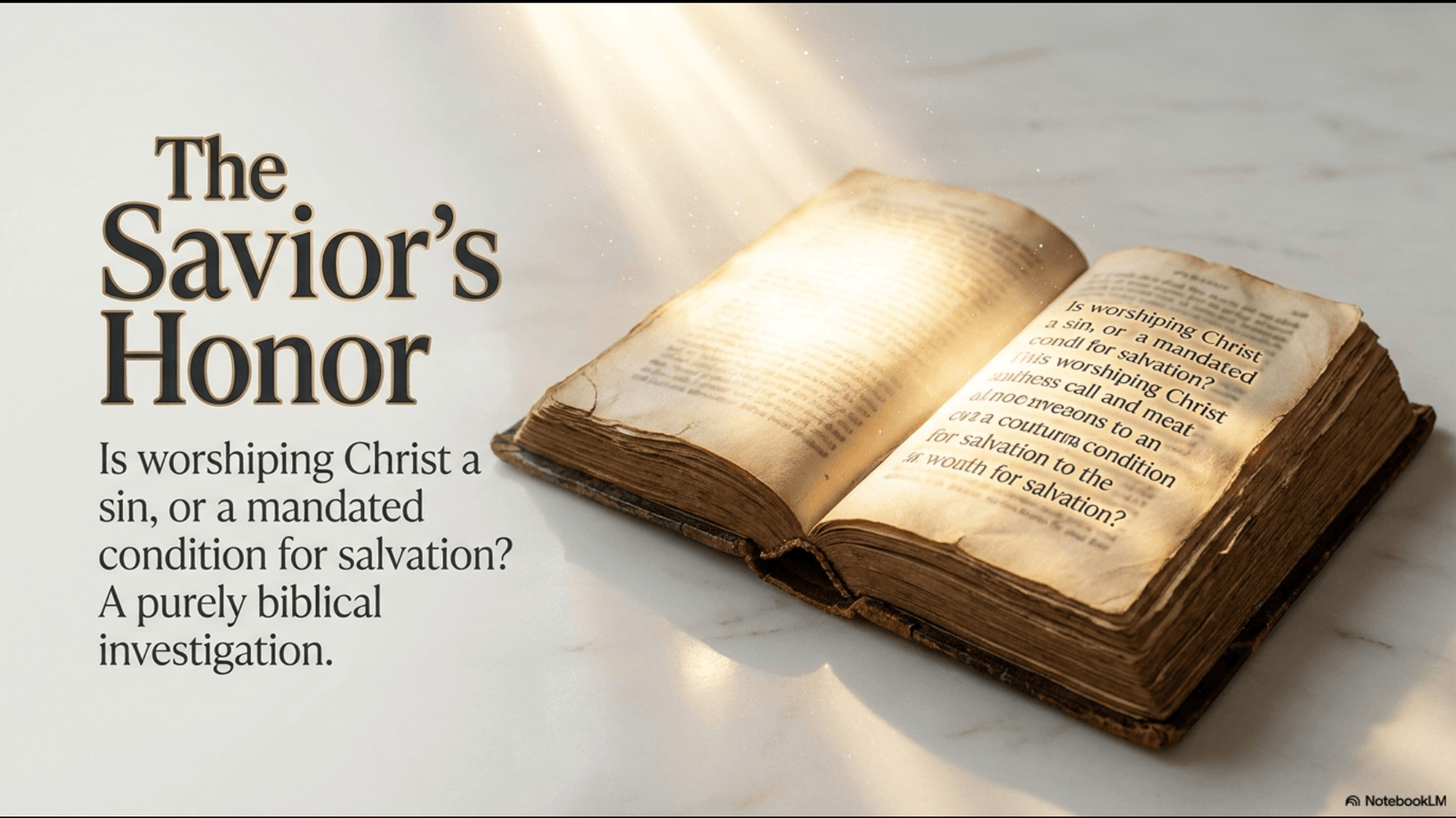
Many believers ask themselves whether bowing down to and honoring Christ is right. The act of bowing itself may physically concern us less today, because we do not meet Lord Yeshu on the street the way people once did, but we have other forms of honoring Him which, in the opinion of many, are reserved exclusively for God – including bowing down. That is why some wonder how they would behave if they met Christ: should they fall to the ground and bow down, or rather speak with Him simply as with someone close.
The second topic, more practical in everyday life, is the question of whether one may pray to Christ and call Him God. We will deal with that today as well. As I have already said – we do not rely on human opinions or tradition, we will look only at what the Word of God says.
I am putting forward a thesis whose correctness you will be able to see for yourselves: the Bible teaches that Yeshu the Messiah is worthy of honor and bowing down just like God the Father, and giving Him this honor is not only permitted, but directly commanded by God Himself. As I announced – there will be only Bible verses here, no philosophy, no bending of arguments. Let’s begin.
To start with, it is worth distinguishing the kinds of bowing down. There were purely courteous bows – given, for example, to kings – which did not have the character of religious honor, just as today a slight nod of the head is only an expression of respect, not an act of worship. However, there were also situations in which God’s servants encountered something that looked like – and truly was – giving them the honor due to God, to the point that they were even taken for deities.
Let us begin with Revelation 19:10, where John describes: “And I fell at his feet to worship him. And he says: «See that you do not do this, for I am your fellow servant and of your brothers who have the testimony of Yeshu: worship God alone!» For the testimony of Yeshu is the breath (spirit) of prophecy.” A mighty angel refuses to accept the homage John offered him, explaining directly that worship belongs exclusively to God.
Similarly, in Revelation 22:8-9 we read: “It is I, John, who hear and see these things. And when I had heard and seen, I fell down to worship before the feet of the messenger (angel) who showed them to me. Then he said to me: «See that you do not do this, for I am your fellow servant and of your brothers, the prophets, and of those who keep the words of this book. Worship God alone!»” So we have it confirmed twice that angels were not allowed to accept honor from people – this is a very important detail, because the Bible also describes cases when someone to whom the people attributed “the voice of God Himself” did not correct it and was punished with death by an angel. So we must be careful not to attribute to ourselves something that does not belong to us.
Since we already know that angels – despite their power and the fact that they represent God as His messengers – consistently refuse to accept worship, it is clear that in heaven this is an extremely sensitive matter. No wonder – some spiritual beings, instead of leading people to God the Father, themselves desired to be worshiped like God. That is why faithful angels are so careful to ensure that not even a shadow of doubt suggests that they too would want to appropriate even a little of the glory due to God.
We see the same thing with the apostles. In Acts 10:25-26 we read: “And as Peter was entering, Cornelius went out to meet him, fell at his feet, and worshiped him. Peter lifted him up, saying: «Stand up, I too am a man».” Since even an apostle – and after all, Christ was also a man – refuses to accept worship, the question becomes all the more justified, whether the bow was due to Christ himself.
Let us first see what He himself said about bowing down. In Matthew 4:10 we read that when Satan demanded a bow from Him – or rather made an offer that if Christ acknowledged him as his master, He would receive in return all the kingdoms of the world – Yeshu answered: “You shall bow down to the Lord your God and Him alone shall you serve.” So Christ himself confirmed that bowing belongs to God, and as the Son of God He should not receive it for himself.
But we are not interested in selected passages of Scripture – we are interested in the whole truth, arising from the entirety of God’s revelation. As we read in 2 Timothy 3:16: “All Scripture inspired by God is also useful for teaching, for convincing, for correction, for training in nobility (righteousness).” Therefore today we appeal to all Scripture to determine whether Christ was allowed to accept honor reserved for God, or not.
Let us begin with Matthew 2:11 – this is the account of Christ’s birth: “They entered the house and saw the Child with His Mother, Mariam; they fell on their faces and bowed down to Him. And opening their treasures, they offered Him gifts: gold, frankincense and myrrh.” Christ as an infant obviously could not protest, and Mariam and Josef – simple, modest people – could have felt lost in the presence of wealthy guests and not reacted. So one could justify this event by the participants’ ignorance. Similarly, after all, when Peter wanted to build tents for Moses and Elijah during the Transfiguration, the Gospel explicitly notes that “he did not know what he was saying” – this is a clear correction. Meanwhile, with the bow of the Magi there is no such reservation at all. And after all, they fell all the way on their faces, just as some today pray with their faces to the ground.
Fine, you will say – Christ was a child then, He could not react. So let us see what happens when He is already an adult. In John 9:35-38 we read about the healed blind man: “Yeshu heard that they had cast him out, and having found him He said to him: «Do you believe in the Son of Man?» He answered: «And who is He, Lord, that I may believe in Him?» Yeshu said to him: «It is He whom you see and who is speaking to you». And he answered: «I believe, Lord!» and bowed down to Him.” The healed man bows down to Christ, and Christ does not stop him at all – He accepts this homage.
Let us go further. Matthew 14:33 – this is the scene after the calming of the storm on the lake: “And those who were in the boat fell down before Him, saying: «Truly you are the Son of God».” Did Christ say: “Do not do this, do not bow down to me”? No – even though He himself was a human, born of a woman, and called himself the Son of Man, He accepted homage from people.
And one more verse – Matthew 28:16-17, already after the resurrection: “The eleven disciples went to Galilee, to the mountain where Yeshu had directed them. And when they saw Him, they bowed down to Him.” And again – Christ does not say: “Do not bow down to me.”
So we see an interesting thing: angels refuse to accept bowing, because it belongs exclusively to God. Christ refuses to bow down to Satan, because it belongs exclusively to God. People – like Peter before Cornelius – refuse to accept bowing, because it belongs exclusively to God. But Christ does not refuse bowing – He accepts it. The question, then, is: what is going on? Could He be God?
I see that Agata is already commenting on this in the chat – she wrote that the angel clearly said that such honor may be given only to God, and she cites Isaiah 45, where God says that only He is God and there is no other. She also adds that all the passages must form a coherent picture – that people bowed down to Christ as the promised Messiah, not as God, and that we too today honor Christ, but not as God, only as Messiah, King and Judge.
Wait, wait, Agata – after all, you yourself admitted that bowing belongs exclusively to God. And yet Christ accepted it. So think about that for a moment longer – we will come back to it shortly, because we still have plenty of interesting verses and you will see how this picture continues to develop. Verses alone, no tradition, no council decisions – only the Bible.
So let us move on. I will open the notes now, because we have before us a key verse that will give some people a lot to think about, and perhaps others not yet – it depends on how you approach the topic. But we absolutely must read it: Philippians 2:6. But before we do that, let us remind ourselves of the context: “Have the same mindset that Yeshu the Anointed had. Who, being in the form of God, did not seize upon the thought that he is equal to God.” And this is an amazing verse, because it says that He by nature, in form, was God. But that does not mean that He placed Himself on an equal footing with God the Father. Do you understand the difference? This is an intermediate verse that probably already suggests something important to us. Why Christ could accept worship – because after all, as you know, in the Old Testament angels are also sometimes called “gods” (elohim). I do not know if you have heard about that. But let us look further. This verse tells us that Christ was in the form of God, but was not God Most High, the Father. And what is very important – He did not claim the right to regard Himself as equal to the Father. So when He accepted the homage that people gave Him, bowing down before Him, He did not at all treat it as making Himself equal to God the Father. This is an important detail for us. Christ remained humble, but evidently had the right to receive bows. Why? Probably precisely because He was in the form of God – not now, when He became human, but earlier, in His original, prehuman nature.
Let us look further, because now we will read the key verse that explains everything. Hebrews 1:6. This is a literal translation, so it may sound a little heavy, but listen: “And when he again brings the Firstborn into the inhabited world, he will say:” – here we know it means the earth – “Let all the Messengers of God bow down to Him!” The Firstborn is of course Christ. So all the angels in heaven are to bow down to Him. And if angels are to bow down to Christ as one bows down to God – because we said that bowing belongs exclusively to God – then how much more we humans? God the Father Himself demands that angels give honor to His Son. In other words, the Father grants the Son the right to receive divine honor – the same that belongs exclusively to God. And now the question: does this also apply to us, humans and other spiritual beings? Is there some hierarchy of beings exempt from this obligation?
Let us look at Philippians 2:9-11: “Therefore God also highly exalted him and gave him the name that is above every name;” People do not understand the weight of this expression – they say: “it is only an ordinary name”. No, the Bible does not say this by chance. “He gave him the name that is above every name; So that at the name of Yeshu every knee should bend, of those in heaven and on earth and under the earth.” All living beings, of course with the exception of God the Father, are to kneel before Christ whose name is Yeshu. All of them – whatever powers, authorities, archons you might name, wherever they may be: under the earth, on the earth, or in heaven. Everyone, except the Father, of course, because that is self-evident – everyone is to kneel before Christ. And it is God the Father who desires this. And yet bowing belongs only to God. God wants His Son to be given divine honor. The key here is verse 11: “And (that) every [each] tongue should confess that the Lord (is) Yeshu the Anointed [Christ], to the glory of God the Father.” Because Christ never acted out of His own vanity or for Himself, but always for the Father. And that is why the Father says: “you are worthy to receive the honor they give Me”.
And now, listen carefully – Agata, try to focus on the lecture now and do not write at this moment, because when you write, you definitely are not listening and you will not understand anything. You mentioned the Book of Isaiah earlier – so let’s check this passage. Isaiah 45:23: “I have sworn by myself; a righteous word has gone out from my mouth, which shall not return: That every knee shall bow to me, and every tongue shall swear.” Who is speaking? It is God YHWH speaking – that before Him every knee will bow. And now the apostle Paul – a person thoroughly familiar with the Scriptures, learned in the law – applies the same quotation to Christ. What in the Old Testament spoke about God YHWH, in the New Testament is applied to Christ by the name Yeshu. This is something many people do not know, and today I am revealing it to you. Prophecies concerning YHWH in the Old Testament refer to Christ in the New Testament. In a moment I will give you several more such examples.
But how is it possible that words about God YHWH are quoted in reference to Christ? I have already given an entire separate lecture on this subject, but today I will briefly recall it. Let us open the Book of Exodus 23:20-21: “Behold, I am sending an Angel before you, to guard you on the way, and to bring you to the place that I have prepared for you.” God says this to Israel. “Be careful before His face; and listen to His voice; do not provoke Him, for He will not forgive your transgressions, for my name is in Him.” So in the Old Testament there appears an angel sent by God, who carries within himself the name of God. Do you know what that means? Of course – this is Christ. It is Christ who is that angel who in the Old Testament is called God YHWH. You do not believe it? Christ Himself said that no one has ever seen God the Father or heard His voice. And yet Abraham spoke with three angels, one of whom – as the Bible says – is directly called YHWH. He negotiated with him the fate of Sodom, asking whether God would spare the city if the right number of righteous people were found in it. And the Bible clearly states that this was a conversation with YHWH. And that was, of course, an angel who had the right to bear the name of God YHWH. This is crucial for you to understand – because that angel was precisely Christ. Christ received worship in the name of God YHWH already in the Old Testament. Exactly the same worship that belongs to the Most High God.
It is very important that we realize this. And now let us see. The Book of Isaiah 40-3: “The voice of one calling in the wilderness: Prepare the way of YHWH, make straight in the wilderness a road for our Gods.” In the original Hebrew the word “Elohim” is used here in the plural. This passage is quoted in the New Testament: “prepare the way of the Lord” – and in the Old Testament it says directly: “prepare the way of YHWH”. The prophet Malachi speaks in a similar tone. You probably already know who the one was for whom the way was being prepared? We will explain that in a moment, but let us look at the second passage in Malachi 3:1: “Behold, I am sending my Messenger [angel], who will prepare the way before my person [face], and suddenly the Ruler whom you seek will come to his temple, and the Messenger [angel] of the covenant, whom you desire; behold, he is coming, says YHWH of hosts.” God YHWH says that He is sending an angel who will prepare the way – for Himself. So who is this YHWH when He comes to earth? And who is that angel-messenger? Malachi says that the Ruler whom the people seek will suddenly come to his temple – the Angel of the Covenant.
And now look – in the New Testament there are several verses that clearly show who the person preparing the way for YHWH was. You already know who it was, right? So the question is: who was YHWH Himself? People somehow do not notice this at all. Because we know who prepared the way – it was not Yeshu preparing the way for YHWH. Let us look at the Gospel of John, 1:23. When they came to John the Immerser, they asked him who he was, so that they could give an answer to those who had sent them. He answered: “I am the voice of one calling in the wilderness: Make straight the way of the Lord, as the prophet Isaiah said” – and in the original we know that this refers to YHWH – just as the prophet Isaiah said, whom we read a moment ago: “Prepare the way of YHWH, make straight in the wilderness a road for our Gods.”And John says that he is the one who makes this path straight. So the question is: who is YHWH, and when did he come to earth? I fear that some are afraid to say the obvious. Christ came to earth. Except not under the name YHWH, but under the name Yeshu, meaning Savior. And many people have a serious problem with this, because it turns their previous faith upside down. They are not aware that Christ was present the whole time – he simply is not seen directly in the Old Testament, because he appeared there under the name YHWH. And as I have already said, the prophecies concerning God YHWH in the New Testament are presented as referring to Christ.
It is similar with the Book of Joel. We read there: “Everyone, however, who calls on the name of the Lord – that is, the name of YHWH – will be saved.” And the apostle Paul in Romans 10:13 applies the same words to Christ: “For everyone who calls on the name of the Lord will be saved.” Exactly the same words. Therefore Jehovah’s Witnesses commit falsification by inserting the name “Jehovah” into this passage. I suppose no one has ever told you about this? I have not come across anyone explaining this to you. And it is very important for you to understand that Christ received divine honor already in the times of the Old Testament. And now the Father wants Christ – appearing now under His own name – to continue receiving honor, and divine honor at that.
Let us now move on to 1 Corinthians, and then to prayer. Maybe I will still look at one passage for a moment, but yes – Christ came in the name of the Father. And now, Agata, so that you can focus, maybe I will block your ability to write in the chat for five minutes. Or no, I will not block you, but please, just do not write now, just focus. Humility is really needed here in order to understand this, and you must think it through carefully. We know that no one has ever seen God the Father, and yet God YHWH was seen – Abraham spoke with Him. You ask where it is written directly that this angel was Christ? I read you a verse that speaks of an angel bearing God’s name – remember? “My name is in him” – that is what God says. So God Himself informs us that there is an angel who uses His name. Further we read: “prepare the way of YHWH” – this wording can be translated and interpreted in different ways. But that is precisely the point, Agata: let us not try to bend the text to our own ideas, but accept what Holy Scripture tells us directly. Let us not change the content of the Bible to fit a preconceived ideology – let us accept what it reveals to us, even if it overturns our previous beliefs.
Let us go further. We now move on to the subject of prayer. Is it permissible to pray to Christ? To this question Holy Scripture gives strong, unambiguous evidence – it only takes a humble mind to accept it without resistance. Let us open 1 Corinthians 1:2. “To the assembly of God that is in Corinth, to those sanctified in Christ Yeshu, called to be holy, with all who call on the name of our Lord Yeshu the Anointed in every place, both theirs and ours.” So the congregations, that is, the assemblies of God, called on the name of our Lord, Yeshu. Now think about how to imagine this – that they go to some mountain and call out: “Yeshu! Yeshu!”. I once met someone who understood it exactly that way. Fine, but let us think more deeply about what such calling on a name actually means. Yeshu is in heaven – so what are you doing then? You are praying to Him. You are simply calling on Him, trying to get His attention, asking Him to hear you. And that is precisely prayer.
So that you have no doubts about this, I will give you biblical proof that calling on the name is nothing other than prayer. Let us turn to 1 Kings 18:24-26 – this is the well-known account of the event with the prophet Elijah. Elijah says there to the prophets of Baal: “Then you will call on the name of your gods, and afterward I will call on the name of YHWH, so that it may be shown that the God who answers by fire is [truly] God». All the people, answering this, cried out: «Good idea!» So Elijah said to the prophets of Baal: «Choose for yourselves one young bull and begin first, because you are more numerous. Then call on the name of your god, but do not set fire to it!» So they took the bull and prepared it, and then called on the name of Baal from morning until noon, crying: «O Baal, answer us!» But there was neither voice nor answer. So they began to dance, kneeling down by the altar they had prepared.” And what did Elijah do? Verses 36-37: “Then at the time of the offering of the grain offering, the prophet Elijah came forward and said: «O YHWH, God of Abraham, Isaac, and Israel! Let it be known today that You are God in Israel, and that I am Your servant and have done all this at Your command. Hear me, O YHWH! Hear me, so that this people may understand that You, O YHWH, are God and that You have turned their heart back.”
So you can clearly see: calling on the name is simply prayer. The prophets of Baal prayed to Baal, and Elijah prayed to YHWH. Likewise, the congregations of God in Corinth, converted by the apostles, called on the name of our Lord, Yeshu – that is, they prayed to Him. This is biblically proven. That is why in Acts 7:59, we have a clear example of a prayer addressed directly to Christ: when Stephen was being stoned, he prayed with the words: “Lord Yeshu! receive my spirit!”
Someone may say: but he saw Him, he had a vision. That is true – but it does not change the fact that Stephen saw both God and Christ at the same time. He saw the glory of God, and yet he prayed not to the Father, but to the Son. After all, we read: “Behold, I see the heavens opened and the Son of Man standing at the right hand of God.” So he sees both – the Father and the Son – and he prays to the Son. I will explain to you in a moment why he did that. But one thing at a time, because this is a very important topic – if you do not honor the Son, it is as if you do not honor the Father. That is exactly why Satan is working so hard to separate us from Christ, to dig a chasm between us and Him.
And now look at another extremely important passage – the Gospel of John 5:21-29, where we read: “For just as the Father raises the dead and gives them life,” – focus, this is crucial – “so also the Son gives life to those whom He wants.” Whomever the Son wants – He will raise from the dead. Further: “For the Father judges no one, but has entrusted all judgment to the Son,”. That is, God said to the Son: “You decide who will rise from the dead, you decide who will bear responsibility”. Why did God do this? The next verses explain: “so that all may honor the Son, just as they honor the Father.” This is precisely the reason. Stephen, as he was dying, knew that Christ would decide about his resurrection, because God had entrusted all authority to judge to Him. That is exactly why he prayed to Christ, entrusting his spirit into His care – because God gave the Son this authority precisely so that all would honor Him equally with the Father.
Some people argue about the word “honor” itself, claiming that it only means “respect”. But this does not change the essence of the matter – whether we call it honor or respect, in the Greek original the same word is used in both cases. Some translators deliberately differentiate the translation: they render the same Greek word in reference to God as “honor”, and in reference to Christ as “respect” – only to diminish His rank. And yet it is exactly the same word, also used in the context of honoring parents. I have studied this subject and I believe that the most precise equivalent is the word “honor”. But regardless of what word we use, the meaning remains the same: God says that just as you treat Him, you are to treat His Son in the same way. And Satan says: “No, I do not allow that. I must forbid people from showing such respect, because supposedly it detracts from the Father”. Well, it does not detract – the Father Himself desires this, and that is why He gave the Son all authority to judge. The Son will raise whomever He wants, and God does not interfere in it. All of this is written in the Bible – it is just rarely spoken about, because people defend their established doctrines. I did not accept any such doctrine in advance – I simply opened the Bible and searched for the truth. And I want to share that truth with you.
Let us read on, because this is only the beginning: “so that all may honor the Son, just as they honor the Father. Whoever does not honor the Son does not honor the Father who sent Him.” That is exactly why Satan spread the teaching that a certain kind of honor must not be shown to the Son, but only to God Himself. Meanwhile, God has handed everything over to the Son. “Amen, amen, I say to you, whoever hears my word and believes (the One who) sent Me has aeonian life” – that is, life without end – “and does not go into judgment, but passes from death to life.” This is what Christ promises. If you believe this, I guarantee you – Christ says so, because it is He who decides who will live and who will not – that you will not even stand before judgment. Immediately after death, you will pass into eternal life, without judgment. You must, however, believe these words.
“Amen, amen, I tell you, the hour is coming, and is even now here, when the dead will hear the voice of the Son of God, and those who hear will live. Just as the Father has life in himself, so he also granted the Son to have life in himself. He gave him authority to execute judgment, because he is the Son of Man. Do not be amazed at this! For the hour is coming in which all who rest in the graves will hear his voice: and those who did good deeds will go to the resurrection of life; those who did evil deeds – to the resurrection of condemnation.” And Christ further emphasizes that he does nothing by himself – but that does not change the fact that he received this authority from the Father. And why did God give it to him? So that, “all may honor the Son just as they honor the Father” – so that everyone would treat the Son as they treat God. Let us call things by their proper name, without any linguistic stretching – that is exactly the meaning of this statement. God accepts worship only through the Son. If someone wants to worship him while bypassing the Son – as in Judaism, for example – they have no chance. God will not accept it. These are the conditions established by God himself. And this is not about some “lesser” honor – the Son is to be honored exactly as the Father is honored.
And when it comes to honoring the Son, let us return once more to the Book of Revelation, chapter 5 – it is precisely there that it is explained why Christ receives such honor. Some theologians claim that this happens because He humbled Himself – but here, from the perspective of heaven itself, it is revealed what Christ earned by His deeds, thanks to which he received such great glory and was raised almost to a divine rank. This does not change the fact, however, that He is not equal to the Father – let us remember that. He is exalted because of His merits, not His very nature. It is through service to God that God makes Him equal with Himself in glory. Revelation 5:11-14: “And I saw, and I heard the voice of many messengers(angels) around the throne and the Living Creatures, and the Elders, and their number was thousands of thousands, speaking with a loud voice: «The slain Lamb is worthy to receive power and wealth, and wisdom, and strength, and honor, and glory, and blessing».” I will explain why in a moment. “And every creature that is in heaven and on earth, and under the earth, and on the sea, and everything that dwells in them, I heard saying: «To the one seated on the throne and to the Lamb be blessing and honor, and glory, and power, for eons of eons!» And the four Living Creatures said: «Amen». And the Elders fell down and worshiped.”
Heaven bows before Christ, and Christ sits on the throne together with the Father. Who is bothered by Christ receiving such honor, by God seating him on his throne and commanding everyone to give him glory? Satan, of course. That is why there are religious groups that spread false teachings, instilling in people fear of praying to Christ – fear of fulfilling this very condition, fear of calling on His name. They are afraid that it will supposedly offend God, while in reality God is demanding exactly that.
There are verses in the Bible that speak directly of Christ as God and Lord at the same time, although the context clearly shows that one person is meant. They are deliberately twisted, just so as not to give Christ the honor due to God. A classic example is the famous passage from the Gospel of John, chapter 20 – the one that is a thorn in the side of everyone who does not want to worship Christ and obey God’s command.
Gospel of John 20:28: “Thomas answered him: «My Lord and my God!” Christ did not protest, did not say “what are you saying”. The evangelist also did not consider it necessary to explain what Thomas meant – he simply conveyed these words directly. Only later did people begin to philosophize that it meant something else, inventing various theories. If it had actually meant something else, John would have corrected it so that we would understand properly. Meanwhile, the text was conveyed without any corrective comment. Thomas simply understood who Christ really is – the Son of God,who came from heaven and possesses a divine nature. That is why he spoke these words: “My Lord and my God”. And Christ answered: “Have you believed because you have seen Me? Blessed are those who have not seen and yet have believed.” – believed precisely that He is Lord and God.
God desired that Christ, His Son, sit together with Him on the throne. This means that He receives the same glory that the Father receives. Naturally, there will be people who will try to deny this or distort the meaning of these verses with other passages. Notice – opponents of prayer to Christ will never reveal to you that calling on the name of Yeshu is precisely a form of prayer. They will twist and scheme, just to avoid fulfilling this condition of salvation. They will also distort other verses, even in the translation itself, giving the words a meaning somewhat different from the original.
That is exactly why people argue over words – the Bible has become a field of verbal disputes. The reason is simple: everyone defines a given word in their own way and claims that since the Holy Spirit wrote it down, it means exactly what that person imagines, drawing complicated conclusions from it. Meanwhile, what matters is not how we define a given word, but how the one who spoke it understood it – and this we often simply do not know. Therefore, the whole of Holy Scripture must be taken into account, and not one verse torn out of context and used as a basis to invalidate all the others.
One such verse that some people cite is the Gospel of John 17:3. I will quote it first in the translation of the Catholic Bible, so that you understand why they refer to it:
“And this is eternal life: that they may know You, the only true God, and the One whom You sent, Yeshu Christ.”
On this basis, some claim that the only true God is God the Father, separate from Christ. I agree – the Father really is a distinct person from the Son. The problem, however, lies in the word “only”, which is somewhat stretched here in translation.
Even the famous confession of faith, that “God is one” (Deuteronomy 6:4), in the original contains the word Elohim – plural. “Gods are one.“ The matter is similar with the verse under discussion. Let us turn to the Greek original to see what word was actually used and translated as “only”.
In the Greek text we find the word “monon” – there is no mention there of “only” in the sense of a numeral, but of an adjective meaning: alone, only, merely, just, single. The main meaning of this word points to solitude, distinction – something like “one of a kind”.
It is worth noting how the same word is translated in other places in Scripture. For example, in the verse “man does not live by bread alone” – no one translates this as “not by one bread”, but precisely “not by bread alone”. How many loaves of bread exist at all is not the subject of consideration here – what matters is the meaning “only”, “alone”.
Taking into account the most common meaning of this word, this verse could be translated more literally as follows:
“And this is eternal life: that they may know You, the true God alone, and the One whom You sent, Yeshu the Anointed.”
The meaning is therefore this: you will know the one, true God. Meanwhile, opponents of Christ’s divinity rely on the claim that the text speaks of God as the only one in a numerical sense. Yes, if we are talking about God Most High – such a term also appears in the Bible – then He is indeed one. However, the Old Testament also calls people gods. Christ Himself, in a dispute with the Pharisees, cited Psalm 82, where judges who had power over life and death were called gods. The word “god” was therefore also used for people. But when we speak of the one, highest God, the Father – we mean only Him. So the key is understanding the context, not arguing over individual words and on that basis invalidating a whole series of other verses in which Christ is called God.
Even Jehovah’s Witnesses cannot deny that in the Gospel of John Christ – as the Word – is called God: “The Word was with God, and the Word was God.” Because of this, they invented the concept of “god” written with a lowercase letter, although in antiquity such a distinction simply did not exist – God was God. Christ, however, is not God Most High or God the Father, although there is a verse saying that in the future His followers will become His children (the Book of Revelation) – but this concerns a future eon, which is still more than a thousand years away from us.
Another verse often cited, mainly by Jehovah’s Witnesses, is 1 Corinthians 8:6:
“But to us there is one God the Father, from whom are all things and we to Him, and one Lord Yeshu the Anointed, through whom are all things and we through Him.”
On this basis some claim that since there is only one God and one Lord, they cannot be the same person as Christ. However, to understand the context, let us go back to verse four:
“As for foods dedicated to images, we know that images in the world are nothing and that there is no {other} god except One. Although they are in fact called gods, whether in heaven or on earth, so there are many gods and many lords, yet to us there is one God the Father, from whom are all things and we to Him, and one Lord Yeshu the Anointed, through whom are all things and we through Him.”
Now let us analyze this logically. God the Father truly is only one – there are not two Fathers. There is one God the Father, and there is the Son of God, who is also called God – for example in the first chapter of the Gospel of John, where Christ is described as the only-begotten God, that is, having a beginning, the Father’s only child.
But see how inconsistent it is to cite this passage as proof that Christ cannot be called God. First, it clearly speaks here of God the Father, and indeed one Father exists. But even if the verse said only “God is one”, without adding the word “Father”, that would not change the fact that there are many other biblical verses in which Christ is called God.
Following the same line of reasoning further – the verse also speaks of one Lord, who is Yeshu. And yet there is a whole mass of biblical passages in which God the Father is also called Lord. So those who claim that the above verse proves that Christ is not God should – according to that same logic – also conclude that God the Father is not Lord. And of course we know that this is not true. One must be faithful to logic, not twist it and not do violence to it – one must be consistent. We have already dealt with this objection, so let us move on to the next supposed argument.
It is claimed, namely, that Christ taught people to pray only and exclusively to the Father. Yes, we have one such example – the disciples ask Him: “Teach us to pray”, and He indeed teaches them a prayer addressed to the Father. But it is not true that only to Him. I will prove that to you in a moment.
Let us turn to the Gospel of John, chapter 14. These are Christ’s teachings delivered just before His death, probably after leaving the Upper Room, on that final night. John then recorded many important things – Christ’s final instructions before His death. And it is precisely there that the thread we are interested in appears – John 14:13-14, it is very much worth remembering.
“And whatever you ask in my name, I will do, so that the Father may be glorified in the Son. If you ask me for anything in my name, I will fulfill it.”
Let us consider: if we pray, invoking the name of the Son, who will hear that prayer? The answer is: Christ himself will hear it, if it is offered in His name. But then we read even more clearly: “If you ask me for anything in my name, I will fulfill it.” So if we pray to the Father in the name of our Lord Yeshu, Christ hears it, because He is the one who receives it. But if we pray directly to Him, calling on His name – He will also hear us. “If you ask me for anything” – here there is a direct mention of calling on the name of the Lord Yeshu. For how else could we ask anything of Christ reigning in heaven?
Let us now move on to the Letter to the Romans, chapter 10:11-13. The apostle Paul writes: “For the Scripture says: Everyone who believes in Him will not be put to shame. For there is no distinction between the Judean and the Hellene, because the same Lord is Lord of all, rich toward everyone who calls on Him.” And we know, after all, that this Lord is Christ – so we are to call specifically on Him. Paul continues: “For everyone who calls on the name of the Lord will be saved. How are they to call on the one in whom they have not believed? And how are they to believe in the one of whom they have not heard? And how are they to hear without someone preaching?”
This is a direct reference to the Book of Joel, where it is written that everyone who calls on the name of YHWH will be saved. Paul now applies this promise to faith in Christ – this is clear in the following verses, where he speaks of those who did not believe, that is, of the Jews. And yet they believed in YHWH – what they did not believe in was Yeshu. The conclusion is simple: Satan knows perfectly well that Christ has the power to save whomever He wills, by grace, but He sets certain conditions – one of them is precisely calling on His name. That is why Satan does everything so that you will not do this, and in many different ways.
One such way is to slip in a false name in place of the true one – so that, even when praying to Christ, you would call on another name. And here we come to the key verse – Acts 4:12. Peter speaks there about the miracle performed in the name of Christ: “He is the stone that was rejected by you, the builders, which has become the cornerstone. And there is salvation in no one else,“ – he says this about Christ. And immediately afterward he adds: “nor has any other name under heaven been given among people by which we must be saved.“
So there are not many names. Satan first replaced this name so effectively that today even adherents of the same religion, in different corners of the world, call on different names – and most of them, unfortunately, call on false names, because they cannot all be right, since they call on different deities. Secondly, if someone were to succeed in learning the true name, Satan at least tries to make people stop praying to Christ altogether. A double safeguard.
Meanwhile, Christ and the apostle Paul clearly say: “whoever calls on His name will be saved.” These are words that can save your lives. After all, we know that when Christ comes, many believers will experience disappointment, because they will hear: “I do not know you. Depart from Me.” And they will not understand why. And yet the conditions are very gentle, even not difficult – is it really so hard to pray to Christ? So hard to show Him respect? So hard to use His true name, especially once you already know it?
Just as the Judeans were resistant and did not want to listen to the apostles, so today many people are resistant and do not want to verify their views – because they think they are the smartest in the world and that everything they come up with themselves must be right. Yet the Bible teaches unequivocally: Yeshu the Messiah is worthy of honor and worship on an equal footing with God the Father, and giving Him this honor is not only permitted – it is even commanded by God Himself.
I know that voices still appear discouraging the worship of Christ. There are also people on the other side – treating Him like God the Father Himself, believing in the Trinity. The truth lies in the middle: Christ is not God the Father nor equal to Him. Look at the Book of Isaiah 43:11 – YHWH says: “There is no other Savior besides Me.” And here comes Christ, bearing a name that means precisely “Savior”, and whoever believes in that name will be saved. Christ Himself said clearly: “Whatever you ask Me, I will do it” – but in His name, that is, the true one, not a false one.
I know that some try to undermine individual texts and manuscripts – the problem is that they do it selectively, accepting what fits their private doctrine and rejecting the rest. That is not seeking the truth, that is seeking confirmation of their own beliefs.
Let us note Revelation of John 1:1: “The revelation of Yeshu the Anointed, which God gave Him, showing His servants what must take place soon [quickly], and having sent signs through His Messenger [angel] to His servant John.” An interesting hierarchy can be seen here: God passes the mystery to Yeshu, Yeshu sends a messenger – an angel – to the prophet, the prophet receives the revelation and writes down the book, and thanks to this we know what will happen.
In chapter 21 there is a particularly interesting passage – concerning the fact that Christ will in a certain sense become the “Father”. At present He fulfills the function of Savior and bears the name Yeshu, but in the future He will take the name Immanuel – God with us. The role of Savior will then come to an end, and He will dwell among people. It is not God the Father who will dwell on earth, but Christ Himself – chapter 21 of Revelation speaks of this.
We read: “I saw a new heaven and a new earth, because the first heaven and the first earth had passed away, and the sea was also no more. I saw the holy city — new Jerusalem. I saw it coming down out of heaven, from God, prepared like a bride adorned for her husband. I heard a mighty voice coming from the heavenly throne, crying: ‘This is the dwelling place of God among people,‘“ It is Christ Himself who will descend to earth to dwell among His people – He will be their God, and they will be His people. He will bear the name Immanuel – God with us. “He will wipe every tear from their eyes, and death will be no more, nor will there be sorrow, nor despair, nor suffering anymore, because what was before has passed away.”
Let us go further: “The One seated on the throne declared: ‘Behold, I make all things new‘. And He said to me: ‘Write: These words are true and worthy of faith.’ And He said to me: ‘It is done.‘“ Who is this One seated on the throne? “I am the Alpha and the Omega, the beginning and the end. To the one who thirsts I will give freely from the spring of the water of life.” We recognize Christ here – after all, it was He who promised to give such water. “The one who conquers will receive his share in all this, and I will be his God, and he will be my son.” Times will come when the Father will give the Son the whole earth and the whole heaven. And the Son is currently working toward this – He had to come to earth, die, and redeem us with His blood in order to gain the right to us.
So, Agata, I will put it this way: Either you acknowledge the Holy Scripture as inspired by God, or you do not. Today we have brought up truly extensive biblical argumentation. There is one more interesting verse here, in chapter 22:6: “And he said to me: «These words are trustworthy and true, and the Lord, the God of the breaths (spirits) of the prophets, sent His messenger (angel), to show His servants what must soon take place.” The Lord, the God of the prophets – who is this God who sent the angel? After all, we read the first verse of the first chapter: it was Christ who sent the angel to John. And here it is written that it was the Lord God of the prophets who sent his angel.
That is not all yet – there is something further on, and this is already decisive. Look: “I, Yeshu, have sent my Messenger [angel], (to) testify these things to you in the congregations. I am the root and offspring of David, the bright morning star”. “I, Yeshu, have sent my Messenger [angel]” – and yet verse six said: “The Lord, the God of the breaths (spirits) of the prophets, sent his messenger (angel).” The conclusion is unambiguous: Christ is that God of the prophets, the God of prophetic spirits. Besides, there is another verse, which I will not quote from memory at this moment, saying that the prophets who foretold the coming of the Messiah to earth had precisely the Spirit of Christ.
Today we are talking about the prophets of the Old Testament, and specifically about the fact that the very spirit of Christ conveyed his revelations to them. Look here – we have beautiful proof of this in 1 Peter 1:11: “They inquired into which or what time the Breath [spirit] of the Anointed One present in them – that is, the Spirit of Christ, was indicating, foretelling the sufferings that would befall the Anointed One and the glory that would follow them.” The prophets themselves tried to decipher what the Spirit of Christ conveyed to them through prophecy. And all prophecies were conveyed precisely by the Spirit of Christ, that is, His Angel.
I will remind you of the principle resulting from the first chapter of Revelation, because many people simply do not know it: the Revelation given to the Anointed One Yeshu by God testifies to the fact that Christ Himself is not able to predict the future. That is why no one knows the day and hour, not even the Son of God – until God reveals it to him. But when God reveals something to his Son, he passes it on to his servants through the Angel – the Holy Spirit, who comes and gives a vision, and sometimes even meets a person face to face, just as the Angel Gabriel met with the prophet Daniel.
Christ is the image of the invisible God, and God is so pleased with Him that He demands of us, humans, that we honor the Son just as we honor the Father. And He does not accept honor from those who bypass the Son.
As for the Gospel of John – not Revelation, but precisely the Gospel – yes, many verses are the subject of dispute, but this first one cannot be refuted, no matter how much one tries to bend it. Even Jehovah’s Witnesses struggle with this, which is why they write “god” there with a lowercase letter: “In the beginning was the Word, and the Word was with God, and the Word was God. It was in the beginning with God.” Already at this point, then, we are clearly speaking of two Gods.
There is one more interesting verse here: “No one has ever seen God, the Only-begotten God [Son], who is in the bosom of the Father, (about Him) instructed.” That is, a God who has a beginning, because after all He is begotten. “Only-begotten” is a clever word – in Greek it also appears in reference to people in the Gospels and simply means “an only child”: an only son or an only daughter. So here we have the only Son of God, close to the Father, who helped us know Him – and yet He is called the only-begotten God. Of course, the interpretation of this verse is also disputed, but no one is able to refute the first verse of the Gospel of John, however much they philosophize.
Here also fits 1 John 5:20: “And we know that the Son of God has come and has given us understanding, so that we may know the true God, and we are in the true one, that is in His Son, Yeshu Christ; this one is the true God and aeonian life.”, or in other words eternal life, without end. This is an interesting but difficult verse – there is also a dispute over its proper translation. However, we see that there are verses in which Christ is simply called God.
Agata asked how I know that in the Old Testament Christ appeared as that Angel. I have already devoted several articles and videos to this. An interesting thing is that the Bible itself nowhere states this directly – it is our conclusion, resulting among other things from the subject of the angel bearing the name of God (I recommend it, because there I give more details and more verses). From it we learn that there was only one such angel, the one and only. There are also verses saying that this Angel led Israel and they were to listen to Him, while at the same time another verse says that the Israelites drank in the wilderness from the rock, and that rock was Christ. This clearly suggests that the Angel leading them was in fact Christ. There are many more such clues.
Additionally, around 135 AD, that is roughly a hundred years after His death, the Christian Justin Martyr – who later himself gave his life for the faith – held a discussion with the Jew Trypho. In it he argued that it was Christ who, as YHWH, visited Abraham. This was very close to apostolic times, only a few decades later, when the great apostasy that occurred after three hundred years had not yet happened. So Christians knew this, although unfortunately it was not written directly in the New Testament, which is why we have to infer it in various ways.
All right, we will slowly wrap up. Beata also cited Revelation 1:4-6 – I will put it here: “John to the seven Called Communities that are in Asia: Grace to you and peace from the One Who is, and Who was and Who is coming, and from the Seven Breaths (Spirits), which are before His throne, and from Yeshu Christ, the Faithful Witness, the Firstborn of the dead and the Ruler of the kings of the earth. To Him who loves us and who through His blood freed us from our transgressions (sins), and made us a kingdom – priests for God and His Father, to Him be glory and power for the eons of eons ! Amen.” This is a very interesting topic, which I have already discussed among brothers and sisters: what will we be doing during the thousand-year reign of Christ? The Bible gives truly interesting indications on this subject.
There is also verse 1:8: “I am the Alpha and the Omega, says the Lord God, Who is, Who was and Who is coming, ruler of all [sovereign over all].”
Thank you for today’s meeting. The topic was really very important, because many people have fallen for Satan’s deception. I will tell you more: this deception is truly incredible. I myself was one of Jehovah’s Witnesses, as you know, and I left them – first unofficially, because I felt there was no Spirit of God there, although I did not yet have hard proof. The proof showing that this is a religion evil in its essence I found, I think, in 2008, and then I formally submitted a letter of resignation. Why? Because I discovered that the name “Jehovah” is in essence the name of Satan. They pray to Satan, of course completely unknowingly. So it is no wonder that it is a hypocritical, Pharisaic religion – pretending to holiness, although it lacks it.
I will briefly say why I consider this name to be the name of Satan. The Witnesses claim that “Jehowah” (because that is how it is written in English) comes from the verb “havah” (Strong H1934) – “to become”, which is supposed to testify to God as Creator. However, they hide the fact that there is also the noun “hovah” (Strong H1943), sounding almost identical to “Jehowah”, meaning “being a destroyer”, “troublemaker”. When I discovered this, I could no longer identify with these people. I was certain beyond any doubt that I had to flee this organization, because people there pray to Satan, thinking they are praying to God the Father. That is exactly how Satan is able to deceive. The same religion also caused,that people are afraid to pray to Christ, because they have been made to believe that it is a sin, that it brings dishonor to the Father. Looking at this anti-biblical teaching, I become even more convinced that this is an organization created by satan – although of course the faithful themselves are deceived and unaware of this fact.
The same, unfortunately, applies to the name “Jesus” – I know that many people will disagree with me, but that is your problem, I am merely informing you, and what you do with it is your decision. The name “Jesus” is the name “Zeus” – it means “being Zeus”, “the one who is Zeus”. It has nothing to do with the Bible or the true Christ.
Thanks for listening until the end. I would be extremely grateful for likes, shares and comments, because it helps grow the channel, which gives a chance to reach even more people.
The full written version of the article is now available at yeshu.blog . There you will also find my videos and music — all created in the name of our Lord Yeshu.
If you receive the gift of faith in the name of our Lord Yeshu, take the next step and contact me to be immersed in the name of Yeshu. You can find contact details on our website or simply write on Messenger.
Glory to Yeshu!!!