Introduction: why I stand in the middle
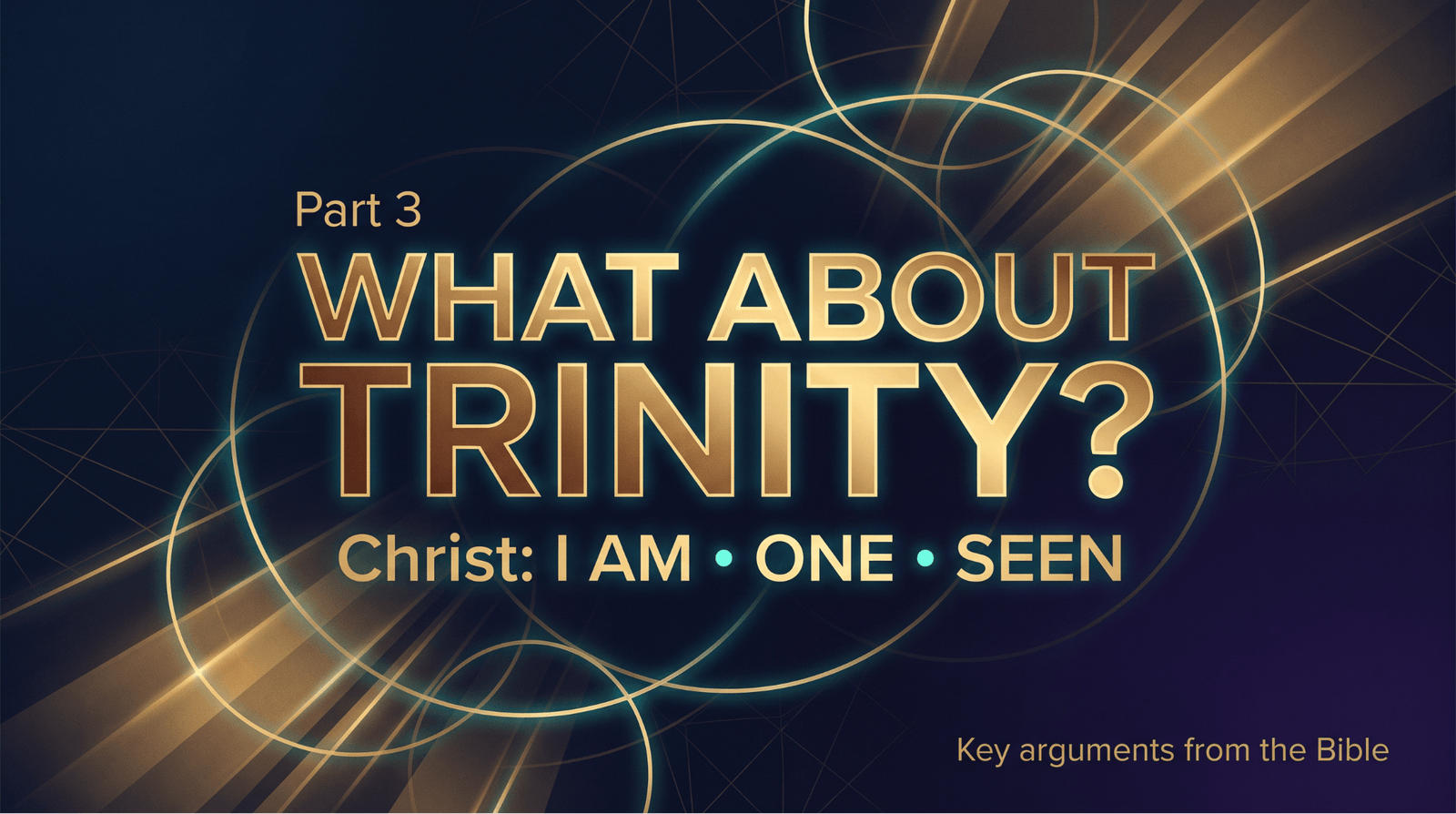
We talked a week ago about how in the Bible we can find places where Christ is called God. I must tell you honestly that I am in a rather uncomfortable position, I am getting, as they say, it from both sides at once. And interestingly, I am trying to help both sides, although they are strongly hostile to each other: Trinity supporters versus Trinity opponents.
Why do I say I am in the middle? Well, I am not a supporter of the Trinity. To one group I explain that the Son of God is not equal to the Father, and the Bible really says that very clearly. To the other group, in turn, I try to explain that you must not deprive Christ of the honor due to Him by denying Him the right to be called God.
That is why I ask for your understanding. When I read your comments, I do not always immediately know which side the accusation is coming from. So it may happen that I miss the point with an argument, I will answer as if I were talking to the other group, while I am talking to the first one. Please keep that in mind.
I hope that last week you really saw how many places there are in the Bible where Christ is called God. In some popular verses from the New Testament, alternative translations have already been developed to make it come out differently, like that trick with “God is the throne”. But there were also verses from the Book of Revelation that almost nobody knows, there Christ is called “the God of the Spirits of the Prophets”. It is clearly said that this God sends His angels with prophecies, and a few verses later we read that it is Christ who sends those spirits with prophecies. There really are lots of arguments like that which cannot be refuted.
“I am” in the garden, was that a declaration of divinity?
Today we will start with Christ’s words: “I am”. Some people think that by saying them, and He said them several times, Christ was, as it were, signing Himself: “I am the God YHWH”. Let us see whether that holds up.
John 18. Before we read the fifth verse, let us look at the context: “Then Yeshu, knowing all the things that were coming upon Him, went out and said to them, ‘Who are you looking for?'”
Imagine this scene. Night. An armed unit is coming, I will not call them a gang, because in a sense they are lawful authority, to arrest a supposed criminal. And suddenly a man comes up to them, boldly steps in their way, and asks, “Who are you looking for?” They answer, “Yeshu of Nazareth.” He says, “I am.” And Judas, who had betrayed Him, was standing among them. “So when He said to them, ‘I am,’ they drew back and fell to the ground.”
How is this usually interpreted? That Christ said “I am YHWH” and they fell in fear. Honestly, that does not fit for me, and for two reasons.
First, God did not introduce Himself with the words “I am” at all, but a little differently, we will come back to that. Second, one would have to assume that those simple soldiers were biblical theologians and knew perfectly well what expressions God used of Himself in the Scriptures. Meanwhile, some of them probably could not even read or write. It was not as it seems to us today, that everyone knew the Bible so well.
There is a much more natural explanation, and for me an obvious one. You may sometime come across modern instructions: if you are standing opposite a potential opponent and it turns out to be an actual enemy, you must step back. Why? Because if you are too close, you will not have time to react to a blow. I suspect that is exactly what happened: the people with the unit came too close, realized it, and wanted to step back. And they were standing one behind another, so one stumbled over another, someone fell, and there was confusion. Peter, in fact, a moment later took advantage of the chaos, grabbed a sword, and struck one of them. They were simply startled by the situation, and that is how I read it.
“Before Abraham came into being, I am”
Before I explain why I read it that way, let us look again at John 8:58: “Yeshu said to them, ‘Amen, amen, I tell you, before Abraham came into being, I am.’ They therefore picked up stones to throw at Him. But Yeshu hid Himself and left the temple.“
By the way, remember one important thing: Christ says here that He already existed before Abraham appeared. That was His point – that He already existed earlier. This shows His existence before coming to earth.
I am writing about this because there are movements that consider themselves Christian and deny this. They claim that Christ did indeed “was,” but somewhere in God’s thought, in His mind – as God’s wisdom, not as a distinct person. There is simply no such teaching in the Bible. But when people invent some theory and then come across verses that contradict it, they have to justify it somehow – and that is how such philosophies arise.
There is no teaching in the Bible that says outright that Christ did not exist before His birth. There is also no teaching that He was merely an undifferentiated element of God. What there is, instead, is teaching that He was first before all creation and that God used Him in creation. We read Colossians 1:15 just two weeks ago – the whole world came into being through Christ and for Christ. Christ therefore had to exist and had to take part in creation. But since people invent their own doctrines, they then have to philosophize and force verses like this one about Abraham.
Is “ego eimi” God’s signature?
Now the key question: was “I am” a unique expression – a signature by which YHWH was recognized?
Let me say right away: I personally believe that Christ appeared under the name YHWH. Exodus 23 speaks about this – the angel appeared under His name. That is why He also appeared to Abraham together with two other angels, and Moses recorded that Abraham spoke face to face with YHWH. We know it was not God the Father, whom no one has ever seen, but the Son of God – who could appear under that name.
So I am fully in favor of saying that Christ appeared under the name YHWH. But – and this is important – I do not stretch the argument to prove it. And in this case, that would indeed be stretching it. I do not think that by saying “I am,” Christ was saying “I am God.”
Why not? Because it was the most ordinary expression in the world, used very often. In the New Testament, the phrase “ego eimi” – Greek for “I am” – appears probably nearly fifty times. There was nothing unusual about it.
Look at Matthew 26:25 – the context is of course different, but you may be surprised who says these words: “Then Judas, who would betray Him, said, ‘Is it not I, Rabbi?’ He answered, ‘You have said so.'” In the Greek manuscripts, the question here is, “Am I?” – ego eimi, only in question form. It was simply part of ordinary speech: “Do you mean me?”
Luke 1:19: “The messenger answered him, ‘I am Gabriel.'” By saying “I am,” Gabriel is not declaring, “I am God Gabriel,” or “I am YHWH Gabriel.” He says exactly what we hear: I am this one and that one.
John 9:9 – this is about the man who had been healed of blindness. People ask whether it is him, and he answers, ego eimi, “I am.” Surely this healed man is not claiming to be God! They simply asked, “Is that you?” – and he replied, “Yes, I am.”
And one more verse, probably the most telling one – Acts 10:21. When Peter was being sought, he went out to the people who had arrived and said, “I am – ego eimi – the one you are looking for. What is the reason for your coming?” Exactly the same construction as at Christ’s arrest. They were looking for Him too, and He also answered, “I am.” Only here it is Peter speaking.
See? This expression is completely natural. Some people give it a greater meaning because they want to identify the Son with the Father – they hope that if they can link the two, they will have proof that Christ is YHWH. I maintain that Christ appeared under the name YHWH, but I do not think that ego eimi is proof of that. I do not stretch it, because I do not see the need. Truth does not need to be stretched – truth is clear enough as it is.
And what exactly did God say to Moses?
There is also a second argument – that God did not say at all that His name is “I am”. Let’s look at Exodus 3:14, the place where these words were supposedly spoken. First, the English Standard Version Bible translation: “God said to Moses, ‘I AM WHO I AM.‘ And he said, Say this to the people of Israel: ‘I AM has sent me to you.‘“
In Hebrew, of course, there is no ego eimi there – it is not Greek, but Hebrew. So let’s check the Septuagint; I have my own translation here: “And God said to Moses: I am the One who exists.”
And here is the crux. Yes, ego eimi appears at the beginning – but not as a name. It is an introduction to the actual answer: “I am the One who exists”. The name, the title, the content of the revelation is “The One who exists” – not just “I am”.
The Hebrew expression meaning “he exists” is confused with “I am”, and yet these are completely different words. The first can be rendered as “the one being” – that is, the one who is without end: was, is, and will always be.
The meaning of this whole statement is clear: The One who is speaking with Moses is the true God – the one who really is. That is why the command is given: “Thus you shall say to the sons of Israel: The One who EXISTS has sent me to you”. It can also be translated: “The One Who Is has sent me to you”. Though I admit – “exists” sounds more sensible and more natural in contemporary language.
So what was the point? God is introducing Himself here. YHWH is introducing Himself. He says: I truly exist, I am not a false little god, I am the true God who will actually act. You can trust Me.
Therefore, when Christ says ego eimi, it in no way means a declaration: “I am God” or anything of that sort. Although – I’ll say honestly – I myself maintain that He really did appear under this name. There is other evidence for this, which we will discuss in future meetings.
“I and the Father are one” – what does that actually mean?
The second phrase very often cited by supporters of the Trinity (of course, taking it out of context) is: “I and the Father are one”. The Gospel of John, chapter 10, verse 30.
Some believe this is very strong proof of the Trinity – that the Father and the Son are one God in two persons. And it might seem that the listeners’ reaction confirms this, because again the Judeans picked up stones to stone Him.
But let’s pause for a moment. Can one really infer from this one God in two persons?
Let’s look at another statement of our Lord, recorded by the same author. This is an important interpretive principle: when another author, another Gospel, uses different vocabulary, it may confuse us. But when the same author uses the same words in another context – this gives us much greater understanding.
John 17:21-23:
“That they all may be one, as You, Father, are in Me, and I in You, that they also may be one in Us, so that the world may believe that You sent Me. The glory that You gave Me, I have given them, that they may be one, as We are one. I in them, and You in Me, that they may be perfected into one.”
Does this mean that we too will become consubstantial with God? No. And yet we are to be one with God in the same way that Christ is one with the Father! We will not thereby become consubstantial, we will not have the same power as God – even when we are fully united with Him.
So it is clear: this “being one” does not mean a shared, single essence of God (as if the Father and the Son were the same God in a personal sense), but agreement of will, purpose, and action – full unity at the level of relationship and mission.
One body, two persons
The same word – both in Hebrew and in Greek – that describes the unity of the Father with the Son also refers to the unity of a man and a woman. It is even said: “they will be one flesh”.
And yet we all see that these are two bodies. And even that unity is sometimes disrupted – divorces do happen, after all.
So it is about communion: about one mind, one spirit. And again – not “one spirit” in the literal sense, but unity of thought and attitude. For consistency, agreement, compatibility.
We are people who cooperate. In practice, this means that Christ does everything the Father expects of Him, and we do everything that Christ and the Father expect of us. Then we become one – but that does not make us equal either to the Father or to the Son. Even when we achieve this so-called unity.
John 10 – Christ’s argument
Let us now return to the Gospel of John, chapter 10. When they wanted to stone Him – but first let us read what they said:
“The Judeans answered Him: We are not stoning You for a good deed, but for blasphemy, and because You, being a human, make Yourself God.”
Why did they accuse Him of making Himself God? Because He called Himself the Son of God.
This may seem strange to us, but in Judaism there was no concept that people could call themselves children of God. This was a new idea that Christ instilled in His disciples. For the Judeans, for the Israelites, it was blasphemy – because in their understanding the Son of God would have to be God. A bit like in Greek or Roman mythology: if God has a son, then the son is also a god. Simple, right?
So when Christ presents Himself as the Son of God, they think: “Aha, you are placing yourself higher than an ordinary human being, you consider yourself God” – and according to some formulations even God Himself.
That was not the point. And Christ explains this clearly.
Psalm 82 – an argument that cannot be invalidated
And here we come to another proof: Christ Himself states that the word “god” can also be used in reference to other people, not only to the Most High God.
What does He refer to? Verse 34:
“Yeshu answered them: Is it not written in your Law: I said – you are gods?”
That is exactly what Psalm 82, verse 6 says. There people are called gods – in Hebrew elohim. And Christ refers to this:
“If Scripture calls those to whom the Word of God was addressed gods – and Scripture cannot be invalidated – then how can you say of Him whom the Father consecrated and sent into the world, ‘You are blaspheming,’ because I said: ‘I am the Son of God?'”
Notice: Christ did not say He was God – though He could have. But then they really would have gone crazy! They already considered it insolent just to call Himself the Son of God, because in their view it was the same thing.
So Christ’s argument goes like this: “I did not call myself God, only the Son of God. But the Holy Scripture shows you that even people may be called gods.”
And here very strong words are spoken: “Scripture cannot be invalidated”.
So all those who claim that only the Most High God may be called God have just invalidated Psalm 82, verse 6. And Christ clearly said that Scripture must not be invalidated.
He referred to this psalm as an argument in His defense: since people can be called gods, and Holy Scripture bears witness to this, what is strange about calling oneself the Son of God? There are no grounds for accusation.
One may be called, but must not be worshiped
This is a very strong passage. It shows that it is absolutely possible to call various people gods, but these gods must not be worshiped. And that is the whole difference.
Therefore, for us there is one God as the object of worship and divine reverence. Which does not change the fact that we can call various people gods, and here, certainly, absolutely, Christ can also be called God. Because if people can be, then all the more the Son of God.
Supposedly obvious, and yet it causes a problem for many people. Why? Because they are used to fighting this verse. They do not want to admit error, so they will dig in their heels, but by doing so they will come into conflict with Christ, who confirmed it. Just as Paul also said: there are so-called gods who are called that, but for us there is only one God.
A small but important detail
Notice one more thing: Christ said “in your Law”, and he quoted a Psalm. What does that mean? That “Law” is not only the Mosaic Law.
Everything that had a prophetic character and was the revealed Word of God had the character of law. When God made his will known, that was law.
Therefore Christ, by calling it Law, legally sanctioned that calling someone a god is not a sin.
The same accusation in John 5
The same pattern of accusation, “he blasphemes because he calls himself the Son of God”, is found in the Gospel of John 5:18. Christ, one verse earlier, had then said: “My Father is working until now”, it was about, among other things, the Sabbath.
“Therefore the Jews tried all the more to kill Him, because He not only broke the Sabbath, but also called God His own Father, making Himself equal to God.”
As I have already said: if you called yourself the Son of God, then in their understanding you called yourself God. Because they had no idea that they themselves could be children of God.
But pay attention to two things. First, this was their accusation, their interpretation, not Christ’s declaration. Second, as we see from Psalm 82, even if he had called himself a god, nothing great would have happened.
Who were the “gods” in antiquity?
And since we are getting into the details: those who had the right to decide on life and death were called gods. That is why princes, kings, or judges who could issue a death sentence were sometimes called gods.
For a god is someone who has authority over someone’s life. That is how it was understood in antiquity.
Later the meaning narrowed, Christians moved toward reserving this term for God the Father, and some narrowed it down to just one person.
Nevertheless, we must reckon with the fact that the Holy Scriptures once had a broader view and used this word also in reference to other persons. And we must not invalidate this, in accordance with what Christ said. The Holy Scriptures must not be invalidated, and this content is there. Nor can it be falsified or hidden. Because it is precisely this that gives us the right perspective and does not allow us to be deceived.
The answer of Christ himself
So was Christ really making himself God, in the sense of equal to the Father? Absolutely not. Look at what he says immediately afterward, in verse 19:
“So Yeshu answered: ‘Amen, amen, I say to you: the Son can do nothing on his own, unless he sees the Father doing it, for whatever He does, the Son likewise does the same.”
It is hard to find a clearer declaration of dependence. Christ himself closes the discussion.
So we clearly see that Christ, contrary to what supporters of the doctrine of the Trinity try to convince us, is not equal to the Father. And this is not about our interpretation. Christ himself said that he can do nothing on his own. And yet there will always be someone who wants to invalidate these words, get around them, explain them differently than they were spoken.
Christ was not equal to the Father. He did everything he saw with the Father, he was an imitator, in accordance with the fact that he was His image, His reflection. The Son did what the Father did.
Let us also look at verse 30 of the same chapter. Again the same thing: “I can do nothing on my own”. Simple, clear, without ambiguity, nothing. We read further: “As I hear, I judge, and my judgment is righteous, because I do not seek my own will,but the will of Him who sent Me”.
Let us note something important: since Christ says that He does not seek His own will, it means that He had His own will and it could differ from the Father’s will. In fact, He Himself confirmed this in prayer before His death: “Not My will, but Yours, Father, be done”. So He could have had a different will – but He never placed it even on an equal level with the Father’s will. All of this is clear evidence for us that Christ was not equal to the Father.
“Whoever has seen Me has also seen the Father”
Let us now move on to a phrase that stirs controversy. Some cling to it in the hope that in this way they will prove the existence of the trinity. The Gospel of John 14:9:
“Philip said to Him: ‘Lord, show us the Father, and that will be enough for us.’ Yeshu answered him: ‘Philip, have I been with you so long, and you still do not know Me? Whoever has seen Me has also seen the Father. So why do you say: ‘Show us the Father’?”
And some are already triumphing: “Look, this is proof! Christ is the Father, He is God the Father!”. But is that really so?
Let us not forget what we read about Him elsewhere. For example, 2 Corinthians 4:4:
“In whom the god of this eon has blinded the minds of the unbelieving, so that the light of the good news of the glory of the Anointed, who is the image of God, would not shine on them”.
Christ is the image of God. Therefore whoever saw Christ saw the Father – but in a figurative sense. After all, this does not mean that God the Father, who in His immense majesty cannot be compared to anyone or anything, is a small human like Christ. No. He is a kind of reflection, because we are not able to grasp the power of God the Father. God the Father presents Himself to us through the image of His Son – insofar as we are able to understand. We can grasp that part of the Father’s divinity which we see in the Son.
The Letter to the Colossians expresses a similar thought. Chapter 1, verse 15: “who is the image of the invisible God, the firstborn of all creation”. But notice: Christ is visible, while God is invisible. So this is not an image in terms of appearance. It is about other qualities.
And here is the key point: there is no other way to know God the Father apart from Christ. Judaism makes precisely this mistake, and therefore will neither know Him nor truly draw near to Him. All such attempts are doomed to failure from the start. Whoever rejects the image of God rejects God Himself.
We can also look at John 14:10: “Do you not believe that I am in the Father, and the Father is in Me? The words that I speak to you I do not speak on My own. The Father who remains in Me, He Himself does these works”. But we have already read about this unity – we too are to be united with God. God is to be in us, and we in God. This also does not mean a literal merging into one. We still remain separate persons, even though we are united. In the same way, the Son and the Father are united. And what the hierarchy between them is is indicated by the very terminology: the Father always stands higher than the Son.
The glory He had before the world came into being
And one more verse. The Gospel of John – notice, today we are reading mostly from it. Chapter 17, verse 5:
“And now glorify Me, Father, with Yourself, with the glory I had with You before the world came into being”.
Here another problem appears. Some believe that Christ did not exist earlier at all – that He came into being as a separate person only at His birth on earth. This is not biblical teaching. For Christ asks to have again the same glory He had before He came to earth – and which He already had before the world came into being. So exactly as Colossians 1:15 said: Christ was before the foundation of the world, before all creation.
Now He asks to return to that same position. In descending to earth, He did after all become lower than the angels – and He wants to regain what He had. Besides, we know that Christ will continue to act: He will come here once more, take authority over the earth, lead the judgment, introduce a new eon. And since He asks for the same position as before, it means He also existed before, also acted, also did something. Only perhaps we do not recognize Him there under His own name, but under the name YHWH – which makes Him blend together for us with the Father. Besides, there is nothing wrong with that, since we know the Father through the Son. Even in the Old Testament we knew the Father through the Son.
Let us go further – chapter 17, verse 24. Again we have confirmation that Christ was before the foundation of the world, but was neither co-eternal nor equal. Notice the recurring phrase: “whom You have given Me”, and a moment later: “that they may behold My glory which You have given Me”. So Christ does not have glory equal to the Father as co-eternal and equal – He receives this glory from the Father as a gift.
This is the essence. Although He was in heaven, although He had great glory, although the Father loved Him in a special way – everything Christ had, He received from the Father. He was not its source in Himself. By nature He was not the possessor of this glory, but received it.
And this verse specifies that this was already happening before the foundation of the world – so it is also an answer to those who claim that Christ did not exist before.
Who raised Christ from the dead?
Besides, 1 Peter also speaks about this. Chapter 1, verse 19 and onward:
“But with the most precious blood of the Anointed One, as of an innocent and spotless lamb. He was indeed foreordained before the foundation of the world, but manifested in the end of the times for you, who through Him believe in God, who raised Him from the dead and gave Him glory, so that your faith and hope would be in God”.
By the way, some believe that Christ raised Himself, because there is a verse saying that He has the power of resurrection. But here it is stated clearly: it was God who raised Him.
There is also this kind of question: when Christ died, where was the trinity? If someone believes in it, does that mean the trinity died then? Of course there was no trinity. Christ was always dependent on the Father, and at that moment as well it depended on the Father whether He would raise Him from the dead. That is why, dying, He cries out from the cross: “Father, into Your hands I commit My spirit”. At the moment of death He lost consciousness and could regain it only through resurrection.
Peter seems to speak of the resurrection first taking place in the spirit – before, after three days, He rose in the body. First in the spirit, and He went to proclaim release to the prisoners. In the Church they say: “He descended into hell, on the third day He rose again”. He really was active then in the spirit, and that is why it is said that He led the prisoners out of Sheol.
From an overall analysis of Scripture we know that He led them out to the third heaven. We mean here those who died in the grace of Christ. For in Sheol there are lower levels, where it is very unpleasant, and higher ones, where Abraham, among others, was staying – there people are not in a bad state. Nevertheless, Sheol remains a common place for everyone. After His death Christ bought the right to these people and, although they have not yet risen, He took their souls to the third heaven. But that is a topic for another lecture – I discussed it, look in my older videos, probably about a year ago. And if you do not find it, we can come back to it sometime. A very interesting issue, lots of verses talk about what happens in the third heaven.
God beyond time
God the Father has neither beginning nor end. And you know, this is a really interesting topic, because some believe that the words “I am the beginning and the end” prove that Christ is Almighty God. Well, no – and that is exactly the crux of the matter.
Almighty God is not subject to time or space. He existed before either of them came into being at all. Time and space do not affect Him in any way – they are untouchable to Him, they have no influence on Him. However, they affect only creatures.
Why Christ first, and then time and space?
I repeat this often, so let us break it down. In the beginning, when there was no Christ, there was nothing else either. There was only God the Father. You could say that God the Father was everything – because nothing existed besides Him.
And now the key moment: God calls the Son into being. I think we can use the term “begets him” here, meaning He separates Him out from Himself. After all, there are no tools, no materials, nothing from which something could be shaped. Man was shaped from the dust of the earth – from atoms, from elements. But when only God the Father exists, there is nothing besides Him. So the Father in a sense brings the Son forth from His very self. This is, of course, a figurative simplification so that we humans can grasp it – and let us remember that the Son is not equal to the Father. Nevertheless, the Father does this.
At that very moment, space becomes necessary – so that the Son has somewhere to exist and move. And then time also comes into being.
Is giving glory to Yeshu idolatry?
As for the Trinity – it simply does not exist. The issue of the Holy Spirit is a separate, serious problem, and there idolatry may indeed occur. But when it comes to the Son, the matter is clear: God demands that we honor the Son just as we honor Him Himself.
And so that we take this seriously and do not disregard it, He gave Him the authority to judge us. The Bible says this clearly: the Son receives the authority to judge, He can give life to whomever He wants and take it from whomever He wants – precisely so that we all honor Him just as we honor the Father Himself.
So see how irresponsible people are who refuse Christ divine honor. It is as if they were saying: “we are not afraid, what will you do to us?”. That is very, very reckless. I know that most often it comes from a lack of understanding – but after all, today this is being preached to them just as clearly as to everyone else. In the Bible it is written in black and white that God wants the Son to be treated just like the Father. So there is no excuse for someone who refuses Christ the due, indeed divine, honor.
Which, however, does not change the fact that there is no Trinity and that the Son is not equal to the Father. I believe that today’s verses showed this clearly: the Son can do nothing of Himself. He is obedient. Last week I even read a passage from the fourth chapter of the Acts of the Apostles, where the apostles in prayer call Christ God’s servant. A servant – not equal to God.
God cannot die
God has no beginning or end – unlike Christ, who did have a beginning. It is possible that He will have no end, but He certainly had a “middle” and interruptions. He came from life in heaven to earth – that was already an interruption. Then He died – and had at least a temporary interruption in existence before He was resurrected in spirit. In the body, the interruption lasted three days. So there are clear stages.
God the Father, however, is independent. God cannot be killed.
That is why when someone claims that Christ had two natures – and fights fierce disputes over it – we are dealing with yet another unbiblical teaching. By the way, in the 4th century people were killed over this. Christians murdered one another over whether Christ had a divine nature, a human nature, or both.
He could not have had a divine nature – because God cannot be killed. While on earth, He was simply a man. And a man who outwardly did not stand out in any special way: no one feared Him, many did not respect Him,and in the end, he was killed – and people even rejoiced over it. This clearly shows how false people’s idea is of Christ as a God equal to the Father.
The doctrine of the Trinity is not in the Bible – and this is confirmed by practically all the verses we cited today.
Christ – image of the Father, but not the Father
Marek writes that Christ is the image of God the Father and of His glory, which He received as the only begotten Son. Adam adds that God in His power is not jealous, and Christ is His emanation, to whom we give glory.
We will talk about this more – about the personality traits of God and Christ, which do not match in some points. One of those points is that God is complete in Himself: He has not only the fullness of authority and power, but also the fullness of knowledge. He knows everything, including what has yet to happen. Christ, on the other hand, does not know everything – there are plenty of verses that are hard evidence. So He does not measure up to the Father.
Supporters of the Trinity list traits that supposedly are identical in both. And I will show you that this is not the case: some are, others are not. And some things attributed to God, Christ even passed on to people.
It also needs to be said clearly: Christ learned. If you read in the Bible that YHWH changed His mind, it means that the Son of God is being spoken of under the name YHWH, not God the Father. God the Father does not change His mind – whatever He says once will happen. The Son of God, however, did change His mind, and because He bore the name YHWH, many get confused here and think that it was the Most High God who changed His mind. What is more, in the Old Testament we find cases where YHWH calls a council. And God the Father does not need a council – Christ does.
Who bore God’s name?
Marek says that before the world was created, the Son bore the name “Word” and was God’s wisdom, power, beginning, alpha and omega, and He was also God.
That is true in principle – but I will add an important detail. The twenty-third chapter of Exodus says that He also bore God’s name, that is, YHWH. It is stated there clearly that a certain messenger – that is, an angel, because “angel” simply means messenger or envoy – bears God’s name, has the authority to judge, and must be obeyed, because he has the right not to forgive and to punish. He was the one who led Israel and was the rock from which water gushed.
The key thing, though, is that Christ did not seek His own glory – and that is why it is so hard to recognize Him by name. There were moments when Christ appears, people ask Him His name, and He refuses to give it. That was the case in Jacob’s struggle – and here again many wonder how Jacob could not have been defeated by God. But he was not wrestling with God the Father, only with Christ. The same was true when the angel came to Manoah, Samson’s father.
Let’s go back to the story of Samson – or rather, his parents. Manoah then says: “We have seen Elohim, so we will surely die”. And he asks the messenger: “what is your name, so that we may honor you when your word comes true?” And he gives no answer. He does not want to reveal his name. In one version it sounds like this: “My name is wonderful” – or “mysterious”, “wondrous”.
And that is extremely telling. Christ is precisely the one who, even while acting as God’s messenger, did everything for the glory of God the Father – never for His own. That is why we do not learn His name in earlier times. We know Him only as the One who represents the Father. That is why He is called His Word – in a sense, His spokesman, His bearer of messages. He is called His Wisdom – because He acted in the Father’s name and acted with extraordinary wisdom.
Notice: these are attributes, descriptions of functions. But we do not learn His name as a person. Because He did not want that Himself. He did not seek glory for Himself.
Are there more gods?
Just don’t accuse me of saying there are many gods – the Bible says that. Look at the first of the Ten Commandments: “You shall have no other gods before me”. That wording alone assumes that those other gods exist – but you are not allowed to worship them. One can even draw the conclusion: I am to be number one. “Before me” – that is, before all of them.
This shows that Israel belonged to only one God, although it was led by a group of angels, with Christ at the head.
Yeshu or Yeshua?
Adam asks: “in Mel Gibson’s Passion it was said something like: Yeshua of Nazareth. What is that about?”.
So, yes. Yeshu is the true name of Christ. The Hebrew word Yeshua is the feminine form. It literally means “savior woman.” For the name of the Son of God, that is unacceptable. The masculine form is Yeshu and simply means: Savior.
Judaism fights against the name Yeshu. Orthodox Jews will even spit at the sound of that name, they do not say it. But “Jesus” does not bother them – because they know very well that this is not the real name, so they do not care about it.
Opponents also spread a rumor to discourage people from using this form – namely that Yeshu is supposedly a curse. No. If it were a curse, Jews would say it without hesitation, because that is how they would curse. And they do not say it. I have seen videos where someone pronounced it and then spat – to spit out the saliva that had come into contact with that name. Because they know that Yeshu is the true name. I am talking about the Orthodox.
When they see it in a text, they never read it aloud. Instead they say: “may that name be forgotten.” They read: something, something, they come across the name – “may that name be forgotten” – and keep reading.
I have also come across undereducated people – sorry to say – who appeared on YouTube as experts in Hebrew and lectured that Yeshu is a curse and Yeshua is the correct form. Among them was even a monk; I commented there. Well, that Catholic monk apparently does not realize that there are countries such as India, where millions of Catholics pray to Yeshu. There they do not know the name “Jesus” – they know Yeshu. So would the local archbishops not know that this is supposedly a curse, while some monk from Poland is so enlightened? Of course not. The man is simply undereducated. Besides, they deleted my comment – the one in which I wrote about India.
Millions of Christians in India – Catholics and Protestants – use the name Yeshu. There are more than forty languages there, so the forms vary, but the largest Christian communities say: Yeshu. In China it is similar: Yesiu. In many countries: Yesu. “Jesus” is not at all the most common form.
And here is something interesting: followers of the form “Jesus” are convinced that this is the only true Christ, and that the other one is false – even though they belong to the same religion. An absurd situation: a Catholic in Poland prays to Jesus, in France to Gezuz, in Spain to Hesus, in England to Jesus. And no one notices that by crossing a border, they change Christ’s name.
And Mel Gibson? They told him “Yeshua,” and he said Yeshua. What does he know about it? He is not an expert, after all. He certainly tried to make it as faithful as possible – but it turned out the way it turned out.
One God, one Word
Rafik writes: “One God, who through His Word and the action of the Spirit of God created everything. The Word became flesh, the Spirit was sent. It is still one God. No twoness, trinity, or quaternity.”
You can interpret it your own way. One thing is certain: the Son had a beginning. The Son is smaller than the Father. The Son depends on the Father. The Son gives honor to the Father. The Son serves the Father. And that is all.
And as for the Holy Spirit – even the Son sends Him, which means He treats Him as a messenger, as a servant. Nowhere will you read that the Holy Spirit sent Christ or that the Holy Spirit sent God the Father. In the same way, the Son never gives orders to the Father – the other way around, yes. You really have to be stubborn not to see that. You have to have blinders on.
The Only Begotten God
Exactly – this is a very interesting verse, directly related to today’s topic. John 1:18: “No one has ever seen God, the Only Begotten God (Son), who is in the bosom of the Father, has taught about Him”.
The Only Begotten God. So Christ is God – only begotten, that is, an only child.
The word “only begotten” simply means “only child”. I can prove this to you, because this Greek word is used in the Bible for various people: the only begotten son of the widow of Nain, whom Christ raised from the dead; Jairus’s only begotten little daughter, that is, the only child of those parents. Only begotten means an only child, an only son.
And Christ is the only Son – because only Him did God create Himself, and the rest He created through Christ. So this very wording shows two things at once: “only begotten” – that He has a beginning, and “God” – that He has the right to that title.
Then manuscripts appear where instead of “God” it says “Son”. But those with “Son” are newer. In the older ones it says “God”. That is why in my translation it reads: the only begotten God. Supporters of the Trinity were probably bothered by the fact that God is only begotten – meaning that God has a beginning. So the word “Son” was used to divert attention. But that is their problem. They will answer for it before God.
Rafik asks: “what does the first begotten have to do with the first created?”.
The word “created” is simply another way of saying that someone was brought into existence. “Firstborn of all creation” means that Christ is first in relation to all creation. Whereas “only begotten” indicates that He was begotten of God – not created by anyone else, but by the Father Himself. That is why He is both firstborn and only begotten. First and only. Everyone else was created through Christ. It really is very simple.
In conclusion
Remember one thing. If you misidentify Christ – meaning you believe not in the true one, but in another – then, I do not know if you realize this, you will be believing in the antichrist. For the apostle John already writes in his letters that some claim Christ did not come in the flesh, but in the spirit. And he calls such a Christ the antichrist – that is, another, substituted Christ. And the Trinity is another Christ.
So if we misidentify the personhood of Christ, then unfortunately we will find ourselves in exactly the same place. That is why it is worth searching. See you next time.
Thanks for listening until the end. I would be extremely grateful for likes, shares and comments, because it helps grow the channel, which gives a chance to reach even more people.
The full written version of the article is now available at yeshu.blog . There you will also find my videos and music — all created in the name of our Lord Yeshu.
If you receive the gift of faith in the name of our Lord Yeshu, take the next step and contact me to be immersed in the name of Yeshu. You can find contact details on our website or simply write on Messenger.
Glory to Yeshu!!!