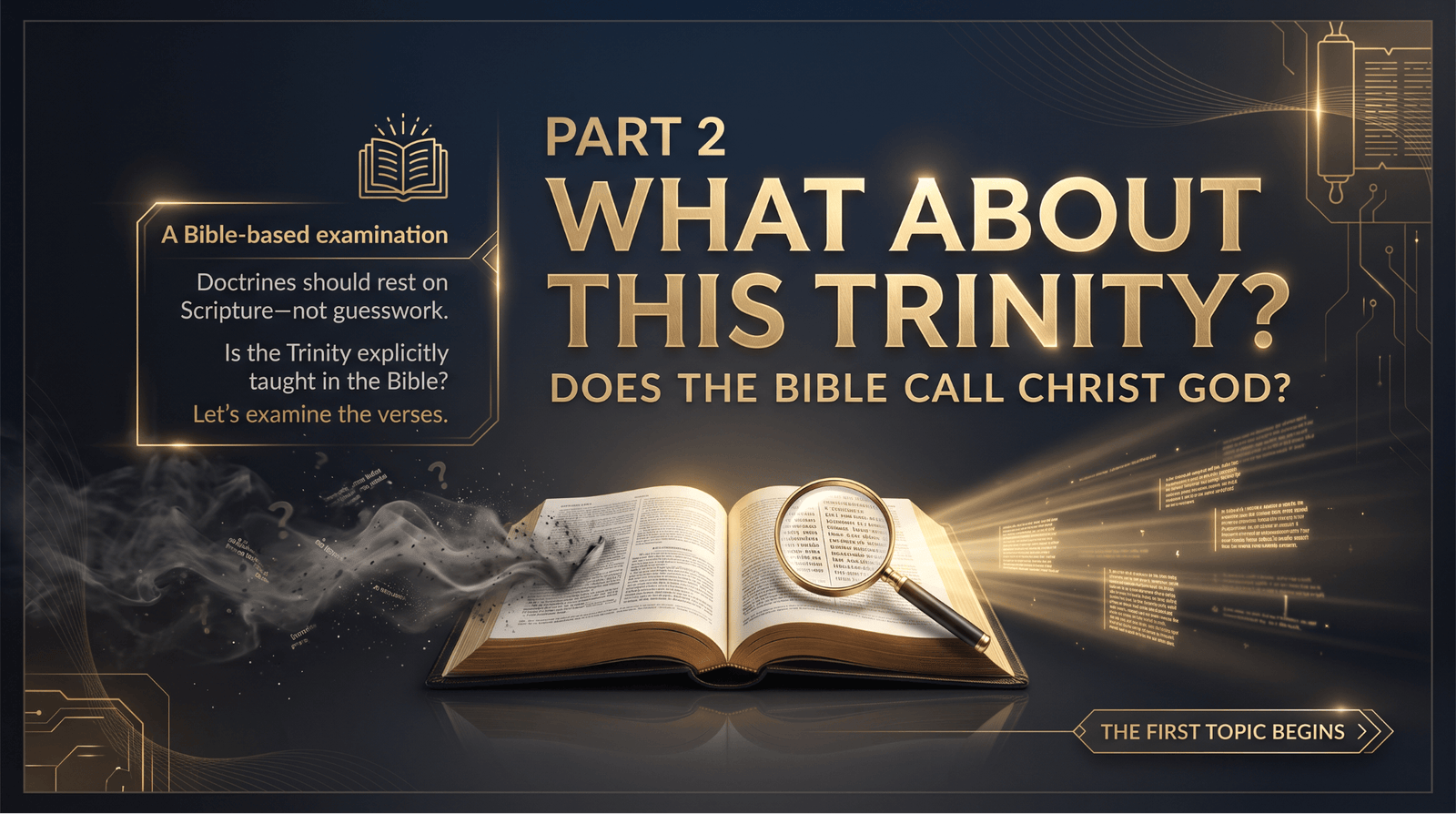
Warm greetings to you in the second part of our reflections. Today we will deal with the question: What about this Trinity?
I know that these kinds of discussions stir up strong emotions in people who deeply disagree with what I preach. I understand that. However, no one can accuse me of preaching something that is not in the Bible. That is the basis of my approach – and today too, the basis will be Bible verses.
If a teaching arises solely on the basis of guesswork, then it is most likely a human teaching that the apostles simply did not know. Of course, there are situations in which we have to settle something – there are disputed, unclear things that require reflection. But the issue of the Trinity is a completely different matter. There is no such thing as the Trinity in the Bible.
If you have any Bible verse that you consider ironclad proof that it is talking about the Trinity – give it to me. But you know very well that there is no such verse. This is a teaching drawn not from the fire, but from the smoke – that is how I would put it. As if someone were trying to read something in the fumes of smoke.
But go ahead, if you have a verse, I will accept every one and examine it. Besides, today I myself will give you a series of verses which – interestingly – are sometimes cited by supporters of the Trinity, and sometimes by its opponents. It is amazing that in the same verse everyone finds something completely different. We begin with the first topic.
Can Christ be called God?
It is sad, but even with people I considered friends, I had to argue about this topic, because they insisted that Christ absolutely must not be called God. I read them a few verses that testify to something completely different.
Why, according to them, can He not be called that? We talked about this last week – because there are verses, taken out of context, that say there is only one God. But as we said: one God the Father and one Lord Yeshu. That does not change the fact that there are many so-called gods and the Bible actually calls them that. It is not that we call them that ourselves – the Bible calls them gods.
Christ even refers to Psalm 82, where it is said of people that they are gods. And Christ adds: “Scripture cannot be annulled”. And today, people who would like to forbid us from saying that Christ is God are in fact trying to annul Holy Scripture. They want to annul all those places where angels are called gods, people are called gods, and Christ is called God.
John 1 chapter
We will of course begin with the Gospel of John:
“In the beginning was the Word, and the Word was with God, and the Word was God.”
Look, this is astonishing. I have come across the theory that in the Gospel of John there is the most evidence for the Trinity. Meanwhile, in the Gospel of John there is the most evidence against the Trinity!
Yes – the Word was God. But the Word was with God. So here we have two Gods. God was with God. I know that this grates on you, because after all there is only one God. But we have already said that in the Bible not only one is called God – it is said that there are many gods, but for us there is only one God the Father, as the Most High God. Besides, such a phrase also appears in the Bible: the Most High God. And if there were no other gods, then why the term “Most High”?
So look – the first verse and we already have proof. Someone is with someone. They are not equal to each other. They are not with each other mutually. “The Word was with God. He was in the beginning with God. All things came into being through Him.” And that is a fact: the work of creation took place through the mediation of Christ – because we identify the Word with Christ, which follows from the context of the whole first chapter.
And further we read about this Word:
“In Him was life, and the life was the light of men. And the light shines in the darkness, and the darkness did not overcome it.”
Then we have the passage about John the Immerser: “There appeared a man sent by God, his name was John. He came as a testimony, to testify about the light, so that all might believe through Him.” We will skip these verses concerning John.
And here again: “The Word was in the world, and the world came into being through Him, yet the world did not know Him.” So the world was created through the Word. This “through” is important – we will talk about it again.
“He came to His own” – because as we know from the Letter to the Colossians, God created through Christ and for Christ. So He came to His own.
“But to all those who received Him, He gave power to become children of God, to those who believe in His name.” This is an interesting thing – about the name, right?
But the key is verse eighteen:
“No one has ever seen God. The only-begotten God, who is in the bosom of the Father, He has made Him known.”
And we have seen Christ, right? So Christ is the only-begotten God. Of course there are disputes, because manuscripts have been found where instead of “God” it says “Son”. But you will see that there are many more verses saying that Christ is God.
However, the doctrine of the Trinity assumes that they are equal to each other. And here is the crux: there is not a single verse in the Bible that says Christ is equal to the Father. There is only extra-biblical philosophy that arose about three hundred years after Christ – that is when the Church adopted the Trinity, and earlier there were fierce disputes about it.
So see for yourselves. Discussions are going on here, but the matter is clear: Christ, called the Word here, is also called God. So can Christ be called God? The Bible calls Him that. But He is not God the Father. There is only one God the Father.
The Gospel of John 5:18 – what was Christ really accused of?
Let’s start a little earlier:
“But Yeshu answered them: My Father is working until this very moment, and I am working. For this reason, therefore, the Judeans were seeking all the more to kill Him, because He was not only breaking the Sabbath, but was also calling God His own Father, making Himself equal with God.”
“Making Himself equal with God” is one version of the translation. It can also be rendered as: “He was making Himself the same as God”. Today I even specifically checked this translation.
And now the most important question: who says this? His opponents. Did Christ say that He is equal to God? No – that is what He was accused of.
Look, He was also accused of nullifying the Sabbath, of dissolving it. But supporters of the Sabbath will firmly state that He absolutely did not dissolve it. And it does not impress them that it is written here that He was dissolving it – because they understand that this was an accusation. Besides, He could not dissolve the Sabbath until He redeemed us from the slavery of the law, that is, until He died.
Christ was also accused of being a drunkard, a glutton, and a friend of tax collectors. Were their accusations true? No. The Bible only informs us what His opponents were saying.
The fact that someone accused Him of something does not mean that He wanted it. Quite the opposite – there is a Bible verse whose translation supporters of the Trinity also manipulate. Philippians 2:6-8 says: “He did not presume to think that He was equal to God.” He did not presume to seize equality with the Father for Himself. “He humbled Himself, being obedient to the point of death, even death on a cross.” It is worth remembering this.
And now look at what He Himself says – verse 19:
“So Yeshu answered them: ‘Amen, amen, I say to you: the Son cannot do anything of Himself unless He sees the Father doing it; for whatever He does, the Son likewise does the same.'”
So Christ not only does not claim that He is equal – He actually says that He is not allowed to do certain things. This is written in the Holy Scripture. He does what the Father does.
And verse 30 as well:
“I can do nothing of Myself. As I hear, I judge, and My judgment is just, because I do not seek My own will, but the will of Him who sent Me.”
And this is supposed to be someone equal to God? He is not allowed to do anything of His own will. He must be obedient. This is not how someone who is equal speaks. This is how someone who is subordinate speaks. I repeat once again that these are the words of Christ, not of His accusers.
One more doubt
Agata writes that the problem is that these things are contradictory – many people suspect that these verses have been distorted, because we know that this has happened, and no one thereby invalidates the Bible.
Agreed, we know that there are distorted passages. But let’s start with the fact that they were most often distorted precisely by supporters of the Trinity. And there are simply too many of the verses we are talking about today to undermine them all.
The problem, Agata, is that people look for anything, just to undermine a verse that spoils their faith. If their faith were based on some other strong biblical passages, I would understand it, right? I have contradictory verses – this one says this, that one says something else. But no, there are no verses that support the Trinity.
And what about calling Christ God? I know that people argue about this, but the thing is – as you will see for yourselves today – that there are verses I could translate in such a way as to support my theory, and yet I do not do it. Why? Because I am aware that it would not be true. I will give you such an example. Actually, I will say right away what it concerns. God YHWH was supposed to have said: “I am”. And some say: look, here is the proof! In this way He announced that He is that YHWH. No, He is not. Although it would suit me perfectly, because after all I claim that Christ appeared as YHWH. But this is not proof. In a moment I will explain to you why I think so. I simply do not accept false arguments, even if they support my theory. I do not want them.
People, however, have such a tendency that they interpret everything in a way that supports their position. They will look for a problem where there is none, just to question an inconvenient verse.There are a few things people missed. Even opponents of calling Christ God missed them. Even Jehovah’s Witnesses, who, you know, are sometimes accused of falsifying the Bible so that everything fits their teachings. Even they missed these verses. They write “god” with a lowercase letter, and every time a Jehovah’s Witness talks about it, they emphasize: it is lowercase. Except that there was no such thing as lowercase and uppercase letters back then! Besides, in this way, perhaps unintentionally, they are saying that He is a God lesser than God the Father. And that is true. Because Christ is not equal to God the Father.
John 17, the whole chapter contradicts the Trinity
Mark writes: “John 17:3, it speaks of two persons, not one and not three”. I discussed this last week, but today there will be a lot from this chapter. In fact, the entire 17th chapter contradicts the Trinity.
Look from the very first verse: “Father, the hour has come. Glorify your Son, so that the Son may glorify You with it.” Is Christ equal to the Father? If He asks Him for glory, then why does He lack that glory?
Further: “…that they may know You, the only true God, and the One whom You sent, Yeshu the Anointed.” The word translated as “the only true God” can just as well be rendered as “the true God Himself”.
An interesting thing: someone wrote in a comment that the word “monotheism” is not in the Bible. Maybe the word itself is not there, but “monos theos“ is, precisely in this place, meaning “one God”. However, in fact, we will not find a teaching on monotheism in the Bible, because, as the apostle Paul wrote, we quoted this last week, there are many persons called gods as a title. It is a title showing that someone has the authority to take life. That is why princes were called gods, and judges who sentenced people to death, Elohim, meaning gods. And this is exactly what Christ referred to, quoting Psalm 82, when He was accused of making Himself equal to God. That was probably in chapter 5, verse 18, yes, 5:18.
Agata claims that I insist, that I am certain it is impossible, and that I create a theory to make all the verses that contradict one another fit. No, the verses do not contradict one another! That is precisely the point, that they only seem to contradict one another. One can get that impression only when one accepts theories like the Trinity. Because how else should one understand: “The Father is greater than I”? Or the words “my God and your God”, meaning Christ has a God above Him. And He says this after the resurrection! And at the same time people believe that Christ is that God whom He has above Himself.
The Divinity of Christ – the other side of the coin
Today we have a scientific approach, a very precise analysis of all the verses, a comparative analysis not only with the biblical books, but even with quotations in letters that people sent to one another. All of this is in archives, all of this can be compared. That is one reason we know that Matthew 28:19 was falsified – until the 4th century it read differently, as can be seen in those letters, and in the 4th century a different version already appears. We catch that.
But when it comes to the divinity of Christ – it is indisputable.
“The Word was God” – no discussion. Even Jehovah’s Witnesses do not argue with that. Since the Word was God, Christ was God. This simply cannot be refuted.
John 20:28: “Thomas said to Him: ‘My Lord and my God!’ Yeshu said to him: ‘You believed because you saw me. Blessed are those who have not seen and yet believed.'” Thomas says: “My Lord and my God”. To whom is he saying this? He is not praying to God at that moment, right? I know that one can again invent various explanations, but this is a fact. And Christ did not consider it necessary to correct him. He did not calmly say: “God is only in heaven, I am only the Son of God, I must not be called God”. He says nothing of the sort. The context also does not indicate that it meant something else.
People who simply do not like that the Bible calls Christ God have to twist this verse somehow. So they invent theories: an exclamation of astonishment, spontaneous, detached from reality. Or: Thomas acknowledges that Christ represents God. Well yes, he represents the Most High God – but he himself is also God.
And look, here next to it, John 20:17 – this in turn is against supporters of the Trinity: “Yeshu said to her: Do not touch me, for I have not yet ascended to the Father. But go to my brothers and tell them: ‘I am ascending to my Father and your Father, and to my God and your God.” This is after the resurrection! When Christ already has power, might, and authority – God is still above Him. The same one who is above all of us. He is our common God. We can acknowledge Christ as God for us, but above Christ there is still God.
So in John we have two things at once: Christ is not the Most High God – but He is God. The Bible called Him that. And one really has to scheme, invent some stories, to get around it. No verse in the Bible says that this means something else. John, when writing this, also did not see fit to explain that Christ is not God – and yet there are cases where someone misunderstood something and the writer corrects it.
Further testimonies
Romans 9:5. “whose are the fathers and from whom is the Anointed One according to the flesh, being over all, God blessed for eons.” Look – it is said about the Anointed One: being over all, God blessed. Of course opponents of the divinity of Christ will protest, but I repeat to you: the fact that I call Christ God does not mean that He is equal to the Father. Once you understand that, it will be easier for you to accept this verse.
It can indeed be understood differently, because there were no commas or periods in the manuscripts. So it can be translated: “the Anointed One according to the flesh being over all” – period – and then end the argument with a doxology: “God blessed forever” (because eons are also ages). Yes, such praise inserted out of nowhere. It can be translated that way, but it can just as well be otherwise – and I lean toward Christ being that God blessed for eons. However, I understand that someone may have a different opinion.
Just look: there are cases where there is a mention of God and Christ. Then it can be interpreted that two persons are being spoken of. But it seems to me that if the apostles wanted to distinguish them, they would have written: “God the Father and Lord Yeshu”. Then we would know for certain – because Paul uses such a distinction when two separate persons are involved. And if that distinction is not there, there is only the conjunction “and” – then it may refer to Christ, who is God. And this verse is one of those. But fine, this may not be the strongest example yet, because honestly, it can be defended both ways.
Titus 2:13: “while waiting for the wonderful hope and the appearing of the glory of our great God and Savior, Yeshu the Anointed.” This is another such example. If it were about two distinct persons, it should be: “God the Father and our Lord Yeshu”. Then we have a distinction. But if we know that Christ can also be God – and much points to that – the matter becomes clear. Because it is Christ who is to appear in glory with the angels, and that is what we are waiting for.
2 Peter 1,1 – one “our” or two?
2 Peter 1:1. “Simon Peter, servant and messenger of Yeshu the Anointed, to those who have obtained a faith equally precious as ours through the righteousness of our God and Savior, Yeshu the Anointed.”
Let’s start with the text I checked again today. In my translation it was: “They received it through the righteousness of our God and our Savior Jeshu the Anointed”. And this is exactly where the problem is – in the manuscripts the word “our” does not appear twice. I myself do not know why I have not corrected this until now, because the difference is significant.
We instinctively repeat: “our God and our Savior” – in this way we distinguish between two persons. But let’s look at the manuscripts. 2 Peter 1,1 reads:
“…a precious faith through the righteousness of our God and Savior Yeshu the Anointed.”
One “our”. There is no “our God” and “our Savior” – there is “our God and Savior”. And this opens two possibilities:
• Our God is the Savior – and the Savior, as we read further, is Yeshu the Anointed.
• God and Savior are two persons – but then “our” should stand in a different place in the sentence.
For me it is obvious that Christ is both God and Savior. That is why people also prayed to Him – calling on His name was prayer. So here we have two titles applied to one person.
I put forward the thesis: if it were about God the Father, the text would state this clearly. I admit honestly, however – theoretically the second reading is possible, so it is not the strongest argument. Sufficient for me, but not decisive.
Hebrews 1:8-9 – either the Son is God, or God is a piece of furniture
Let’s move on:
“But of the Son He says: Your throne, O God, is forever and ever. The scepter of righteousness is the scepter of Your kingdom. You loved righteousness and hated lawlessness. Therefore, O God, Your God anointed You with the oil of gladness above Your companions.”
This is a quotation from Psalm 45:7. I know that various translational contortions are done with this verse to translate it differently. Out of curiosity, I checked the Catholic translation:
“Your throne, O God, is forever and ever, the scepter of righteousness – the scepter of Your kingdom… Therefore God, Your God, has anointed You with the oil of gladness more than Your companions.”
Notice: to the Son He says, “Your throne, O God.” If the translation is good, and there is no teaching that only one being can be called God – then we clearly have two here, and that agrees with John 1:1.
But there are opponents. The most characteristic is the translation of Jehovah’s Witnesses. I remembered there was something there “about furniture” – let’s check:
“With reference to the Son: God is your throne forever.”
And there you have it – God has been made into a piece of furniture. A chair. To me this is not serious, but they had to translate it that way, because otherwise it would come out that the Son is God, and they cannot bring themselves to say that.
Besides, they fall into their own trap, because further on we read: “God, Your God, anointed.” Not “God anointed God,” but “Your God.” What would this other God be, if supposedly there is only one?
This is precisely the defense mechanism of a human teaching that is not in the Bible – that Christ must not be called God. There is no such teaching. But in order to maintain it, every verse has to be stretched to fit the assumption – that is, the truth has to be bound and enslaved. The Letter of Peter warns against those who deceive us with “plastic words.” This is exactly an example of such plastic words: an attempt to take away from the Son the glory that God demands people give Him.
Isaiah 9:5 – “Mighty God”, but is it certain?
Here I will be critical of myself, so you can see that I am trying to be objective. The Catholic translation:
“For a Child is born to us, a Son is given to us, and authority has rested upon His shoulders. He was called by the name: Wonderful Counselor, Mighty God…”
For many, this is decisive proof. But notice two things.
First: even if the verse is faithful, it says “Mighty God”, not “Almighty” or “All-ruling”. And that is a difference – here we would have a lower level than All-ruling.
Second: this version comes from the Masoretic text, Hebrew, and priority is given to it. But the Septuagint reads differently:
“A Child is born to us, a Son is given to us. Authority has rested upon His shoulders. He will receive the name: Messenger of the Great Plan. Because I will send peace for the rulers, peace and healing through Him.”
There is no “Mighty God” here. Perhaps the Masoretic version is true, perhaps the Greek one – I am not able to settle this. That is why I myself do not treat this verse as an argument.
Matthew 1:23 – why did they not call Him Emmanuel?
“Behold, the Virgin shall conceive and bear a Son, and they shall give Him the name Emmanuel, which means: ‘God with us.'”
And here again – this is not proof in itself. Why? Because prophets bore names with the word “God” in them, and no one considered them gods. The best example: Eliyah, that is Elijah – “God Yah”. “I am” is the shortest form of the divine name, the name of the One who is. And yet Elijah was not God, even though he bore such a title.
But a question arises that many ask: why did Yeshu not bear this name on earth? In the Gospels no one calls Him that. Did the prophecy not come true?
Let’s look closely. The angel says: “She will bear a Son, and you shall give Him the name Yeshu“ – that is, Savior. And he immediately explains why: “For He will save His people from their shortcomings.” Only then does he add: “all this is so that what the Lord said through the prophet may be fulfilled.”
So on earth He is to be Yeshu – Savior, because He is on a mission of saving. And Emmanuel? That is still ahead of us. The Book of Revelation says that Christ is to receive a new name. And do you know when that will be fulfilled?
Revelation 21 – “God with us” in full
Let us open chapter 21 of the Revelation of John, when there will be a new heaven and a new earth:
“I heard a mighty voice coming from the heavenly throne, calling: ‘This is the dwelling place of God among people, because He will dwell with them, and they will be peoples belonging to Him, and He will be the God who will reside with them, because He is their God.”
Who is being spoken of? God the Father, who is so powerful that the earth could not bear His presence, of whom it was said that the earth is only His footstool? Would He come down and dwell on earth? God Most High?
No – from the context we know that this refers to Christ. And this is Emmanuel. Then He will bear the name “God with us”. Now He is the Savior, because the mission of saving is ongoing. Later He will be God with us.
We read further: “It is done. I am the Alpha and the Omega, the beginning and the end. To the one who thirsts, I will give freely from the spring the water of life.” Who gives the water of life? Christ. He is the Alpha and the Omega, the First and the Last.
And one more thing: “The victor will receive his share in all this, and I will be God to him, and he will be a son to Me.“ So Christ will also be Father – simply because He receives such authority from the Father.
“I will be God to them” – God will be with us. But notice something important: God does not dwell in temples built by human hands. The whole Earth could not contain God, His power, His might. He is so great that the cosmos does not encompass Him.
I always picture it this way: where the cosmos ends, heaven begins, and where heaven ends – only there is God. When everything ends, He only begins. God is not part of His creation. His Spirit works in creation, but He Himself is not creation. He is outside it, above it. So God cannot be locked in a cage that He created for Himself.
There will, however, be a representative of God Most High – the Son, who here is clearly called God. This is precisely Emmanuel: “God with us”. Then God will dwell with people.
Revelation 22 – who is the “God of the spirits of the prophets”?
Since we are already in the Book of Revelation, let us also look at chapter 22. Here we have further proof that Christ can be called God.
Verse 6 says: “And he said to me: These words are faithful and true, and the Lord God of the spirits of the prophets sent His messenger (angel) to show His servants what must happen soon.” The meaning is what matters most here: these words are reliable and true, and the Lord God of the spirits (breaths) of the prophets sent His messenger.
Who is this “Lord God”? Look at verse 16: “I, Yeshu, have sent My messenger (angel) to testify these things to you in the assemblies. I am the root and offspring of David, the bright morning star.”
Do you see the logic? Christ sent His angel with the prophecy. And verse 6 says that the “Lord God of the prophetic spirits” sent that angel. So who is this God of the prophetic spirits? Christ. Therefore He can be addressed with that title – He is even God to the spirits, that is, their Ruler.
Who passes the revelation to whom?
And to remove any doubt about who sends angels, let us return to chapter 1, the first verse. See how this revelation was delivered in the first place:
“The revelation of Yeshu the Anointed, which God gave Him, showing His servants what must happen soon; and having sent signs through His Messenger [angel] to His servant John.”
The chain is clear: God gives the prophecy to Christ – Christ sends the angel – the angel brings it to John. That is why elsewhere we read that the Spirit of Christ informed the prophets about the sufferings that Christ was to endure. It was Christ who sent prophecies in advance.
But pay attention to something absolutely crucial: until God tells Christ something, Christ does not know it. So He is not equal to the Father.
The verse that settles the matter
And now, for supporters of the Trinity, I have a verse after which, honestly, the matter will be settled. I do not know why you do not know it and why even opponents of the Trinity do not quote it. The main thesis of the doctrine of the Trinity says that the Son, the Father, and the Holy Spirit are equal to one another in every respect. And I will give you a verse from which it follows that Christ is a servant of the Father.
Acts of the Apostles – the apostles’ prayer. Listen: the apostles knew best who Christ is and what His relationship to the Father is. Notice that they say “Lord”, not “God”. So someone might say: “since there is one Lord, and He is Christ, they are praying to Christ”. But the context does not allow that – they are praying to the Father:
“And now, Lord, look upon their threats and grant Your servants to proclaim Your word with all boldness, while You stretch out Your hand to heal and to perform signs and wonders through the name of Your holy Servant, Yeshu.”
Christ is the Servant of God. Case closed, there is nothing more to add here. Which does not change the fact that by the will of the Father He can be called God and is called God – as I proved in the Book of Revelation.
A warning that must not be ignored
If someone wants to keep insisting, then in practice they are claiming that today, in the XXI century, they know better what Christ’s relationship to the Father was than the apostles – those who knew Him, saw Him with their own eyes, walked with Him, touched Him, spoke with Him. They knew that Christ is the Servant of God.
I know that many of you have simply been deceived – I have no complaint against you if you repent. Truly. But if you remain in false teaching, do you know what will happen?
The apostle Paul in the Letter to the Galatians 1:8-9 proclaimed: “But even if we, or a Messenger [angel] from heaven, should proclaim to you good news contrary to the good news we proclaimed to you, let him be accursed. As we said before, and now I say again: If anyone proclaims to you good news other than what you previously received, let him be accursed.” And at the beginning, the teaching was that Christ is the Servant of God the Father. Today it is proclaimed that He is equal to Him.
And the people who proclaim this, if they do not repent – according to this biblical warning, and I believe the Holy Spirit made sure to leave it for us – will be accursed. They will have nothing in their defense, because they proclaim human teachings, not biblical ones. They twist the Holy Scripture, forcing everything upside down just to prove human theses that have no support in the Bible.
Almost every verse of the Bible contradicts the teaching of the trinity – because in one way or another it emphasizes Christ’s servant role or His limitations. We will, in fact, talk about those limitations in the next meetings too, because that is a subject for a longer conversation.
Psalm 89 and the “sons of God”
Lumik quotes Psalm 89 – “among the sons of God”. And rightly so: if Yeshu is the Son of God, then he cannot be similar to or equal to God. The Son is not the Father.
With Christ, the matter is that He appeared under the name YHWH. Go back to the material we discussed a week ago – we will return to this again, because the prophecies concerning the name YHWH were fulfilled in Christ. We will devote a separate meeting to this. I will show you plenty of Bible verses that clearly indicate that YHWH is Christ.
The problem arises with verses such as: “The Lord said to my Lord”. It would turn out that YHWH is speaking to my Lord. And here is the key: this angel, that is, Christ, appeared under the name YHWH – but sometimes the Bible speaks of YHWH as God the Father, that is, God Most High. This is where this slight confusion comes from.
I will put it this way: if we read that the word of God YHWH is unchanging, this applies exclusively to God the Father. But when the angel appeared – Christ under the name YHWH – He changed His mind. Not His name, but His mind. You have plenty of such verses, which people uneducated in the Bible mock: “What kind of God is this, if Moses convinced Him to change His decision? Did He not know right away that it would be better this way?”.
Well, Christ, appearing under the name YHWH, was a God who learned. God the Father – did not. I will also demonstrate this to you with Bible verses, though we will not have time today. There really are plenty of passages that are simply being hidden from you. I will show them all to you.
Another gospel
“But even if we, or a Messenger [angel] from heaven, should proclaim to you good news contrary to the good news we proclaimed to you, let him be accursed“.
Look: the trinity is another gospel.
I will give you some historical background as well. This teaching arose earlier than people think – it was born in Samaria, in gnostic movements. Simon Magus, who was a Christian because he accepted immersion in the name of Yeshu, brought in apostasy: he took over Samaria, deceived it, and introduced the trinity there. He started it. Then it smoldered, smoldered, smoldered – until finally it spread.
I will tell you more. Even supporters of the trinity have to admit – because these are historical facts – that in the oldest manuscripts the word “trinity” appears for the first time in gnostic writings, not Christian ones. In Christian writings it appears much, much later. This teaching simply infiltrated.
It is a human teaching. It is the teaching of the antichrist. Christ equal to the Father is a different Christ than the one from the Gospel. It is the antichrist. A deceiver.
Thanks for listening until the end. I would be extremely grateful for likes, shares and comments, because it helps grow the channel, which gives a chance to reach even more people.
The full written version of the article is now available at yeshu.blog . There you will also find my videos and music — all created in the name of our Lord Yeshu.
If you receive the gift of faith in the name of our Lord Yeshu, take the next step and contact me to be immersed in the name of Yeshu. You can find contact details on our website or simply write on Messenger.
Glory to Yeshu!!!
2026-08-18 @ 20:22
Yay google is my world beater aided me to find this outstanding site! .