Warm greetings.
I would like to thank you for all the likes, shares, and comments under the previous published video. It’s very important for our channel to grow, which allows us to reach even more people. In the name of our Lord Yeshu, thank you!
I encourage you to explore the other materials on our website. You will find many interesting topics there that are sure to capture your interest.
If you receive the gift of faith in the name of our Lord Yeshu, take the next step and contact me to be immersed in the name of Yeshu. You can find contact details on our website or simply write on Messenger.
I’d like to present to you our new song based on John chapter 14. We warmly invite you to listen and share your thoughts.
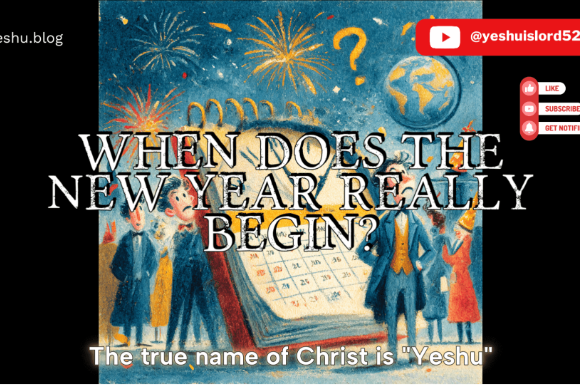
Today we’ll consider a relevant topic that’s worth remembering every year. Especially for people who might not be aware that certain things truly threaten their faith and their standing before God. It is during periods like the holidays—holidays that, as we know, aren’t exactly in line with the Bible—that many things happen which are worth evaluating sensibly. A week ago we talked about Christmas: we know this holiday was set in place of Saturnalia. At that time, a question was raised about New Year’s Eve: what about the New Year? That’s what we’re going to discuss today. Let’s start by asking supporters of celebrating the New Year: what is so special, almost “magical,” that happens between December 31 and January 1 that someone decided to consider this boundary the beginning of the year? Why does the whole world highlight this one day, and not some other? It’s worth considering, because we often unthinkingly accept what everyone around us is doing. Meanwhile, the surrounding crowd is a wide road. Christ spoke of the broad road that leads to destruction and the narrow one that few find, which leads to life. If we want to blend in with the crowd, we risk going down the broad path. Of course, let’s not go overboard—it’s not about brushing our teeth with the left hand just because everyone else uses the right. It’s not about reversing everything, but about reasonable examination: is a given thing related to God, to demons, or is it just an empty custom?
Do you know why January 1 should be the start of the year? When I was a child, I truly felt fear that when midnight struck the end of the world could come. Childhood logic: if something ends, maybe it won’t start again. So it seemed to me that this night was extremely important. Over time, however, I realized there is no solid foundation for considering January 1 as the beginning of the year—not scientific, nor astronomical, nor biblical. The only consistent rationale is the Roman tradition: the Romans decided so at a certain point. But what do we care about the decisions of pagans? Especially since on that day they worshipped Janus—the god of beginnings. It wasn’t always like this: only from 153 BC did Rome adopt January 1 as New Year’s Day; before that, another day was considered the beginning. Anyone who even slightly studies the holidays and ceremonies of people going down the broad road sees that many of them have pagan origins. We are born with a pure spirit, then culture “installs” us a package of traditions—today via the media, previously via the pulpit or decree from a ruler. It was enough for political power to announce: “from now on, the New Year begins on such and such a day”—and everyone would just adapt.
What is it really like? Is it possible to point to a date that would objectively be the beginning of the year? After all, we have to count time somehow. It’s a bit like the start of a day: why from midnight? Wouldn’t it be more logical to start from sunset or sunrise? Counting from midnight is purely a matter of agreement. The agreement itself isn’t harmful. The problem begins when rituals and practices are built around this agreement, which are echoes of old cults. If we simply agreed “for convenience” that from this day we count the new year—there’s nothing wrong with that. Evil begins when we start doing things we don’t do every day, but we do them just then—and specifically because that’s how it was done to honor a false god. In our understanding, a false god is a demon. Someone might say: “the night is darkness, that’s their domain,” hence the emphasis on night time holidays like Halloween, or even certain folk Easter practices. Let’s not look for sensation, but observe soberly: where does it come from, and what is its purpose?
Let’s give examples showing that January 1 is by no means a natural beginning of the year. Let’s go far back—from 2000 BC to around 500 AD. In ancient Babylon, the new year began after the first new moon following the spring equinox—that is, around March or April. In Egypt, it was counted from mid-summer, around July, when Sirius appeared in the sky and the Nile flooded—this was a sign of blessing. In some parts of ancient Greece, the beginning of the year was the winter solstice, around December 21. In Rome – until 153 BC – New Year was celebrated on March 1 (associated with Mars), and then the Senate moved it to January 1, in honor of Janus, the god of beginnings, who looked with one face to the past and the other to the future. Even then, customs were practiced that are surprisingly similar to today’s New Year’s traditions. Meanwhile, in ancient Persia (Zoroastrianism), New Year was celebrated on March 21, at the time of the spring equinox.
Let’s move on to the period from about 500 to 1800. Much of Europe was Christian, so a religious logic emerged: some reckoned the new year from December 25 (since they considered that day the birth of Christ), others – and for a long time the majority of medieval Europe – from March 25, on the Feast of the Annunciation, understood as the moment of the Messiah’s conception. In England, until 1752, the year began on March 25 (so-called Lady Day). Only with the shift from the Julian to the Gregorian calendar and the strong influence of Rome was January 1 accepted there. This raises suspicions: why the Vatican, why would Rome force this? Well, Rome had a deeply rooted festival for Janus. It was particularly strong there. As a result, the establishment of New Year was not a Christian act – on the contrary, the Christian element was more about eliminating such pagan remnants. In Byzantium and in Rus’ – until 1700 – the New Year was counted from September 1; echoes of this order can still be felt today, for example in the association with the start of the school year. In China, on the other hand, the date was movable, linked to the moon; it was there that parades, fireworks, and various rituals “to ward off spirits” developed.
Now the period after 1600. Scotland adopted January 1 as early as 1600, in Germany and Denmark it was done around 1700, and in England – as I mentioned – in 1752. Russia changed the beginning of the year under Peter the Great, who wanted to catch up with the West. In the Muslim world, the beginning of the year is movable, resulting from the purely lunar calendar, so it has fallen at different times – sometimes in summer – historically associated with Muhammad’s journeys. Jews also celebrate the New Year on a movable date (Tishri), at the turn of September and October – as for how it was biblically before, we’ll discuss that separately. In short, there is no uniformity here – and never has been.
In modern times (20th century and onwards), January 1 became a widely accepted civil convention in most states. But it still isn’t complete unity. In China, Korea, and many Asian diasporas, New Year’s is celebrated according to the lunar calendar, in Thailand it falls on April 13–15 (Songkran), in Iran and Afghanistan on March 20–21 (Nowruz), and in Ethiopia on September 11. So you can clearly see that the date itself is purely conventional – that’s not the point. The key question is: what do we do with this date and why? If it’s just an arrangement for easier timekeeping – fine. But if we get into practices rooted in the worship of foreign gods, that’s a completely different matter. Therefore, let’s examine everything, retain what is good, and flee from all appearances of evil.
All this shows that there is no single “scientific” moment that we can indisputably say: here the year begins. It’s a matter of convention. A convention for people who do not take into account what God says, although God clearly pointed out when the New Year is. True, about 190 countries have recognized January 1 as the beginning of the year, but in many cases they did so mainly for the purposes of international contacts. There are countries where New Year is even celebrated twice. In China, for example: they recognize January 1 because they want to be modern and compatible with the world, but they also have their own – more boisterously celebrated and more important – New Year, falling between January and February. However, to be able to communicate with the world, they also accept January 1. Meanwhile, many countries hardly recognize January 1 as a holiday at all. For example, Ethiopia: New Year falls there on September 11, and in a leap year on September 12. The Ethiopian calendar, based on Coptic tradition, it is also interesting because it counts years differently: while it is 2025 for us, it is 2017 there—about 7–8 years “less.” Ethiopia never adopted the Gregorian calendar as the main one. Then Iran: the official year begins on March 20–21, around the time of the vernal equinox, which—in my opinion—is natural and astronomically justified. They use the Gregorian calendar in foreign relations because they need to communicate with partners from America, France, Germany, or Poland. Similarly, Afghanistan: the official start of the year is March 20–21; they know January 1, but it’s not the start of the year for them. Nepal: New Year is April 14; their calendar means that according to them we are “living” in the year 2082. The Gregorian calendar is mainly used in tourism and business—again so they can communicate and settle bills efficiently with others.
Saudi Arabia is similar: January 1 functions in the private sector and in international settlements, but it is not a national holiday; officially, they use the Islamic calendar, so their New Year falls on a shifting date (recently, around the beginning of July). It is also worth mentioning Israel: they accepted January 1 as a civil date, but also have a religious New Year—at the turn of September and October—celebrated more festively and, for many, more important; this is a moveable holiday.
So more than 190 countries recognize January 1, but even so, it’s clear there is no single, definitive, “scientific” date for the start of the year. And since not everyone recognizes the authority of the Bible, they’re not interested in what the Bible says about it. What’s sadder is that even many of those who claim to acknowledge the Bible don’t think about what it says regarding the New Year—perhaps because no one explained it to them, and they think it’s silent. Meanwhile, the Bible does take a stand on this matter. In the Book of Exodus, at the time the nation of Israel was being formed—remember, they were slaves in Egypt—God organized their calendar. In Egypt, the then-beginning of the year fell roughly in mid-summer, around July. The very fact that God tells Moses when the New Year is to occur, and that it’s at a different time from the Egyptian one, shows His intention to take Israel out of their habitual ways.
Exodus 12:2. “This month shall be for you the beginning of months: it shall be the first month of the year for you.”
This refers to the month we now know as Nisan, which Moses knew as Aviv—the “month of ears [of grain].” This is around late March and April, when ripe heads of barley appear in the fields. When the twelfth lunar month ended, and there were ears in the field and a new moon appeared, the start of the new year—the first month, the month of ears—was announced. If there were no ears, a month (the so-called leap month) had to be added, and only after about 29 days would the New Year begin. Therefore, setting the beginning of the year wasn’t fixed to a set date—and it seems God didn’t want the “New Year’s festival” itself to become a special object of celebration. Instead, He established a whole cycle of significant festivals connected with the harvest and calendar. The first celebration—Passover—fell on the 14th day of the first month (Aviv/Nisan). Then days were counted to the Festival of Unleavened Bread, then to the Festival of Weeks (Shavuot), and then to other subsequent festivals. So it’s clear that God specified the point from which the entire order of the year should be counted. Similarly, He set the rhythm of the week—six days of work and the seventh day of rest—and from then on the seventh day, the Sabbath, was kept.
We also see that God establishes the start of the year in the spring, around the equinox (around March 20–21). That’s understandable: then the day and night are equal—a kind of “zero point”—and the sun begins to clearly “prevail,” the days get longer. It’s like dawn on a yearly scale. This raises the question of when a day begins. Today, by convention, we’ve adopted that a day begins at midnight—in the middle of the night—artificially splitting it into before and after. In the Bible, however, a day is counted from sunset to sunset: the end of the day is marked by the sunset, and the entire ensuing night already belongs to the new day. “Day” in the colloquial sense is associated with light, and “night” with darkness, which is why we say “day” to mean the 24-hour period, including both parts. Hence some, by analogy, have concluded that if the night already belongs to the next day, then the “autumn night” of the year could mark the New Year in autumn, around the turn of September and October. However, the Bible clearly states that the year begins in the spring. Winter—at least in our latitudes—can be seen as a time of dying. After the winter solstice (between December 24 and 25), days start getting longer; no wonder the ancients celebrated the birth of the “Sun God” at that time. The question of whether Christ was born on December 25 remains disputed; nevertheless, it’s a fact that from the solstice the day gradually “is reborn,” becomes equal with night around March 21, and later “exceeds” it. According to the Bible, that’s roughly when the new period—the spring start of the year—begins.
In biblical practice, the start of the year was marked by the first new moon after the twelfth month, provided the ears of grain had ripened; if not—a leap month was added, so that the calendar wouldn’t “drift” toward summer or autumn. This is a correction known to all calendars. A similar issue occurred in systems based on the solar year. The Julian calendar, introduced in 45 BC, was much more accurate than a purely lunar one, but still imperfect—the tropical year does not last exactly 365.25 days. For centuries, the error accumulated and by the 16th century, there was nearly a 10-day difference compared to astronomy. That’s why, during the Gregorian reform in 1582, the calendar was “jumped”: after October 4 came October 15. However, the Julian calendar persisted for a long time: Protestant countries and England adopted the Gregorian only in the 18th century (in England in 1752), and in Russia even later. As a result, to this day, some Orthodox traditions celebrate the New Year according to the old style around January 14, while the rest of the world celebrates January 1—the difference is due to a 13-day shift. Meanwhile, with the Gregorian calendar we correct the inaccuracy by occasionally adding a day in February instead of an entire extra month, as is done in the lunisolar calendar. Thanks to this, our calendar is “fairly” accurate.
And so we come to an important observation: no calendar is completely perfect. The cycles created by God—the movements of the Earth, Moon, and Sun, the seasons, and harvests—are beautiful, but they elude attempts to fit them into perfect equations and even grids. That is why different cultures agree on practical dates among themselves, and God in the Bible indicated a rhythm starting in spring—with new life and light—and from that He commanded Israel to count the whole year. It is simple, natural, and instructive.
What is important for us is that the Bible clearly says: the first month is Nisan. That’s why I not only don’t celebrate any New Year’s Eve festivities, but even the calendar that I issue—the biblical calendar—I run from April 1 to March, because that’s roughly when the start of the biblical cycle falls, with an adjustment according to today’s realities. On the other hand, in the civil calendar the year begins in the fall. I don’t know if you know, but in Israel and in the Bible there is some variety: some verses are written according to a calendar other than the biblical one. Why? Because the influence of neighboring nations was strong, and they began the year in the fall, not spring. That’s why in some places time is counted not from 1 Nisan, but from Tishri. So we can say that the biblical calendar is the order given by God, and the “human”—secular—calendar began in the fall, in accordance with the surroundings. The Israelites actually used two calendars. Fortunately, this can be organized: Nisan, the first in the biblical calendar, was also the seventh month in the secular calendar; while Tishri, the first in the secular, was the seventh in the biblical. It’s an interesting, but clear, system.
Around September–October, in our current Gregorian calendar, in the month of Tishri—that is, the seventh month of the biblical calendar and the first of the civil—Rosh Hashanah was celebrated, literally “head of the year.” It would fall on 1–2 Tishri. We can cite several biblical passages that refer to this. For example, in Leviticus 23:24, God commands the Day of Blowing the Trumpets to be observed on the first day of the seventh month—which later evolved into the festival of Rosh Hashanah. In Ezekiel 45:18 and elsewhere there are echoes of counting the years from the fall, and the dating of the reigns of kings—for example, in the Books of Kings—is often based on this secular system, not the “from God” one. Just like today: some privately believe the year starts “differently,” but for international reasons they function according to January 1. It’s an analogy to languages: Poles have Polish, but use English for international contacts. It was the same with the calendar. Therefore, it’s not any kind of deviation that prophets or biblical authors sometimes used “secular” dating—it was more understandable to outside recipients. The “from God” calendar was fully understood primarily by Israelites in the land; those from the diaspora used other calendars daily—just as they did other languages—because those were the realities of the environment. That civil, agricultural calendar served everyday matters: dating documents, determining the reigns of rulers, contracts, or fieldwork cycles. Symbolically, autumn is the closing of the old cycle, the harvest, reflection, court – motifs related to Rosh Hashanah. It is also the time of the creation of the world according to some interpretations of the Talmud.
And here comes the Talmud, which—let’s be frank—often takes a stance opposite to the Bible. Not only because God established the beginning of the year in the spring, while contemporary Jews recognize either January 1 or autumn; similar reversals are found elsewhere. The Apostle Paul, an Israelite from the tribe of Benjamin, a scholar of the Scriptures, wrote that a man praying with his head covered disgraces his head; meanwhile, today Jews pray exclusively with their heads covered. Everything seems to be reversed, and at the same time presented as the only proper tradition. Similarly with the New Year: most of them do not acknowledge the “true” biblical beginning of the year, but establish secular solutions that suit them.
And what was it like in Poland? In pre-Christian times, from what we can infer (since we don’t have direct surviving sources), New Year was most likely celebrated around March 21, at the time of the equinox. We know about spring rituals, and separately about harvest festivals in autumn. So it’s possible that there were “New Year” celebrations both in spring and in autumn. However, it’s hard to say whether they set a precise date for the beginning of the year; more often, people would just say “I’m twenty springs old”—and that’s how they counted age, according to the cycles of nature.
After the so-called baptism of Poland—which, in my opinion, probably never happened in that form—the Church imposed different customs. With Christianization, Poland adopted the Julian calendar, introduced by Caesar in 45 BCE, common in Christian Europe. The beginning of the year, however, was not uniform—it depended on region and context: religion versus administration. Some recognized December 25, others March 25. Why? Because it was believed that Christ was born on December 25, and on March 25 the Annunciation took place—that is, conception, when the Word became flesh in the womb of Mariam. For a long time, Christian Poland wavered between these two dates. In fact—for people it didn’t matter much in terms of the festive “New Year”; it was more important for organizing chronicles and events. If anything was celebrated, it was Christmas; the change of the year itself was not that ceremonial. January 1, on the other hand, was the Feast of the Circumcision of the Lord. In my opinion, this was a church ploy to justify celebrating the pagan day of Janus under the Christian banner of a “new beginning”. So it was invented that Christ was circumcised on January 1. Only, that doesn’t add up: Mosaic Law says on the eighth day, and if the birth falls on December 25, counting the days to January 1 results in seven, not eight. Unless someone counted December 25 as “day one”—then you can kind of stretch it, admittedly, cleverly arranged. But we know it was really about something else. Besides: why should the circumcision mark the beginning of the year for the whole world? It’s hard to explain that logically. In any case, the Julian calendar had a flaw, so over time Poles—like others—switched to the Gregorian calendar, which corrected it. On October 4, 1582, it was announced that the next day would be October 15. Thus, the Julian calendar was corrected to the new, Gregorian one. Some Orthodox Churches did not accept this reform, so to this day they follow the Julian calendar for liturgical matters, which creates a 13-day difference (previously it was 10, then 11, 12; after 2100 it will be 14). Hence their holidays fall on other dates. It’s interesting, because the problem results from staying true to the old calendar, even though it was modified as well; if nothing changed, the discrepancy would still grow and by now it would not be 13, but 14, then 15 days apart. Later, under the influence of Rome and the spread of the Gregorian calendar, there were attempts to standardize this. However, the period of the partitions brought additional chaos to Poland. Why? Because the Austrians and Prussians celebrated New Year according to the Gregorian calendar on January 1, and the Russians according to the Julian calendar—until 1918—so the so-called Old New Year fell on January 13. So Poles lived in three systems at once. This caused confusion, but—as Poles do—they could be contrary and celebrated both dates: January 1, a bit in defiance of the Tsar, and January 13, in defiance of Prussia and Austria-Hungary. We can see, then, that dates can be conventional and administrative—established by a decision of authority, sometimes imposed. At the same time, this was precisely when New Year’s customs began to take root, which I’ll discuss in a moment. From 1918, after regaining independence, Poland uniformly adopted the Gregorian calendar and since then January 1 is the beginning of the year throughout the country.
What customs and rituals accompany New Year and which might be disturbing? First—the driving away of evil spirits with noise. You might say: what spirits? Yet that’s exactly what fireworks were historically used for. When there were no fireworks, in the villages, people cracked whips or made noise with whatever they could. The noise was meant to drive away evil—similar ideas can be found in Chinese tradition, from which fireworks originated. The echo of this custom can even be seen in clinking beer mugs and loud toasts. Folk explanations said that noise protects against evil, which “enters through the mouth,” so people made noise first and then drank. Another thread—divinations and predictions for the New Year. In various regions, people poured wax (though this is more often associated with St. Andrew’s Night), used shadows, cards, apples, peels—a whole repertoire of folk imagination. Another element was evergreen decorations and New Year’s trees—echoes of old pagan practices connected with the rebirth of life. Then there were “lucky” and prosperity dishes: peas, lentils, poppy seeds, pork. The association is simple: grain—like coins—means abundance. In Rome, during Saturnalia, people ate round or grainy dishes, and among the Slavs, peas or beans appeared at harvest festivals as a request for good crops. Poultry was avoided, “so that luck doesn’t fly away”—a classic superstition. What remains of all this? In many homes in Poland, there is still cabbage with peas “for plenty” or pork “for good fortune,” and some people avoid chicken—an obvious remnant of old beliefs. In Italy, people eat lentils for wealth, in Spain, at midnight, they eat 12 grapes—also a tradition with Roman roots.
Yet another constant motif, known thousands of years before Christ (its origins can be found, for example, in the Babylonian festival of Akitu), is New Year’s resolutions. These were made to the gods: promises to pay debts, improve one’s life, purification rituals. In Slavic practices, there were gestures of symbolically “burning the old” to make room for the new. Today, we say: I’ll quit smoking, lose weight, start running, learn a language—the idea is the same, though the forms are secular. It’s worth noting its pagan roots. Further—the Slavic Szczodre Gody, the winter festival of abundance and turning points: carolers in masks would go around offering wishes of fertility and luck, and in return received gifts. This custom survived, though it often shifted toward Christmas; children still “go caroling” with well-wishes and collect sweets or small change—an example of the intermingling of pagan and Christian traditions.
And now Janus. January 1 is directly a Roman festival in honor of Janus—the two-faced god of beginnings and endings, gates, transitions, and time. He looks into the past and the future. Since 153 BC, the January kalends became the official start of the year in the Roman Republic, replacing the previous March 1. Offerings were made at the temple of Janus; closed doors meant peace, open doors—war. The celebrations included feasts, gift exchanges, the making of wishes, and purification rituals—all to “open” the new time well and avoid conflicts. The Church could not entirely uproot these deeply rooted rituals, so it “christened” them: December 31 is the feast of Pope Sylvester I, and January 1 in Christian tradition eventually became the day of the Circumcision of Jesus, and later the Solemnity of Mary, Mother of God. The core of secular customs, however, remained Roman.
The exchange of New Year’s wishes and toasts has ancient counterparts. The Romans would say “Felix annus novus!” or wish “faustum, felix fortunaque”—success and happiness. The intent was to “open” a good year with Janus’s help, the guardian of gates. Today, we simply say, “Happy New Year!”—via SMS, card, or over a glass at midnight. Gift giving also has Roman roots: people gave small presents, such as dried fruit, honey, laurel branches, or coins—to ensure favor and protection from bad luck. Today, this has turned into a more consumer-oriented “what will I get?” but the mechanism of symbolically “inviting” prosperity remains. The same goes for resolutions: Romans vowed to the gods to pay off debts or improve their ways—now people promise the gym, a diet, tidiness. Of course, after a month, results vary. Feasts and balls? Of course—Janus was also celebrated with wine and festivities to honor a new beginning. But what real reason do we have today to celebrate more loudly on January 1st than on any other “arbitrary” date? That’s precisely the power of tradition and the symbolism it’s been given.
Here’s another less well-known custom: doors and gates. In rural areas, it would sometimes happen on New Year’s Eve that a prankster would take a gate off its hinges and move it somewhere else. That happened to me once, too. Later, when a large dog showed up, the would-be jokers quickly lost enthusiasm. This theme of the “gate/passage” ties in beautifully with Janus—the god of doors and thresholds—and the symbolism of crossing the boundary between old and new.
And what should we do with all this? How should we view “baptized” pagan customs? It is known that in Roman tradition, the New Year was dedicated to Janus, and what about us today? Can a Christian celebrate this? I’ll be honest: I regret to see that some, considering themselves disciples of the Lord, participate in this without reflection—sometimes even profiting from it. What do you think: where is the line between culture and cult, between a neutral custom and a ritual with religious roots?
I also searched for information on when the Church first turned a blind eye to New Year’s and what came before: were Christians originally against it? It turns out they were—and quite clearly, even in relation to New Year’s celebrations.
They didn’t always address this topic directly, but we do have some significant examples. Clement of Alexandria (ca. 150–215), at the turn of the 2nd and 3rd centuries, discusses the birth dates of Christ, trying to calculate them based on the Bible and Jewish tradition. Among other things, he suggests the 25th day of the month of Pachon (May in the Egyptian calendar), and his reasoning indirectly influenced later Christian dates, such as December 25th. Clement criticizes pagan calendars and holidays, including those tied to the start of the year, as based on myths (for example, the cult of Janus). He encourages Christians to experience a “spiritual new year” by studying Scripture, not pagan rituals. He emphasizes that the true new beginning is conversion to Christ, not calendar festivals. He writes roughly as follows: “The pagans celebrate their calend by gifts and feasts, but we have our own holy times based on the prophets.” I always repeat: according to the Bible, the year begins around March and April. And for you, dear listener/reader, your new year in terms of personal reckoning starts on your birthday—that’s your new year, because those are your years that count. And by the way: your birthday is, in a sense, your mother’s celebration; you didn’t do anything “great” on the day you were born. At most, you can be congratulated for having survived another year—not everyone manages that, especially if they live irresponsibly. But let’s get back to the topic. Athenagoras of Athens (ca. 133–190) defends Christians against the charge of atheism, contrasting them with pagan holidays; he doesn’t mention New Year’s directly, but criticizes Roman festivals, including the kalends, as forms of idolatry and worship of demons. He encourages not to mix with pagan customs. Tertullian (3rd century, ca. 200–300), in his treatise On Idolatry (chapters 14–15), sharply criticizes Christians participating in pagan festivals, including the January kalends. He mentions the New Year exchange of gifts (strenae: dried fruits, coins) as a practice linked to the cult of Janus. He says: if you give strenae on New Year’s, you do so within a custom marked by idolatry; better to give alms to the poor in the name of Christ. And he encourages total separation: “Do not celebrate the kalends, saturnalia, or other pagan days. Your New Year is the Lord’s Day, not Janus.” Then Hippolytus of Rome (ca. 170–235)—calculates dates related to Christ, suggesting March 25th as the day of the creation of the world and the conception of Christ, which later influenced the Christian calendar. He criticizes pagan calendars, including the Roman New Year, as inventions of demons, and emphasizes that the true New Year for a Christian is Easter, the sign of resurrection, not the January kalends. He encourages: “Do not mix with their feasts—they lead to destruction.” These are the voices of the first Christians; later, apostasy arose. Origen (ca. 185–254), in “Against Celsus,” defends Christianity and criticizes the empty rituals of the kalends, offered to false gods. He writes that a Christian does not need New Year’s divinations and feasts, as their new beginning is daily conversion and hope in the Kingdom. In his homilies on the Book of Leviticus, he refers to separation from pagan customs, including those related to the beginning of the year. Cyprian of Carthage, in his letters “On the Lapsed,” warns against apostasy through participation in pagan festivals, also for the new year; he recalls Christians offering wishes at the Kalends as if worshipping Janus – and calls for repentance. He emphasizes that the true New Year is the Lord’s Day, not pagan dates.
So we have the Old and New Testaments, then the period I mentioned – writings of zealous Christians whom the Church would later call the “Fathers” – and then the 4th century, when the Church begins to move away from that original austerity. In the 4th century, the Church embarks on a path of adaptation and “Christianization” of pagan dates. This can already be seen in so-called St. Augustine. It’s hard to call that a good decision: earlier authors called such practices fraternizing with demons, and later this was attempted to be “baptized” and tamed. Now, let’s return to the Bible for a summary.
Leviticus 18:2-3. “Speak to the Israelites and tell them: I am the Lord, your God! Do not do what they do in the land of Egypt, where you lived. Do not do what they do in the land of Canaan, to which I am bringing you. You shall not follow their customs.”
So there’s a prohibition against mixing customs: neither those brought from Egypt nor those found in Canaan. We know that in Egypt the New Year was celebrated in the middle of summer, while God establishes the beginning of the year differently for Israel – the first month (Nisan) falls around March or April. That’s a simplification, because the calendar was different and movable, but for us it’s a rough equivalent.
Book of Jeremiah, chapter 10. Churches that adopt pagan customs take them for themselves and ignore these injunctions – as if they knew better. Yet it says: “Do not learn the way of the nations and do not be dismayed at the signs of the heavens, even though the nations are dismayed at them. For the customs of the peoples are vanity…”
In other words: do not go their way. As for the New Testament, it can be even stricter.
2 Corinthians 6:14-17. “Do not be unequally yoked with unbelievers; for what partnership is there between righteousness and lawlessness? Or what fellowship has light with darkness? And what harmony is there between the Anointed and Belial, or what does a believer have in common with an unbeliever? And what agreement has the temple of God with idols? For we are the temple of the living God. As God has said: I will dwell among them and walk among them, and I will be their God, and they shall be my people. Therefore come out from them and be separate, says the Lord, and touch no unclean thing, and I will receive you.”
Meanwhile, today many who consider themselves Christians don’t even ask anymore whether someone is a believer or not – as long as it’s “fun” and everyone has a good time. And that’s where the question comes up: fidelity to biblical principles, and which holidays we choose to celebrate and why.
Who actually came up with the idea that certain celebrations should unite believers with unbelievers? The Bible, after all, teaches the opposite: “What does light have in common with darkness?” The difficulty is that today many people who declare faith practically live like non-believers, sometimes even worse. They sin, steal, commit acts of violence, commit adultery. So it’s hard to say what their faith is based on – apparently only that they say they “believe in something,” but you don’t see it in their lives. No wonder, then, that they see nothing wrong with partying together at various gatherings or discos. It’s really one and the same. The same applies to New Year’s Eves and other, even “more religious,” ceremonies. If someone is carnal, they won’t see a problem; if, however, someone is spiritual, they’ll simply feel uncomfortable there – that won’t be an atmosphere for them, more a reason for shame. Let’s listen to what it says:
Ephesians 4:17-19. “So this I say and testify in the Lord, that you must no longer walk as the other nations do, in the futility of their minds, they are darkened in their understanding, alienated from the life of God because of the ignorance that is in them, due to the hardness of their hearts. They have become callous and have given themselves up to sensuality, greedy to practice every kind of impurity.”
Let’s pay attention: “that you must no longer walk as the nations do.” Customs, traditions – even if we disregard their pagan origins – the very fact that they are practiced by people who do not worship Christ is itself a reason to avoid such celebrations. There is nothing there that brings one closer to God or to Christ. It is similarly said:
1 Peter 4:3-4. “For it is enough for us that in the past we have committed the lusts of the pagans, walking in debauchery, lusts, drunkenness, feasting, carousing, and vile idolatry. Therefore, since you do not join them in such excessive debauchery, it seems strange to them and they slander you.”
Precisely this: “when you do not join them in excessive revelry, it seems strange to them – and they slander.” The first Christians did not celebrate these festivals and did not participate in such gatherings, so they were accused of blasphemy and of lacking respect for the gods. Public feasting was proof of idol worship. And here the question arises: what does today’s Christianity, which happily enjoys itself to the rhythm of old pagan customs, have in common with that which avoided such things, wanting to remain pure and unblemished? It is hard to justify in any way that someone calls themselves a Christian and at the same time wants to have “pagan-style” fun, in a way that—consciously or not—pays homage to what is demonic.
In the Roman, Julian calendar, Saturn’s day was the first day of the week – hence the English “Saturday” and the German “Samstag.” Sunday also has pagan connections, “Sun Day.” That’s why some accused Christians of sun worship. In the Polish language, Sunday is not associated with any deity; etymologically, it is sometimes explained as “the day on which one does not divide (does not work).” As for the months: March indeed comes from Mars. Before January 1 in honor of Janus was introduced in Rome, Mars played a crucial role. For us, many names of the months have native, “natural” character, although March (and a few others) have ancient roots. English speakers have it harder – for them, the names of the days of the week and the months refer directly to pagan deities, which in itself is an interesting fact and a reason for caution for many.
It is striking that Christianity accepted so easily names bearing traces of old cults, as if it did not bother anyone at all. It is not for nothing that Scripture says the whole world lies in evil and you can see it every day. These rituals have been celebrated for thousands of years. Only the Word of God has ultimate significance; people should give glory to God as the Bible instructs – that is God’s will. Many people give praise and glory to Satan unknowingly. However, it doesn’t change the fact that this is indeed what they are doing.
I hope you found the topic interesting. If you can, share this material, send the link to your friends. Let people think and consider – maybe it will make someone reflect. I know there is already a group convinced, and those who are hard to convince, especially those who chase after entertainment and pleasure, living as if “here and now” were everything, since “who knows what will happen afterward.” It is not normal for such people to call themselves Christians, since Christians believe in the resurrection and the life to come.
The full written version of the article is now available at https://yeshu.blog . There you will also find my videos and music — all created in the name of our Lord Yeshu.
Thanks for listening until the end. I would be extremely grateful for likes, shares and comments, because it helps grow the channel, which gives a chance to reach even more people.
If you receive the gift of faith in the name of our Lord Yeshu, take the next step and contact me to be immersed in the name of Yeshu. You can find contact details on our website or simply write on Messenger.
Glory to Yeshu!!!